


Lavandula pinnata Seeds | Fernleaf Lavender
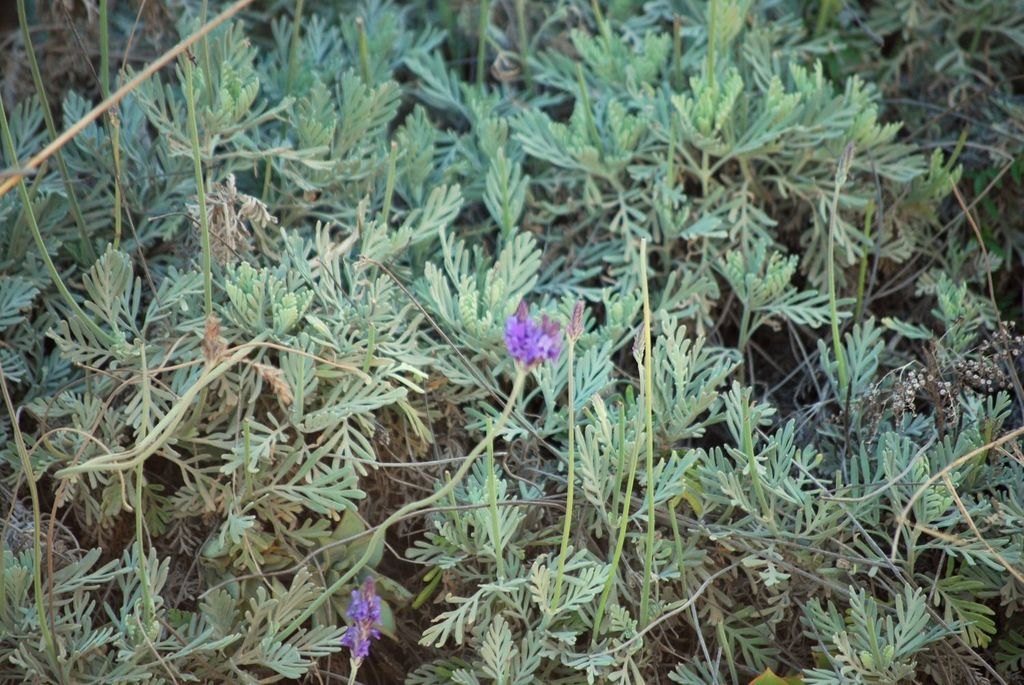
LATIN NAME: Lavandula pinnata
COMMON NAME: Fernleaf Lavender
Plant Profile
Fernleaf lavender is the odd one out among the cultivated lavenders, and it looks it. The leaves are pinnately dissected into narrow segments and covered in fine white hairs, so the plant reads as grey-green lace rather than the narrow grey strap of a lavender from Provence.
It makes a subshrub of forty-five to sixty centimetres, with square stems, opposite leaves, and deep violet flowers carried in single or triple spikes from late spring into summer. The habit is looser and more open than the Mediterranean species, and it never forms the tight cushion of a lavender hedge.
The native range is tiny: southern Madeira and the eastern Canary Islands, including Lanzarote. That is Macaronesia, the Atlantic archipelago group, and it places the plant in a climate with mild winters, constant humidity and no frost at all. The eastern islands are the driest of the group, which may explain why this species takes more sun than its laurel-forest relatives.
Authorship of the name has been argued over for two centuries. The World Checklist attributes it to Lundmark in 1780; GRIN and the African Plant Database give the younger Linnaeus; the International Plant Names Index records both, plus a later use by Moench in 1802. It sits among Mentha piperita, Salvia farinacea and Physostegia virginiana, all Lamiaceae.
Science & Biotechnology
The Macaronesian lavenders form a distinct group within the genus, separated on leaf anatomy and chromosome number from the woolly-leaved Mediterranean species. Their leaves are broader, thinner and less protected against desiccation, because they evolved where drought is mild and humidity is high.
The consequence matters in cultivation. A fernleaf lavender given the full sun and gravel regime of a Provencal lavender will fail, because it is not built for that. It wants light, air, and regular water, and it resents both baking and waterlogging in equal measure.
The essential oil differs too. Oils from this group are dominated by camphor and borneol rather than by the linalool and linalyl acetate that give true lavender its perfume, so the plant is a garden ornamental and not a raw material for fragrance, whatever the label on a bottle of island lavender oil may imply.
Uses & Benefits
Its niche is the coastal garden and the container. The fern-cut foliage is worth growing on its own, and the violet spikes give a colour that the grey-leaved lavenders cannot reach. In a pot on a sunny terrace it will flower for months and scent the air when brushed.
Records from the islands peak in February and March, the Canary Island winter, and reflect a plant that flowers when the days are short and mild rather than in high summer. In northern cultivation that translates into a long early-summer flush and a scattering afterwards.
It also makes a decent cut flower, though the stems are short and the spikes loose. The foliage dries well and holds its colour for a season, and a handful of stems in a small vase will perfume a room for a week before the leaves begin to drop. Strip the lower leaves before conditioning, since they blacken in water.
Growing from Seed
Sow in late winter on the surface of a gritty, free-draining compost, because lavender seed needs light and, in most strains, a short cold spell. Two to three weeks in a refrigerator, then warmth at eighteen to twenty degrees, gives the most even germination, usually within a month.
The seed is slow and the seedlings are initially tiny. Prick them out into individual pots as soon as they can be handled, keep them cool and bright, and water sparingly. Damping off is the main risk, and it is caused by still, humid air rather than by water alone.
Plant out after the last frost in a warm, sheltered, sunny position. In cold gardens, treat it as an annual or bring the pot under glass for winter. Take cuttings in late summer from non-flowering shoots, because the plants are short-lived and a stock plant is worth insuring.
Our Take
Fernleaf lavender is not a lavender to plant in rows. It is a lavender to plant once, in a pot by a warm wall, and to replace every three or four years without complaint. Judged as a shrub it is a disappointment; judged as a long-flowering, silver-leaved, violet-scented annual, it is excellent.
The mistake people make is treating it like the Provencal sorts and giving it drought. Water it, feed it lightly, cut it back after the first flush, and it will reward you with a second. Let it dry out in July and it will sulk for the rest of the year.
Related Reading
Gardeners who grow Fernleaf Lavender often pair it with these related subjects: