


Physostegia virginiana Seeds | Obedient Plant
LATIN NAME: Physostegia virginiana
COMMON NAME: Obedient Plant
Plant Profile
The common name is a parlour trick. Push a single open flower sideways and it stays where it is put, at least for an hour or two, instead of springing back like a snapdragon. Children discover this before adults do, and it is the reason the plant is grown in more gardens than its flowers alone would justify. False dragonhead is the older name and refers to Dracocephalum, the genus it once sat in.
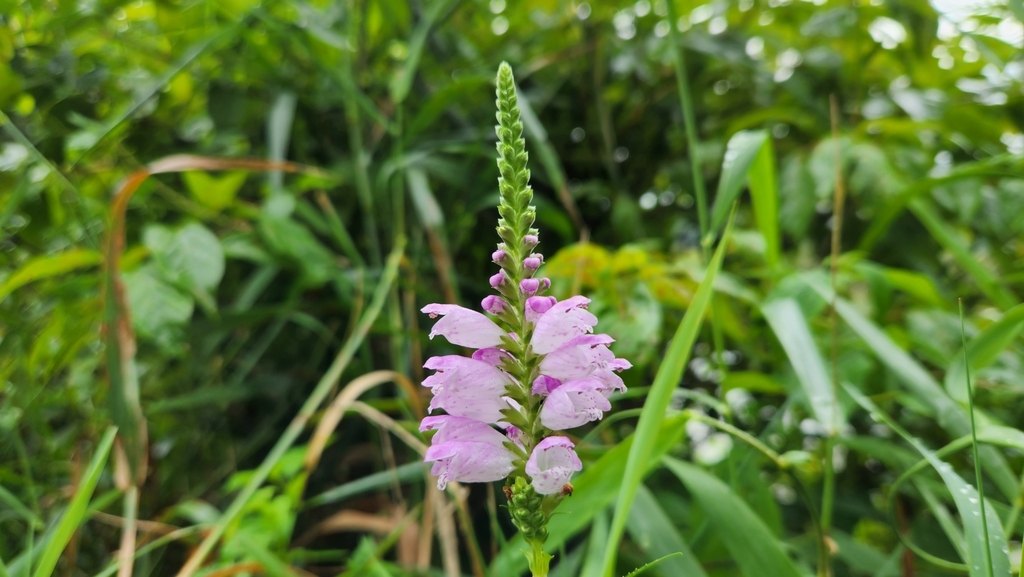
It is a rhizomatous herbaceous perennial in Lamiaceae, with stiff square stems 60 to 120 cm tall and lance-shaped, toothed leaves set opposite each other. The inflorescence is a long dense raceme of tubular flowers in pink or white, each one shaped like a snapdragon but built on a different plan. Antirrhinum is in Plantaginaceae; the resemblance is convergence, not kinship.
The fruit is worth looking at, because it is not the usual papery capsule. It opens into a shape like a small vase, and inside sit four triangular black seeds. The whole structure dries in place and stands through the winter, which is one reason the plant photographs well in November when everything else has collapsed.
Science & Biotechnology
The obedience is a matter of tissue, not muscle. The pedicel is flexible enough to bend without kinking and stiff enough to hold the new angle, and the cells on the compressed side do not immediately push back. The response is temporary: the raceme gradually returns to vertical over a day, and repeated bending eventually kinks the stalk permanently.
Two subspecies are recognised and they behave like different plants. Praemorsa grows further south, into Texas and New Mexico, on dry upland prairie and glade. It has larger flowers, sterile bracts below the inflorescence and no rhizomes. Virginiana grows further north and west, in wet streambanks and bottomland, with smaller flowers, no sterile bracts and a spreading rhizome.
Garden cultivars fit neither. They are intermediate in every character, and the usual explanation is that they arose from hybridisation between the two subspecies where their ranges met in cultivation. That is why named forms vary so much in vigour: the ones closer to virginiana spread hard, and the ones closer to praemorsa stay in a clump. Other Lamiaceae on the list: Mentha × piperita, Lavandula pinnata and Prunella grandiflora.
Uses & Benefits
Its season is September and October, when the asters are the only real competition. A raceme of clean pink at 90 cm, above a border that has gone to seed, is worth having, and the white forms light up a corner that would otherwise be a brown mass. It is also one of the few late flowers that holds up in a vase for a week.
The spreading is the price. On fertile soil the rhizomes run and the clump doubles in two seasons, and the plant will walk through a herbaceous border in five years if nothing stops it. Sinking a bottomless bucket, or planting it against a path with a solid edge, is not fussiness but the only way to keep it. In rough grass it can be allowed to fight.
The cultivars are mostly colour selections. Vivid is bright pink and holds an Award of Garden Merit, Summer Snow is pure white and also holds one, and Variegata carries green and white leaves with pink flowers and is weaker than either. Crown of Snow and Alba are older whites, and Rosy Spire is a lavender-pink that reads as grey in flat light.
Growing from Seed
The seed needs cold. Sow in autumn and leave the tray outside, or mix the seed with damp grit and hold it in the refrigerator for four weeks before sowing. Surface sow, because light helps, and expect germination at 15 to 20 °C over three to four weeks. Fresh seed germinates better than seed kept dry for a year.
What comes up will not be the cultivar you hoped for. Physostegia seed from a garden carries the mixed genetics of whatever the bees visited, so a packet saved from Vivid gives a range of pinks and whites and a range of spreading habits. If a particular colour matters, buy plants or divide, and accept that seed is for the fun of the variation.
Plant out at 45 cm and expect the first year to go into roots. The second year flowers properly. Cut half the stems back in early June and the plant will flower three weeks later at half the height, which is useful at the front of a border and removes most of the staking problem in one operation.
Our Take
Grow it where it can spread and it is a good plant. Grow it in a mixed border without a barrier and you will be digging it out for a decade, cursing a flower you once found charming. The plant has no malice; it simply has a rhizome and good soil, and those two things together always end the same way.
The obedience trick is worth showing a child once. After that, the reason to keep the plant is October, when the raceme is still standing and the garden is not. A row of it against a dark hedge, with the seed heads left for the frost, is as good as anything else in that week of the year.
Related Reading
Gardeners who grow Obedient Plant often pair it with these related subjects: