


Prunella grandiflora Seeds | Large Self-heal
LATIN NAME: Prunella grandiflora
COMMON NAME: Large Self-heal
Plant Profile
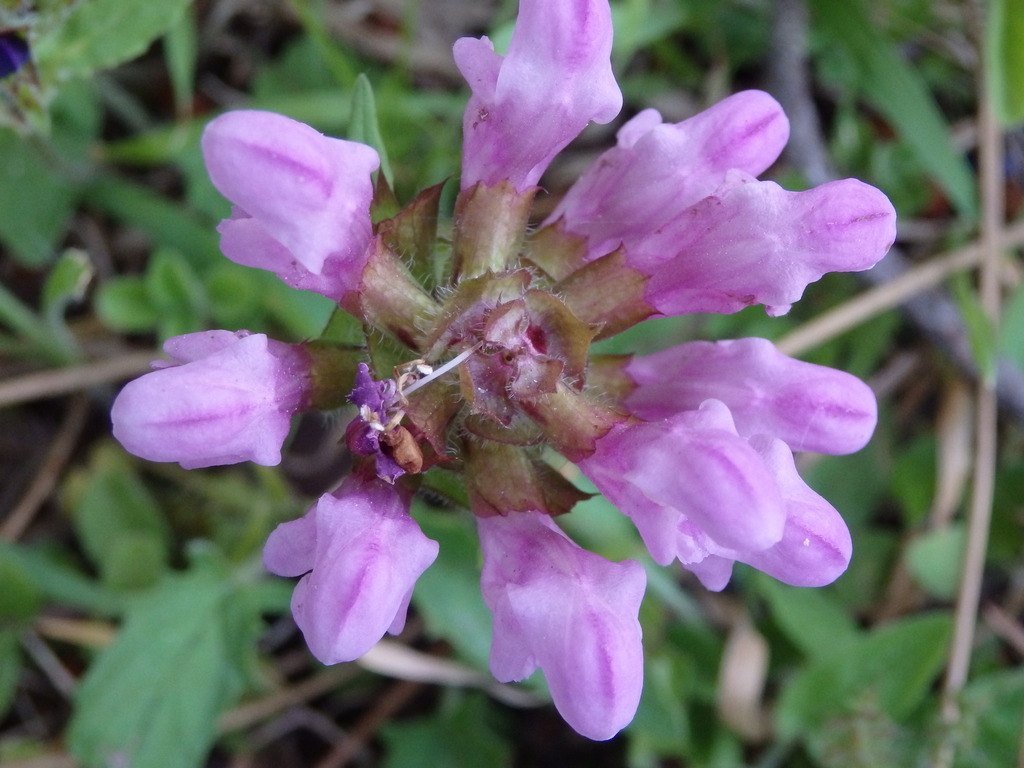
Large self-heal is the robust sibling of the common lawn weed, promoted to a flower worth a border. Prunella grandiflora, a low perennial of fifteen to thirty centimetres, carries dense violet spikes four to five centimetres tall above paired, toothed leaves, blooming through June and July. In the wild it often holds company with orchids on the same chalk banks.
It is a mint by every sign: square stems, opposite leaves, a two-lipped hooded flower and a creeping rootstock. The spikes are packed with whorls of blooms whose lower lip drops as a landing platform for a bee’s weight, and the whole plant smells faintly of the family when clipped.
The name goes back to the German die Braeune, the throat inflammation that its common cousin was brewed against, latinised to Brunella and later softened to Prunella. The species was Linnaeus’s Brunella grandiflora in 1753; the Italian botanist Turra transferred it into Prunella and his combination stands.
It grows across Europe from France to the Baltics and east into Russia, favouring calcareous grassland, mountain meadows and light woodland, rising to the subalpine zone. Farming with fertiliser has thinned its grassland strongholds, which is one reason garden strains now carry more of the species than some valleys do.
Science & Biotechnology
The flower is engineered for long-tongued bees. The corolla tube runs deep, so bumblebees and wool-carder bees reach the nectar while honeybees, their tongues too short, resort to robbing holes bitten by earlier visitors. Carder bees work the spikes with slow, methodical circles that shingle one floret against the next. Spikes open gradually from the bottom, so one plant feeds a foraging circuit for weeks.
The genus is chemically active. Self-heals are rich in rosmarinic acid and related phenolics with documented antimicrobial action, the same chemistry that justified the old throat gargles, and modern work on the common cousin has screened extracts against herpes viruses. The large-flowered species shares the profile in a prettier package.
Like its cousin it keeps a fallback: hidden, self-pollinating flowers that never open, produced low on the plant late in the season. They guarantee seed even in a cold, bee-less summer, an insurance strategy shared across the genus and one reason seed-raised strains stay so uniform. Three other Lamiaceae are catalogued alongside it: Salvia pratensis, Coleus scutellarioides and Mentha canadensis.
Uses & Benefits
In the garden it serves three posts at once: edging perennial, pollinator plant and low ground cover. The dense mats suppress weeds between stones and along path edges, and selected strains such as Loveliness in pink and deep Bella Blue extend the colour range beyond the species violet. Newer compact strains top out at twenty centimetres and suit front-of-edge duty.
It has become a quiet favourite in the movement toward mixed lawns and no-mow borders. Tolerant of a mower’s wheel, evergreen in mild winters, and flowering after the first cut, it fills the role in a herbal lawn that clover fills in the sward itself.
Young leaves are edible in the family manner, usable sparingly in salads or brewed as a mild tea, though no tradition attaches to this species specifically; the medicinal reputation belongs to the common self-heal. Gardeners should treat it as an ornament with harmless foliage rather than a herb.
Growing from Seed
Sow on the surface of moist seed compost, light being a germination cue, at eighteen degrees; expect sprouts in two to three weeks, faster after four weeks of cold stratification. Autumn sowing outdoors in trays takes advantage of winter to do that chilling for free. Seedlings pricked out small move without complaint, provided the taproot is barely touched.
Transplant to full sun and lean soil; richness makes it floppy and short-lived. Space twenty-five centimetres, shear hard after the first flowering to trigger rebloom, and divide every three years in spring. Pests ignore it, and drought is handled once the rootstock takes hold.
Seed ripens in the browned calyces of late summer and shakes out when the spikes are dry; cut whole spikes into a paper bag and thresh. It comes reasonably true from home-saved seed, though bee crosses introduce variation, and the best plants can be held as divisions instead.
Our Take
Our take: this is the plant to reach for when a border edge must do three jobs and look like none of them are work. It flowers in the gap after spring and before the main summer, at a height nothing else occupies.
The honest limitation is a taste issue rather than a flaw: to eyes trained on bedding plants, its violet spikes read restrained, even plain. In a wildlife border or a herbal lawn that restraint is the point, and the bumblebees’ preference for it is written across every July record.
Related Reading
More species in the same orbit as Large Self-heal: