


Glandularia canadensis Seeds | Rose Vervain
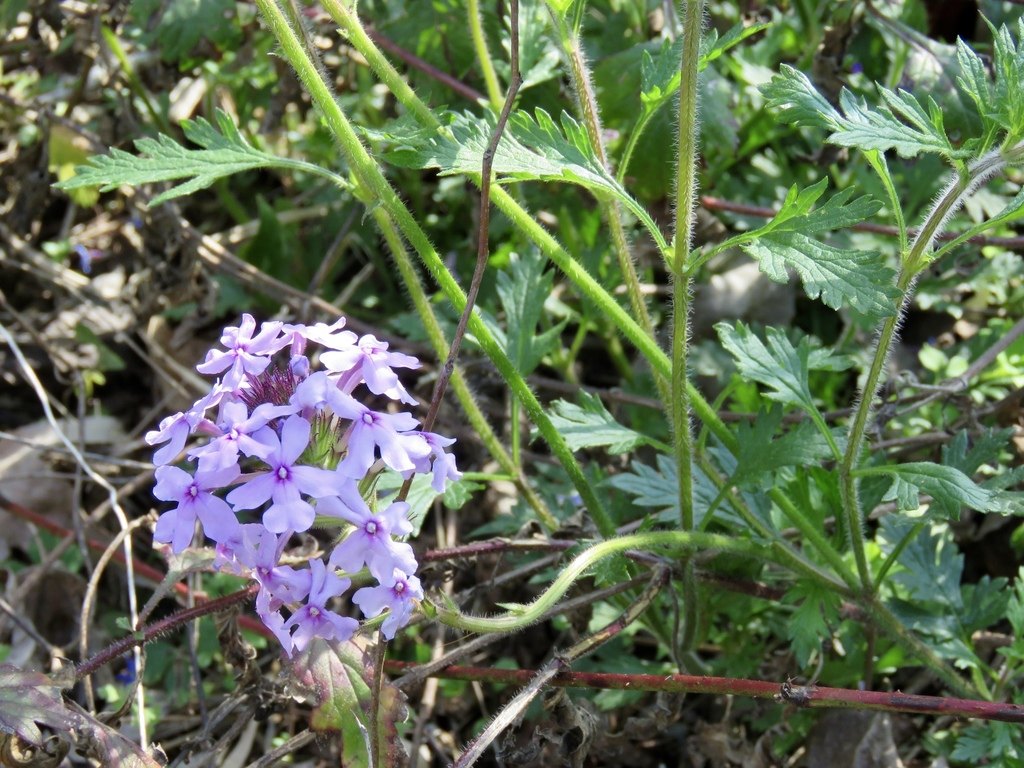
LATIN NAME: Glandularia canadensis
COMMON NAME: Rose Vervain
Plant Profile
Rose vervain, also called rose mock vervain, clump verbena or rose verbena, is a perennial herb of the verbena family that stays low, typically about 30 cm. It grows by walking: roots form where the stems touch the ground, and over time the plant spreads into a low mound that behaves like groundcover without being invasive about it.
The leaves reach 8 cm, dark green above and lighter below, opposite and pinnately lobed, semi-evergreen in mild winters. The flowers are pink to purple, a tubular corolla opening into four or five spreading lobes, carried from spring and persisting until fall, which in a good year makes six months of colour on a plant 30 cm tall.
It is native to the eastern and south-central United States, with naturalised populations established outside that range in the Northeast. Its natural habitat is sunny: glades, forest openings and bluffs, and it is tolerant of dry conditions. In some areas its presence is taken as an indicator of high-quality natural communities.
The habitat list runs longer and stranger than the summary: mesic to dry black-soil prairies, sand prairies, hill prairies, pioneer cemeteries, thinly wooded slopes, rocky upland woodland openings, thinly wooded bluffs, limestone and sandstone glades, pastures, abandoned fields and roadside embankments. Hardiness sits around USDA zone 5 to 9.
Science & Biotechnology
The rooting-at-the-nodes habit is the botanical mechanism behind the mound. Each stem that touches bare soil can anchor and feed a new crown, so an established plant is really a federation of them, which also explains why pieces moved with a little stem attached take so readily in new ground.
Nomenclature is a two-name affair. The species was long published as Verbena canadensis and is treated as Glandularia canadensis in current work, the split resting on glandular hairs and other characters that separate the American species from the true Verbenas of the Old World. Seed racks use both names, and both plants in the packet are the same.
Its wildlife value is specific rather than decorative: the flowers attract butterflies through their long season, and the foliage is eaten by rabbits and deer, so it is a nectar plant that does not pretend to be browse-proof. In a restored prairie or glade planting that palatability is a feature, not a flaw. The list carries allies in Glandularia tenera, Glandularia hybrida and Tecoma stans.
Uses & Benefits
In the garden it works the front edge: spilling over walls, threading between stones, softening the skirt of taller perennials. The mound habit and the long bloom mean one plant covers ground and colours it at the same time, and the semi-evergreen foliage holds the line through winter in mild districts.
Selected varieties and hybrids built on this species include Homestead Purple with deep purple flowers, Snow Flurry in white, and Carlos, a bicolor of white and lilac. Some of the cold-hardy garden verbenas also carry blood from the related Peruvian verbena, V. peruviana, so the family tree of the rack plants is mixed even when the label is short.
Its ecological credentials are the quiet argument for it: a native of prairies and glades that marks high-quality remnant communities, dry-tolerant, long-flowering, and useful in native plant and pollinator schemes where a low perennial that blooms from spring is exactly the gap in the plan.
Growing from Seed
Sow the seed on the surface of moist compost in spring, pressing it in rather than burying it, and keep it evenly moist until germination. The seedlings are small at first; grow them on cool and bright, and pinch once to start the branching that will later become the mound.
Set plants out into full sun and sharply drained soil, 30 to 45 cm apart to let the mounds meet. It takes drought once established, and lean ground suits it better than rich; the prairie and glade heritage shows in both. Water the first summer and then largely leave it alone.
Through the season, trim lightly after the first heavy flush to keep the mound tight and trigger fresh growth, and any stem that roots where you want it can simply be left, or lifted with its new roots and moved. It ranks among the few perennials that propagates itself politely while you watch.
Our Take
Rose vervain solves the hardest spot in the border, the dry front edge where everything either bakes or rots, with a plant that flowers from spring until autumn and fixes itself in place as it spreads. Few perennials offer that combination at any price, let alone from seed.
Sow more than you think you need and space them to touch; the look that works is a drift, and the plant will finish the joining-up for you. Give it sun, drainage and one light trim after the first heavy flush, and it will ask for nothing further.
Related Reading
Continue exploring with these related plants: