


Tecoma stans Seeds | Yellow Trumpet Bush
LATIN NAME: Tecoma stans
COMMON NAME: Yellow Trumpet Bush
Plant Profile
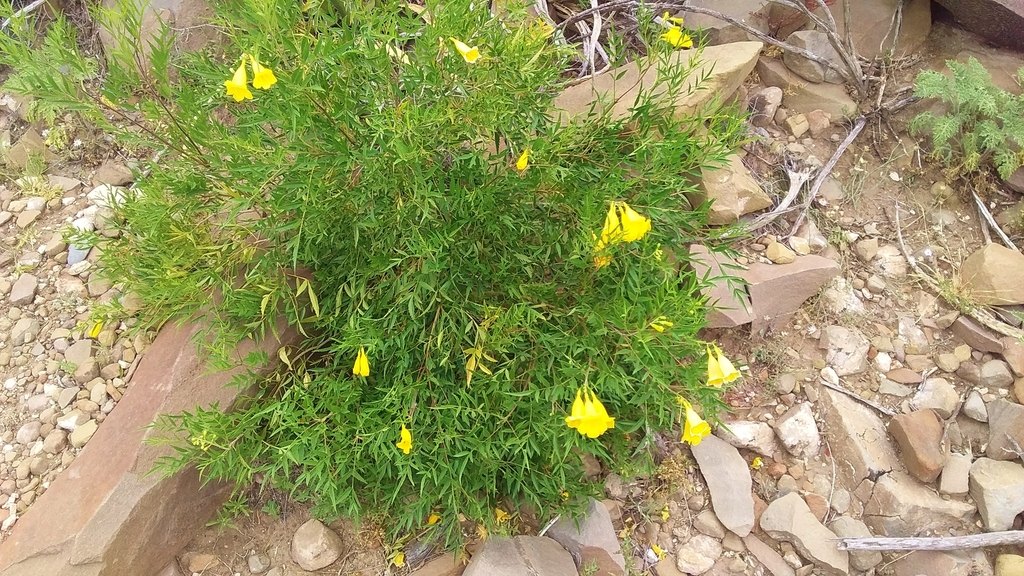
Yellow trumpet bush is a bignonia, and most bignonias are vines. Jacaranda, catalpa and the trumpet creeper are the family’s better-known faces, and all of them either climb or are trees of the tropics; Tecoma stans sits between the two, a shrub that will make a small tree of ten metres where winters are warm and stay at two or three in a pot. The stems are pale grey and shallowly fissured, the leaves opposite and odd-pinnate, with three to thirteen lance-shaped leaflets whose serrated edges catch the light. Crushed, the foliage smells green and slightly rank, a family trait.
Flowering is the reason it is grown. The corolla is a bell widening into five shallow lobes, three and a half to eight and a half centimetres long, golden yellow with a few faint red lines running into the throat. Flowers are carried in clusters at the ends of the current season’s shoots, and the plant produces them for months rather than weeks, heaviest in the dry season before the rains and again in autumn.
Long, narrow pods follow, up to twenty-five centimetres, packed with papery winged seeds that twist out as they dry and travel on the wind. In the tropics the plant is evergreen; where there is a real dry season it drops its leaves and comes back from the wood.
Science & Biotechnology
The genus is named for the Nahuatl tecomaxochitl, and the species has been investigated more for its chemistry than its horticulture. The leaves and bark contain monoterpene alkaloids, among them tecomine and tecostanine, which have shown hypoglycaemic activity in animal studies and are the basis of its reputation in Mexican folk medicine for diabetes.
The same alkaloids make the plant unpalatable to most livestock, though goats will browse it. Curiously, the nectar is another matter: honey produced from Tecoma stans in parts of Mexico has been recorded as toxic to people, a rare split between a harmless plant and a harmful product made from its flowers.
The reproductive biology is a textbook case of a generalist that still excludes most of the market. The flower opens with the stigma already receptive, but the anthers shed pollen a day later, so a first visit deposits foreign pollen and a second collects fresh; large Xylocopa bees and hummingbirds are strong enough to work the tube, while smaller insects are left with nothing. Seed set is heavy, germination is fast and the seedling puts down a deep taproot within weeks, which is exactly the combination that makes the plant a weed wherever it escapes.
Uses & Benefits
In warm countries it is a street tree, a hedge and a car-park plant, because it takes hard pruning, poor soil and reflected heat without complaint. In colder gardens it is a large-pot subject that spends winter under glass and flowers through the summer on the terrace.
The wood is light and durable enough to be used in rural building and for tool handles in parts of Mexico, and the plant has a long record in local medicine, mostly as a bitter tonic for digestive complaints and, more recently, as a candidate against diabetes.
For a garden in the right climate, the draw is the visitors. The tube is too long and too narrow for short-tongued flies, so the work is done by large bees and, through most of the American range, by hummingbirds, which hover at the mouth of the flower rather than landing.
It is the floral emblem of the United States Virgin Islands and of the Bahamas, and in South Africa, Australia and parts of the Pacific it is a declared problem: a ruderal species that colonises disturbed ground, forms nearly pure thickets, and re-sprouts from any root left in the soil after cutting. Gardeners in those countries are asked not to plant it at all. Nearby in the classification: Radermachera sinica, Campsis radicans and Glandularia canadensis.
Growing from Seed
Sow in late winter or early spring at 22 to 25 degrees C, just covering the seed, which needs darkness as much as warmth. Germination takes two to four weeks and is usually high; the seedlings grow fast enough to be pinched at the fourth pair of leaves to make a bushy plant rather than a single stem. Named forms, and the paler Tecoma hybrids, are raised from summer cuttings, since seed does not come true.
Grow in full sun and a free-draining compost, in the largest pot you can move, and water generously while the plant is in growth, sparingly once it is dormant. Prune in early spring, hard if the plant has outgrown its space, because the flowers come on new wood and a light trim costs you the season’s display. Keep it above 5 degrees C in winter, watch for spider mite indoors, and expect the first flowers in the plant’s second summer, not its first.
Our Take
A generous plant with a bad reputation abroad. In a cold garden it is worth the pot space for eight months of yellow; in a warm one, plant it only if you are prepared to dig out every root the day you tire of it.
Related Reading
More species in the same orbit as Yellow Trumpet Bush: