


Aster alpinus Seeds | Alpine Aster
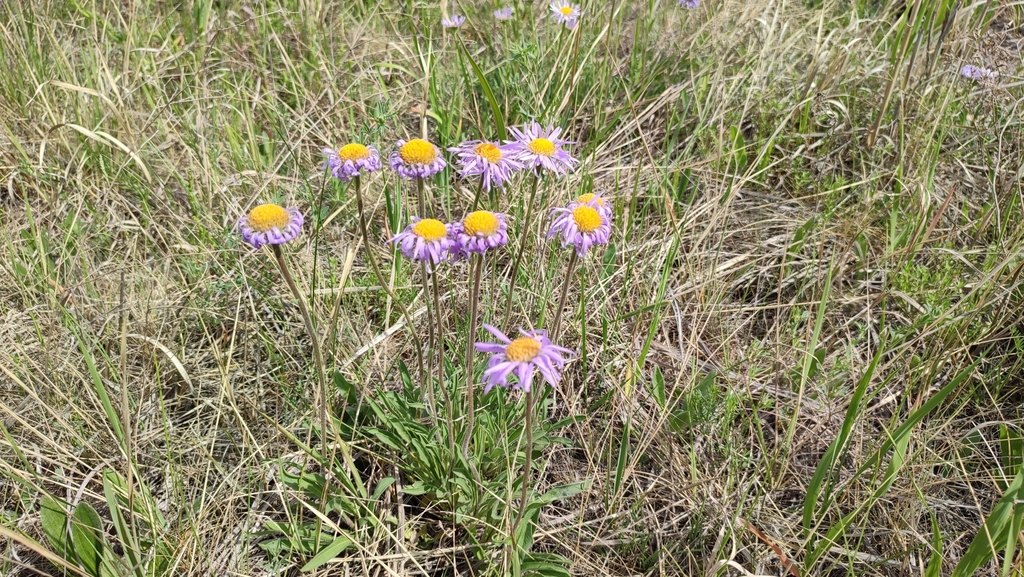
LATIN NAME: Aster alpinus
COMMON NAME: Alpine Aster
Plant Profile
The alpine aster is a cushion with a single ambition: one large, erect daisy on every short stem, in blue, violet, pink or white, opening just as the snows leave the high ground. Plants stand ten to thirty-five centimetres and form tight caespitose clumps that look older than they are.
The foliage stays near the ground. Leaves are untoothed, lanceolate to spatulate, and mostly basal, forming the dense green shoulder from which each flower stem rises. The achenes that follow are topped with a brush of white bristles, a departure mechanism the lowland asters share and the wind exploits.
Its name is its address: the epithet alpinus points to life above the timber line, and the species runs along the high mountains of Europe, the Alps and Pyrenees foremost, with a North American presence through the variety vierhapperi in Canada and the western United States. After the great aster break-up, it is among the few true Aster species left standing.
The North American populations carry their own conservation file. NatureServe lists var. vierhapperi as secure in Canada overall, yet critically imperilled in Ontario, vulnerable in Alberta, and critically imperilled in both Colorado and Wyoming: a reminder that a widespread mountain plant can be vanishingly rare at the edges of its map.
Science & Biotechnology
Chemistry and classification have both moved on this genus. Once the alpine aster belonged to a vast Aster with hundreds of members; molecular work has since dismantled that empire and moved most species into other genera, leaving Aster alpinus in the reduced true-Aster group. The plant itself, indifferent to taxonomy, stayed exactly where it was.
Its ecological tolerances are narrow and measurable. The species prefers rocky mineral soils, takes a soil reaction between pH 6 and 7.5, and performs best in cool climates, so it thrives in hardiness zones 5 to 7 and sulks in humid heat. Altitude substitutes for latitude: a garden in a warm valley can still grow it in a scree bed.
Pollination biology is straightforward but efficient. The solitary heads present a broad, flat landing platform to early butterflies and hoverflies, and the colour range within the species, from indigo through pink to white, appears to reflect local population genetics rather than any single adaptive story. Seed set is generally reliable where two clones flower together. For more of the Asteraceae, the list offers Aster tataricus, Centaurea macrocephala and Dimorphotheca sinuata.
Uses & Benefits
The Royal Horticultural Society’s Award of Garden Merit records what gardeners learned long ago: this is the most dependable of the true alpine daisies, tough once established, indifferent to frost, and content in the rock garden’s leanest pockets. It suits troughs, crevices, moraine beds and the top of a dry wall.
In the border it plays a small part precisely because it is small. Plant it at the front of a well-drained bed with other cushion plants, where its May and June flowers bridge the gap between the spring bulbs and the early summer perennials. In hot-summer gardens, afternoon shade and gritty soil keep the clump composed.
Wildlife value runs to the early pollinators: bumblebee queens patrolling a cold May garden find the flat heads as useful as any bulb, and butterflies work them through the bloom. In North American gardens, the native variety offers local insects a familiar flower at a season when few natives are open.
Growing from Seed
Seed germinates best after a cold stratification of four to six weeks. Sow on the surface of a gritty mix in late winter, press the seed in without covering, and keep it cool and just moist; warmth during germination is the commonest cause of failure. Seedlings appear in two to four weeks.
Grow seedlings hard: full light, cool air, sharp drainage, and no coddling. Pot them singly once the rosette fills, and plant out in early autumn so the roots run before winter. Flowering usually arrives in the second year, and the clump improves annually as the cushion tightens.
Established plants ask for one thing above all: drainage. Winter wet around the crown kills more alpine asters than any frost, so slope the ground, add grit generously, and never mulch with rich compost. A top-dressing of grit after division keeps the collar dry and the cushion tidy.
Our Take
The alpine aster rewards precision rather than effort. It is not a plant for rich borders or humid summers, but in a scree, a trough or a mountain-garden crevice it is as reliable as stone, flowering every spring with almost no maintenance.
Grow it from seed for the pleasure of the colour range, then keep the best forms by division. The species’ only unforgivable conditions are winter sogginess and summer humidity, and both are easier to design around than to fight, and easier still to avoid at planting time.
Related Reading
More species in the same orbit as Alpine Aster: