


Gazania rigens Seeds | Treasure Flower
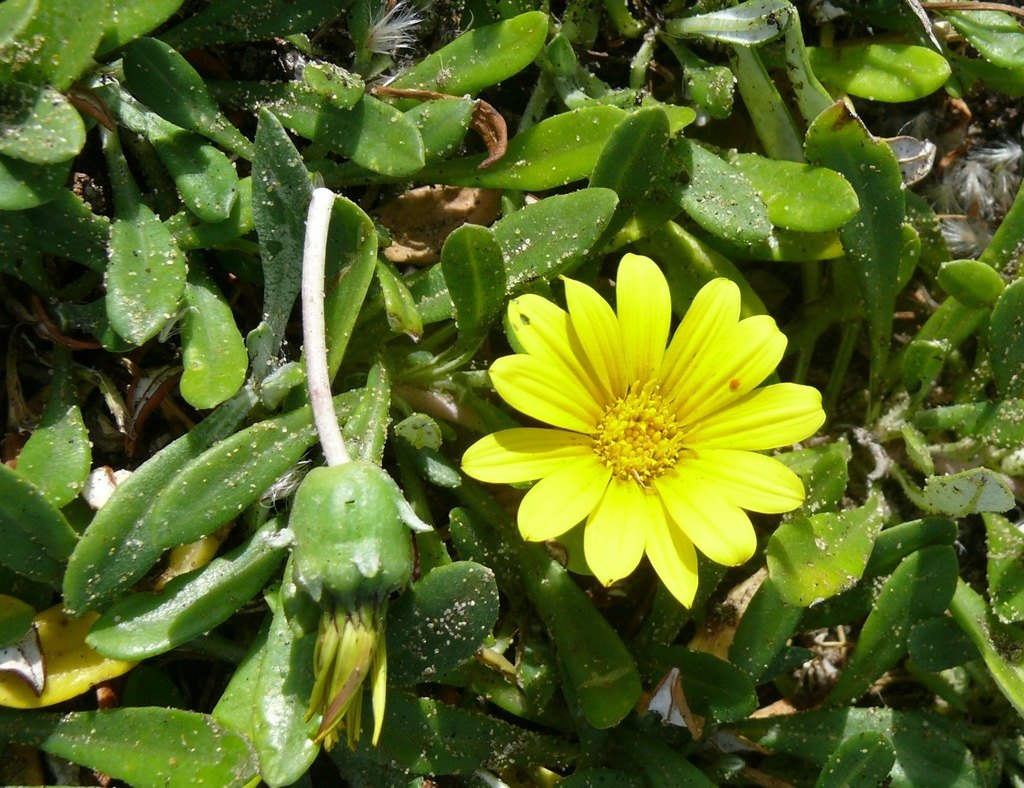
LATIN NAME: Gazania rigens
COMMON NAME: Treasure Flower
Plant Profile
Treasure flower is a low, spreading perennial from the coastal belt of southern Africa, grown for daisy heads that open flat and close like a book. It rarely tops 30 cm and spreads to 50, forming a dense tuft of blue-grey foliage that roots wherever the stems touch bare ground. In cold gardens it is grown as a half-hardy annual and treated as expendable.
The leaves are all basal, narrow and lance-shaped, usually entire and sometimes lobed, glossy green on top and grey-white underneath. Both surfaces carry a felt of hairs, which is what gives the plant its colour and its tolerance of salt, wind and reflected heat from a wall.
Heads are solitary on stalks that stand just above the leaves, 4 to 8 cm across, with a disc of tubular florets ringed by strap-shaped ray florets. Orange and yellow are the commonest colours, and the base of each ray usually carries a black spot. The fruit is an achene, and the seed is easy to collect.
Science & Biotechnology
The closing is hydraulic. The bracts at the base of the head swell and shrink with water pressure, and the whole head shuts in shade, at night and under heavy cloud. That is why a plant in a pot turns its back on a room while a plant in the ground faces the sun all day and follows it across the sky.
Three varieties are recognised, and the commonest garden plant is the odd one out. Var. rigens, with large heads and a black eye-spot, is known only from cultivation and has never been found wild. Var. leucolaena has grey-white leaves and plain yellow heads; var. uniflora has smooth green leaves and a single head per stem.
Its weed record is serious. It is a declared weed in Madeira, Sicily and Sardinia, has naturalised on dunes in New South Wales and Queensland, and South Australia has banned its sale outright. Victoria lists every subspecies as an environmental weed, and the genus keeps escaping gardens into coastal scrub. Asteraceae is well covered here, with Arnica americana, Tithonia and Pycnosorus globosus alongside.
Uses & Benefits
For a hot, dry, sunbaked bank it is close to ideal. It takes salt, wind, drought and poor soil, and it flowers through the worst of the summer when most bedding is finished. It is also one of the few plants that will grow in the strip between a wall and a pavement, where the soil is rubble.
The name honours Theodore of Gaza, a fifteenth-century Greek scholar who translated Theophrastus into Latin. That is a thin claim to fame for a plant from the Cape, and it is typical of how botanical names attach themselves to whoever did the paperwork rather than to the plant or the place.
The weakness is the gap between flushes. After the spring peak the plant looks flat and the flowers are small, and in a wet autumn the centres rot. Shearing after flowering and a sharp hand with the watering can keep it presentable; neglect makes it look like a worn carpet by August, which is what most of them do.
Growing from Seed
Sow in late winter at 18 to 21 °C, barely covering the seed, and allow ten to twenty days. Fresh seed germinates well and old seed hardly at all, so buy in the season you mean to sow. Prick out early, because the seedlings are sturdy but resent crowding and damp at the collar.
Cuttings are the reliable route to a named colour. Take 5 cm tips in late summer, root them in gritty compost, and keep the plants just frost-free through winter. A light frost will cut the foliage back but the crown usually survives, and regrowth starts in April from the base.
Plant in full sun, 25 to 30 cm apart, in poor to moderate soil. Fertile ground and irrigation produce soft leaves and few flowers, and the plant is more likely to rot at the crown in winter. A gravel mulch suits it, keeps the leaves dry and stops the stems from rooting where you do not want them.
Our Take
It is a plant for the places where nothing else will grow, and it should be sold that way rather than as a bedding annual. Give it a bank, a wall or a pot in full sun and it will look after itself; give it rich soil and a shaded border and it will sulk, rot and flower once.
Gardeners in Australia, Portugal and the Mediterranean islands should check before buying. A plant that is banned in one state and still on the bench in the next is a plant to keep in a container, and the flowers will not be any less bright for the restriction. Deadhead it either way.
Related Reading
Continue exploring with these related plants: