


Craspedia globosa Seeds | Billy Buttons
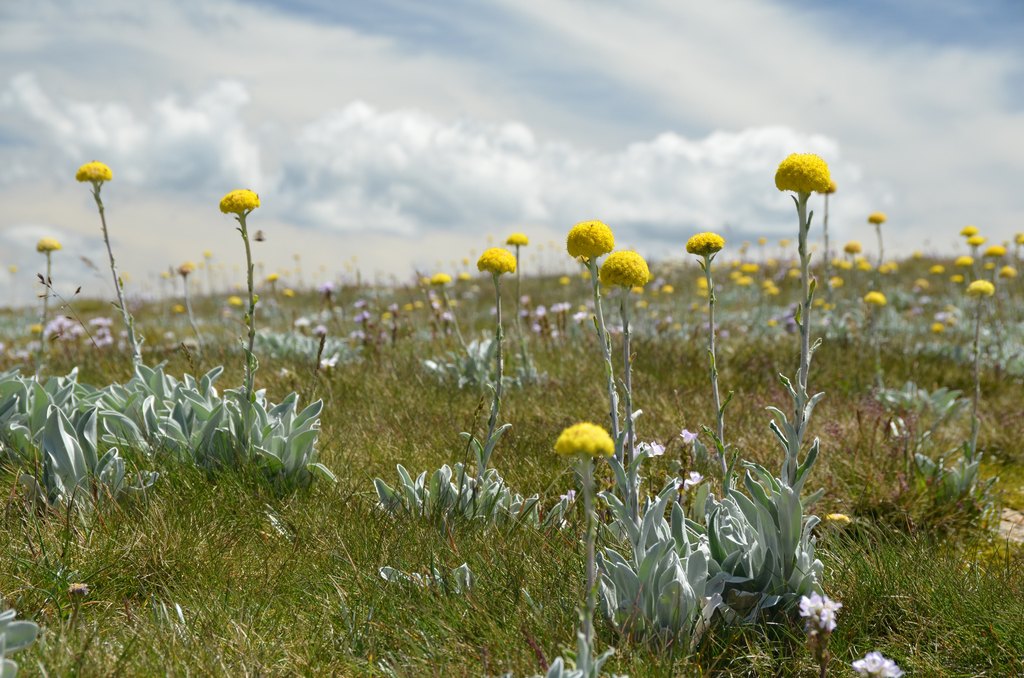
LATIN NAME: Craspedia globosa
COMMON NAME: Billy Buttons
Plant Profile
Billy buttons look drawn rather than grown. Craspedia globosa, an Australian perennial of grasslands and open forest, sends up leafless stalks of thirty to sixty centimetres each topped with a dense golden sphere, two to three centimetres across, above a rosette of silver-woolly leaves at the base. Each stalk carries a single sphere, and a strong rosette may produce dozens in one season.
The drumstick is not one flower but a head packed with hundreds of tiny florets, each opening and setting seed without ever changing the silhouette. Once flowering finishes the sphere dries on the stalk, holding shape and colour into the next season, which is the whole of its commercial value.
George Bentham described it in the 1830s and later folded his own genus Pycnosorus into Craspedia; Australian checklists have since restored Pycnosorus, and official plant lists keep this species there. The two genera also part ways in the seed, the drumstick achenes carrying a distinct pappus crown. Seed packets worldwide still say Craspedia globosa, and the name is so fixed in trade that few sellers know another.
It records across Queensland, New South Wales, Victoria and South Australia, in tussock grassland, open woodland and along moist flats where summer storms collect. The southern-hemisphere season shows plainly in observation records, which peak through the Australian spring and early summer from September to November.
Science & Biotechnology
The silver wool on its leaves and the bare stalks are water economy. Hair slows transpiration in the grassland sun, and leafless stalks mean the plant invests nothing in cooling a blade that would shade its own rosette. Florets open in rings so pollination is spread across weeks.
The genus question is active science. Craspedia in its broad sense spans some thirty species across Australia and New Zealand, and the drumsticks differ in their dense, chaffy heads. Molecular work has so far backed the split, and the two genera now stand apart with the trade lagging behind.
In its native flood-flats the plant responds to moisture rather than a fixed calendar: good rain brings a flush of stalks, drought brings almost nothing. Cultivation flattens that rhythm, and a spring-sown crop flowers evenly from early summer, so the commercial crop replaced wild gathering decades ago. The other Asteraceae in the catalogue are Anthemis arvensis, Aster novi-belgii and Ageratum conyzoides.
Uses & Benefits
As a dried flower it is the benchmark: cut with a centimetre of stem, hang dry, and the sphere keeps its gold for years without shedding. Whole-farm crops in several countries feed the preserved-flower trade, and a single good clump in the garden yields dozens of stems. Commercial growers grade stems by sphere size, and heads over three centimetres fetch the top price.
Fresh, the stems are straight, clean and unbothered by water depth, making them a florist’s line flower that never fights the bouquet. Gardeners get a second use: the rosette itself, a neat silver clump that persists through winter and anchors the front of a dry border. In the vase the spheres never shed, even as they fade to straw.
Its limits are damp and shade. In wet winters or rich, moist ground the rosette rots, and in half-light the stalks lean and never straighten. Neither is a reason to skip it; both are reasons to place it as Australia would, in sun, in lean, fast-draining ground.
Growing from Seed
Sow in late winter into modules at eighteen to twenty-two degrees, seed on the surface and pressed in, germination in two to three weeks. Grow cool and bright, and plant out after frost at thirty centimetres; the rosette is the foundation, so do not bury the crown.
Full sun, lean soil, and water only until establishment. It stands drought, coastal wind and indifferent ground, and it asks for no staking because the stalks carry their own weight. Slugs take an occasional young rosette; beyond that the pest list is blank.
Seed ripens in the dried heads, and each floret leaves a small seed tipped with a crown of fine scales; rub dried heads over a sieve. Stored cool and dry, seed keeps several years, and successive sowings let a garden hold both cut stems and overwintering rosettes.
Our Take
Our take: billy buttons are the closest thing the flower world has to punctuation. In the border they add a colour and geometry nothing else offers; in the drying shed they pay the seed back fiftyfold. Every dry garden should have a drift.
The honest note is patience: the first year builds the rosette and the real show arrives in the second, though spring-sown annual crops flower in year one. Choose the sunniest, poorest corner you own, and the spheres will do the arguing from there.
Related Reading
More species in the same orbit as Billy Buttons: