


Oenothera longissima Seeds | Long-tubed Evening Primrose
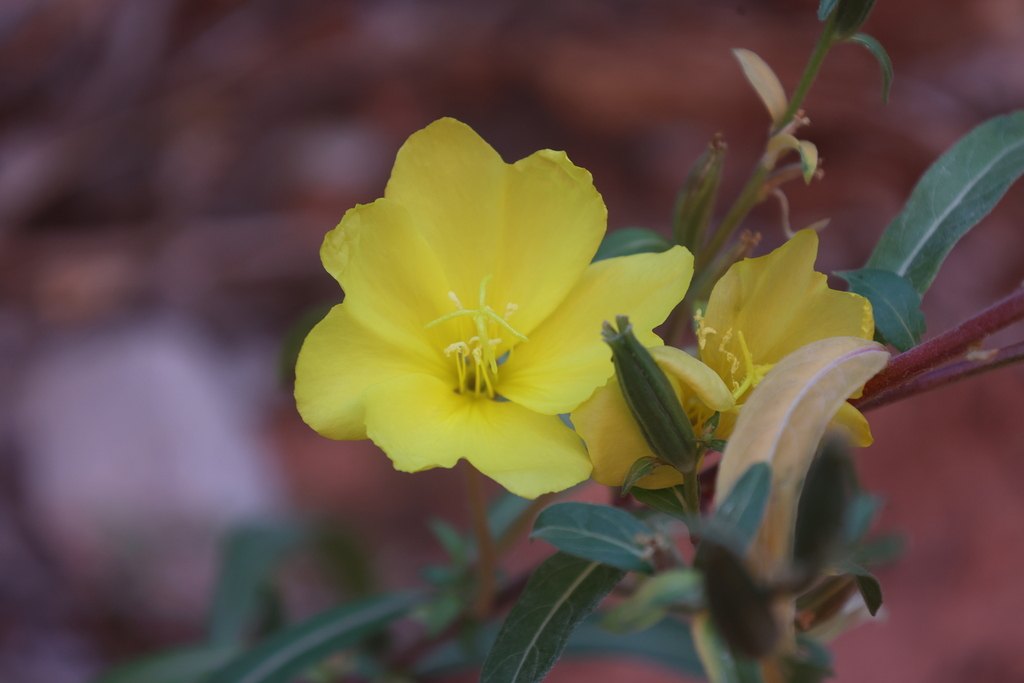
LATIN NAME: Oenothera longissima
COMMON NAME: Long-tubed Evening Primrose
Plant Profile
Per Axel Rydberg described Oenothera longissima in 1913 from material collected in the American southwest, where it grows as a biennial in scrub and woodland on ground that stays moist. Flowering stems can pass two metres and leaves reach twenty-two centimetres, which makes it the tallest of the yellow evening primroses.
The flowers are yellow, five to six centimetres across, with four petals and a floral tube that can run to twenty-five centimetres. They fade to orange and then red as they age, so a spike in July carries three colours at once. The capsule that follows reaches five and a half centimetres.
The flowers open in the evening and last until the following morning, which gave the genus its English name. Hawkmoths pollinate them, and their tongues are long enough to reach the nectar at the base of the tube; tube length and tongue length are matched.
Among the evening primroses this one ranks tallest, and among the few grown as an ornamental. It also tolerates drought better than most, since it comes from desert country, and a dry sunny border suits it. Give it gravel and sun, and it asks for nothing more. Near kin on the list are Oenothera speciosa, Clarkia elegans and Clarkia amoena, all Onagraceae.
Science & Biotechnology
Oenothera holds about 145 species and is famous in genetics for permanent translocation heterozygotes, an arrangement in which genes pass on in linked blocks. Work on it in the early twentieth century helped found cytogenetics. The rings of chromosomes at meiosis are still worth a look under a microscope.
The long floral tube is an adaptation to hawkmoth pollination, and among the most extreme cases of co-evolution in the genus. Tube length varies between populations and matches the tongue of the local moth, a classic geographic mosaic. Where the moth is absent, the tube shortens.
The genus has a base chromosome number of x = 7, and this species is diploid with 2n = 14, like most of the yellow-flowered group. The chromosomes form rings at meiosis rather than tidy pairs, which is the mechanism behind the genus’s strange genetics and its stable hybrid lineages.
A biennial, it grows a rosette in the first year, flowers in the second, then dies. The cycle suits unpredictable desert rainfall, since the rosette can wait a year for the right conditions before spending itself on flowers. The wait is the strategy.
Uses & Benefits
Use it at the back of a border, in a gravel garden or a wild garden, where height and evening flowers earn their space. A moth garden suits it too, and few plants are better for watching insects at dusk. Sit still and they arrive.
The plant is not edible, and the seed has no medicinal use, unlike the seed of O. biennis, the commercial source of gamma-linolenic acid. This one is grown for flowers and for the moths they bring. Nothing in it is worth eating.
In a border it needs a position where the height can be seen and the evening flowers not wasted, near a terrace or a seat. Formal beds do not suit it, since the habit is loose and the stems tall and branching. Give it room and it will lean.
Meadow and wild garden suit it as well, where it self-sows and returns year after year. Seed comes in abundance, and few biennials establish more easily. Scatter it once and it does the rest, which is more than most border plants can manage.
Growing from Seed
Autumn or early spring suits it, at 15 to 20 °C, covered lightly. A fortnight to a month to germination. The seed is small and germinates reliably, and the seedlings grow quickly once they are established. Sow in place, because the roots do not take to being moved, or start them in deep cells and set them out early. Space plants 45 cm apart in full sun and well-drained soil.
Irrigate until it is growing away, and never again in a normal summer. Do not feed it, because rich ground makes tall growth that flops. Stake the stems in a windy site, or plant at the back of a border where they can lean. Let a few plants set seed if you want the colony to persist. In a mild climate it self-sows freely; in a cold one it must be resown, and the plants may behave as annuals rather than biennials.
Our Take
Long-tubed evening primrose belongs in a moth garden and a dry border, and among the most curious plants in the catalogue. The flowers are modest; the tube is extraordinary, and the moths worth staying up for. Grow it at the back of a border near a seat, and watch at dusk. Daylight does not show it at its best.
Related Reading
Readers interested in Long-tubed Evening Primrose frequently explore these as well: