


Carex breviculmis Seeds | Asian Shortstem Sedge
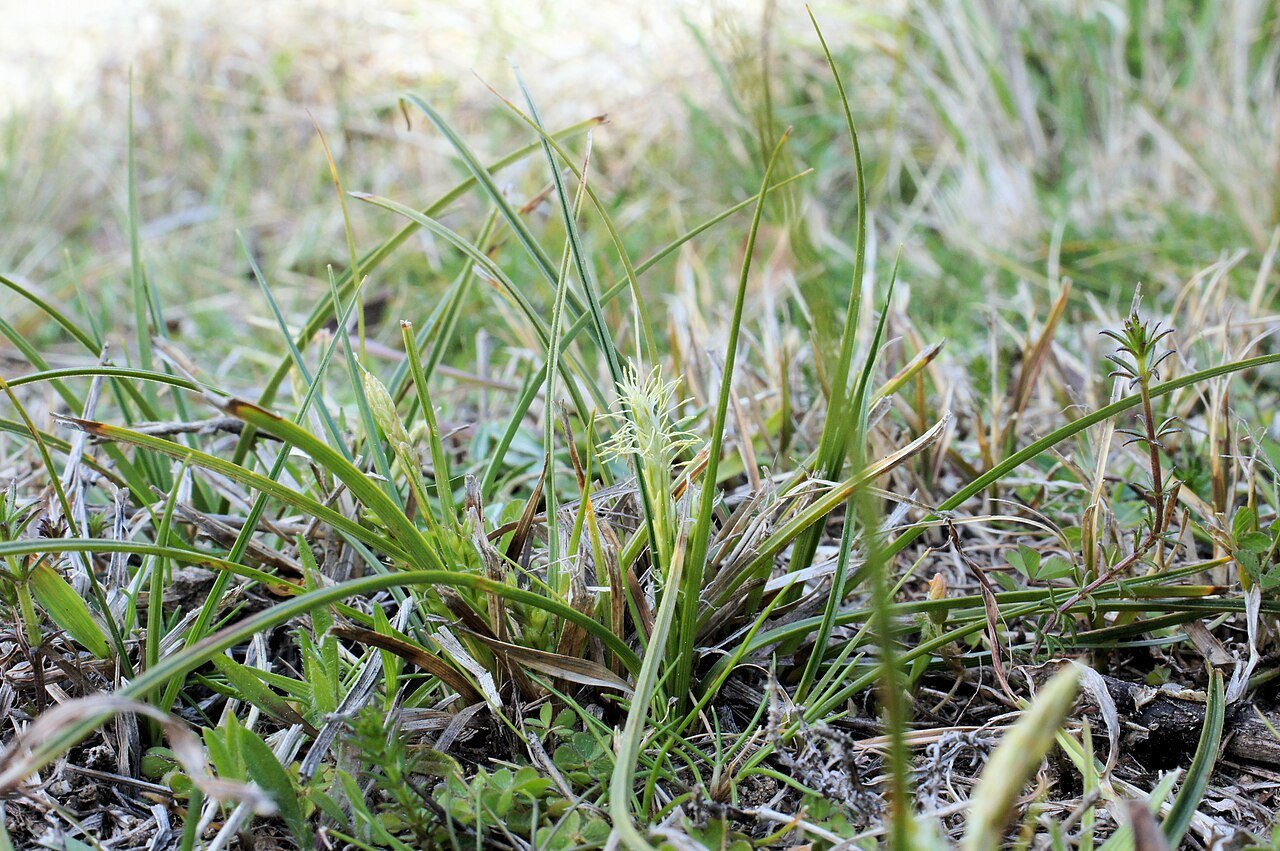
LATIN NAME: Carex breviculmis
COMMON NAME: Asian Shortstem Sedge
Plant Profile
Carex breviculmis is a sedge of the Cyperaceae, native from the Indian subcontinent through China, Taiwan, Korea and Japan to Khabarovsk Krai in the Russian Far East, and south through Malesia and New Guinea to Australia, Norfolk Island and New Zealand. It has been introduced to Mississippi, which is the only record of it outside its native range.
It forms dense, neat tufts of fine, arching, evergreen leaves 20 to 40 cm long, dark green above and slightly glaucous beneath. The flowering stems are shorter than the leaves, which is where the name comes from, and they carry small brownish spikelets in spring. The plant spreads slowly by short rhizomes, forming a clump rather than a mat.
In the wild it grows in forests, where it ranks among the few sedges that tolerates deep shade, and it is often found on forest floors, along tracks and in rocky ground in woodland. That shade tolerance is the reason it has become a garden plant, since most sedges and grasses need sun and few will grow under trees.
Science & Biotechnology
Carex is one of the largest genera of flowering plants, with about 2,000 species, and it is the core genus of the Cyperaceae, the sedge family. The family is characterised by triangular stems, closed leaf sheaths and reduced flowers arranged in spikelets, and it is wind-pollinated, so the flowers are small and green.
The genus is notoriously difficult taxonomically, because the species hybridise and because the diagnostic features are tiny. Carex breviculmis belongs to section Mitratae, a group of small Asian sedges with short-beaked perigynia, and it is distinguished from its relatives by the shape of the female scales and the length of the beak.
Sedums and sedges are often confused by gardeners, but the difference is easy to see: sedges have edges, grasses are round, and rushes are jointless. The rhyme is old and accurate, and it is the quickest way to tell a Carex from a grass in the field. Carex breviculmis has a distinctly triangular stem, visible if you roll it between your fingers. Near kin on the list: Cyperus glomeratus and Isolepis.
Uses & Benefits
It is used as a ground cover under trees, as an edging for a shady path, and as a texture plant in a woodland garden, where its fine leaves contrast with ferns and hostas. It is also good in a container, where its arching habit softens the edge of the pot and its evergreen leaves give interest in winter.
It is drought-tolerant once established, which is unusual for a sedge and which makes it useful in dry shade, the hardest situation in a garden. It competes well with tree roots, and it does not need watering once it has settled in, which is more than most shade plants can claim. It is not a food plant and not a medicine. In its native range it is a component of forest vegetation and is grazed by livestock in open woodland, but it has no commercial value beyond horticulture.
Growing from Seed
Sow in autumn or at the start of spring, 15 to 20 °C, with a thin covering. Germination takes 21 to 30 days and is improved by cold stratification. The seed is small and the seedlings are slow, so sow early in the season if you want plants for the same year.
Prick out into small pots and grow on at 15 °C in bright, indirect light. Plant out in spring or early autumn, 25 cm apart, in shade or partial shade. The plant tolerates dry soil once established, but it establishes faster in soil that holds some moisture.
Water in the first season, then leave it alone. Cut back the old foliage in early spring if it looks tired, but do not cut into the crown, since the new shoots emerge from the centre of the tuft. Old foliage goes straw-coloured and spoils the look of the plant by February.
Divide clumps every three or four years in spring, replanting the outer pieces and discarding the dead centre. In a garden it is best used in a drift rather than as a specimen, since a single tuft disappears in a border but a group of twenty makes a texture that reads from a distance.
Our Take
Carex breviculmis is a plant for the difficult places: dry shade, tree roots, the strip behind a wall. It is not exciting, and it will never be the reason someone visits a garden, but it will be there in February when everything else has gone, and it will look tidy without any help. Plant it where nothing else will grow, divide it every few years, and forget about it. That is the highest compliment you can pay a ground cover plant.
Related Reading
Gardeners who grow Asian Shortstem Sedge often pair it with these related subjects: