


Clarkia amoena Seeds | Godetia
LATIN NAME: Clarkia amoena
COMMON NAME: Godetia
Plant Profile
Clarkia amoena, long known as godetia, is an annual of the coastal hills and mountains from British Columbia south to the San Francisco Bay Area. It grows in open grassland and on grassy slopes within reach of summer fog, in soils that dry out by midsummer, and it completes its life before the drought sets in.
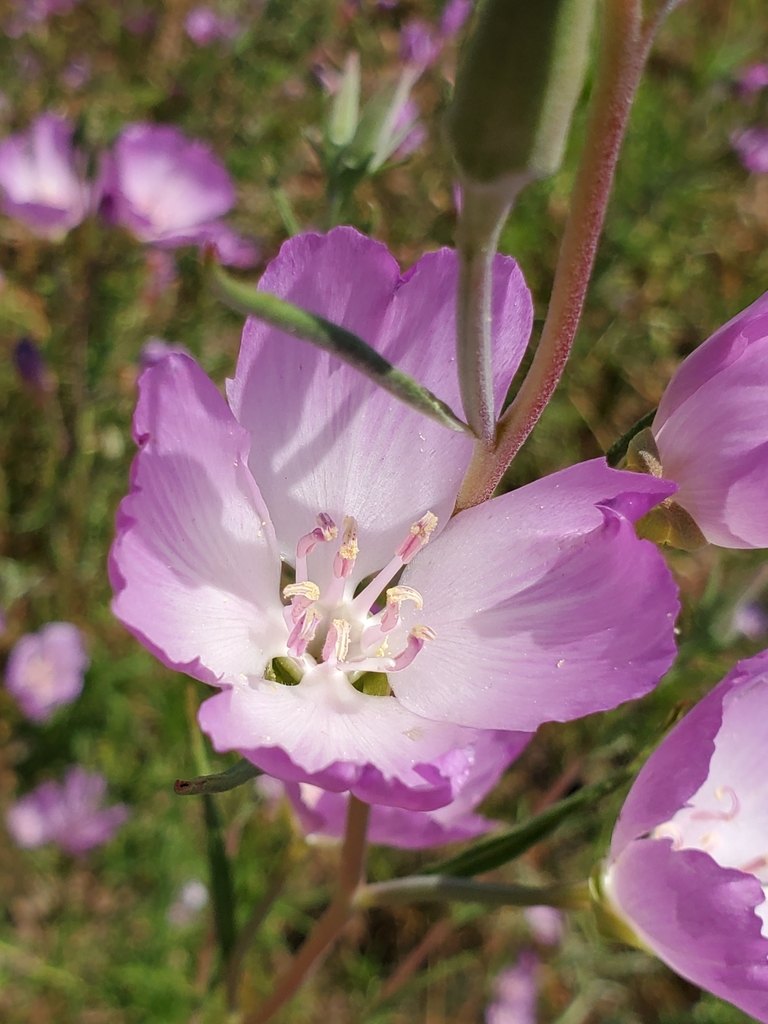
It makes a bushy clump 30 to 60 cm high with narrow, lance-shaped leaves and cup-shaped flowers 4 to 6 cm across, each with four broad petals that overlap at the base. The colour runs from white through pale pink to salmon and deep crimson, usually with a darker blotch at the centre and sometimes with a paler edge. The petals have a sheen that is unusual in a flower: thin, almost translucent, and catching the light like the nap of a satin ribbon.
The plant was formerly placed in the genus Godetia, and the old name persists in the seed trade and in the common name farewell-to-spring, which refers to its habit of flowering as the California spring ends. It is one of about forty species of Clarkia, most of them western North American, and it crosses with several of them in cultivation.
Science & Biotechnology
The satin sheen comes from the structure of the petal surface rather than from pigment. The epidermal cells are raised into tiny conical papillae, and light striking them is scattered rather than reflected flatly, which produces the soft lustre and makes the colour appear to shift as you move. The same trick is used by tulips and by some roses, and it is why a photograph of a godetia rarely captures what the eye sees.
Clarkia has been a model organism for evolutionary biology since the 1950s, when Harlan Lewis at UCLA used the genus to study chromosomal evolution and speciation. The group shows dramatic rearrangements of chromosome number and structure between closely related species, and some species have shifted their flowering time by a few weeks, which is enough to reproductively isolate them from their neighbours.
That work made Clarkia one of the standard examples of how speciation can happen without geographic separation. For a gardener the practical consequence is that the genus is genetically restless: seed saved from a garden plant will not come true, and mixed packets produce a range of forms that can be charming or muddled depending on your taste.
Uses & Benefits
Godetia is a plant for a cool, coastal or northern garden, where it flowers for six weeks in early summer with very little help. In heat it collapses quickly: the flowers fade, the leaves crisp, and the plant is finished by the time the first hot spell arrives. That makes it a poor choice for a hot inland site and an excellent one for a maritime garden.
Use it at the front of a border, in a cutting garden, in a meadow mix with cornflowers and California poppies, or in containers where you can control the water. It is good for cutting if picked in the morning, before the flowers open fully, and it will last four or five days in water.
The plant self-sows readily where it is happy, coming back year after year from seed in gravel, in the cracks of a path and at the edge of a bed. That self-sowing habit is the reason it persists in old gardens long after anyone has stopped sowing it, and the reason it can become a minor weed in a mild coastal climate. It shares the family with Clarkia elegans, Oenothera longissima and Oenothera speciosa.
Growing from Seed
Sow direct where the plants are to flower, in early spring once the soil can be worked, or in autumn in mild climates. The plant has a taproot and resents transplanting, so modules are a poor option unless you sow into deep cells and move the plants while they are small.
Sow at 15 to 18 °C, barely covering the seed, and keep the ground moist until germination, which takes 7 to 14 days. Thin to 20 to 25 cm apart when the seedlings have two pairs of leaves. Crowded plants grow tall and thin and fall over; thinned plants branch and flower far better.
Do not feed. Rich soil produces leaf at the expense of flower, and the plants become floppy. Water during dry spells while they are establishing, then reduce; a dry finish is what the plant expects, and it ripens seed for the next year. Cut the plants back after flowering if you do not want self-sowing, or leave the last stems to set seed and shake it where you want it.
Our Take
Godetia is one of the best annuals for a cool summer and one of the worst for a hot one, and there is no way around that. If your June is mild and your July is dry, it will outperform almost anything for six weeks; if your June is 30 °C, it will be over before it starts.
The colours are worth the trouble, particularly the salmon and the deep crimson, which are hard to find in annuals that flower at the same moment. Grow it in a bed you can see from the kitchen window, pick it for the house, and let a few stems go to seed. It will come back without being asked, and that is the cheapest sort of gardening there is.
Related Reading
If Godetia appeals to you, these related plants are worth a look: