


Oenothera speciosa Seeds | Pink Evening Primrose
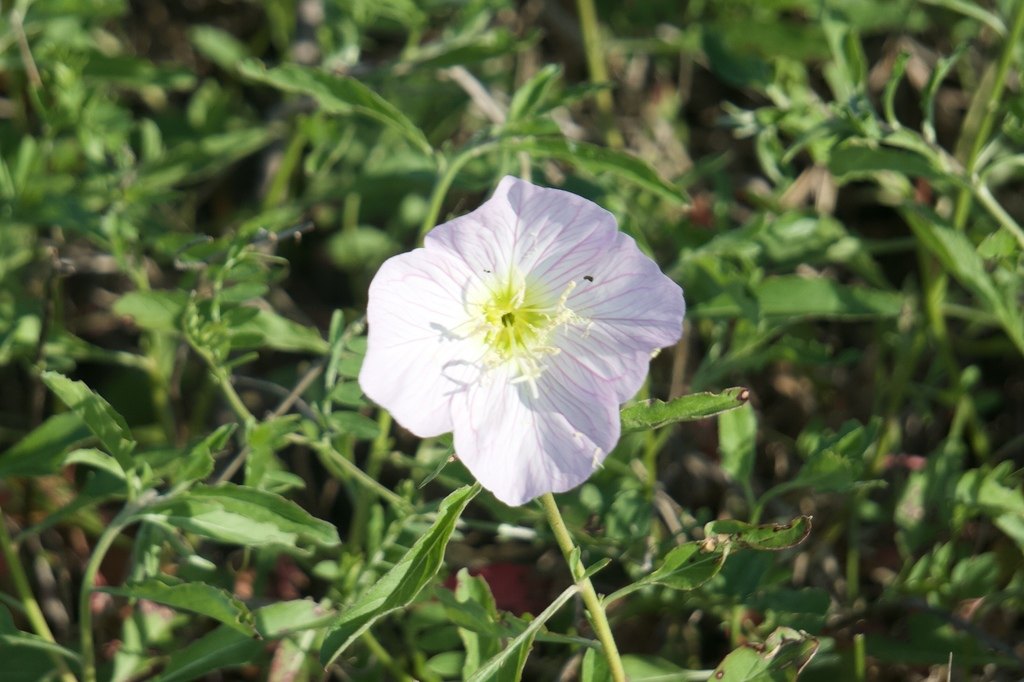
LATIN NAME: Oenothera speciosa
COMMON NAME: Pink Evening Primrose
Plant Profile
Pink evening primrose is a herbaceous perennial of the south-central grasslands, 30 to 50 cm tall, with stems that are smooth or softly hairy depending on the population. It runs at the root as well as seeding, and a single plant becomes a patch in two seasons. The leaves are alternate, almost stalkless, up to 10 cm long, and vary from linear to spoon-shaped.
The flowers are borne singly in the upper axils, four-petalled and cup-shaped, 4 to 5 cm across, with a soft yellow throat and yellow stamens. They open white and turn pink as they age, so a flowering patch carries both colours at once and reads as a wash rather than a dot. The scent is faint and sweet.
The timetable is the curious part. The flowers open in the hours before dawn and close when the sun reaches them, and they also open at night, so the plant is placed in the evening primrose family and why moths, rather than bees, are its most frequent visitors.
Science & Biotechnology
The colour change is not decoration. A flower that has been open overnight and has already been visited fades to pink, which tells a moth that the nectar is gone and sends it to a white one. That is a common arrangement in the family, and it works because the change is a cue rather than a reward.
The species is native to Kansas, Missouri, Nebraska, north-eastern New Mexico, Oklahoma and Texas and to Chihuahua and Coahuila in Mexico, and it has naturalised in 28 of the lower 48 states. Gardens are the main vector: it escapes, it establishes on disturbed ground, and it does not need help after that.
It is a drought-tolerant plant of loose, fast-draining soil in full sun, and it behaves as a groundcover where it is happy. The three named varieties, var. speciosa, var. berlandieri and var. childsii, differ mainly in leaf shape and hairiness, and the trade sells them interchangeably. Nobody buying seed can tell which one they have. The Onagraceae thread continues with Oenothera lindheimeri, Oenothera longissima and Clarkia elegans.
Uses & Benefits
It is a plant for a rough bank, a gravel garden, a roadside verge or the front edge of a border where nothing else will hold the soil. The pink is soft and the flowering is long, from late spring into autumn, and it will grow on ground that dries to dust in August. Few perennials give that much for that little.
It is also a good cut flower if you pick it in bud and sear the stem ends, and it opens indoors in the evening, which is either charming or inconvenient depending on the occasion. The stems are weak, so it is better in a short vase than a tall one.
The name is a small trap. In parts of the United States it is called buttercup, which it is not: true buttercups are Ranunculus, in a different family, and the resemblance is entirely in the colour of the throat. The specific epithet speciosa simply means showy, which is fair.
Growing from Seed
Sow in autumn or early spring, on the surface, because the seed needs light. Germination is quick at 18 to 20 °C, ten to twenty days, and the seedlings are vigorous enough to plant out at six weeks. A cold spell improves the percentage but is not essential, and fresh seed beats seed from a packet two years old.
Plant into poor to moderate soil in full sun. Rich ground produces floppy growth and fewer flowers, which is the opposite of what most people expect. Space them 40 cm apart and give them room; they will fill it in a season whether you want them to or not.
Control is a seasonal job, not a one-off. Pull the runners at the edge of the patch in spring, before they root, and deadhead if you do not want it in the lawn. It will still come back from fragments of root left in the ground, so choose the site as though you were planting mint.
Our Take
For a hot dry bank it is close to ideal, and the white-to-pink change gives it a quality that most groundcovers lack. It flowers for months, it asks for nothing, and it looks after itself. Those are real virtues and there is no reason to be snobbish about them.
The reason to hesitate is its manners. This is a plant that walks, and it does not stop at the path. Put it somewhere it can be the only thing, or put it where you can mow around it, and you will be glad of it. Put it in a mixed border and you will be pulling it out for a decade.
Related Reading
More species in the same orbit as Pink Evening Primrose: