


Rudbeckia amplexicaulis Seeds | Clasping Coneflower
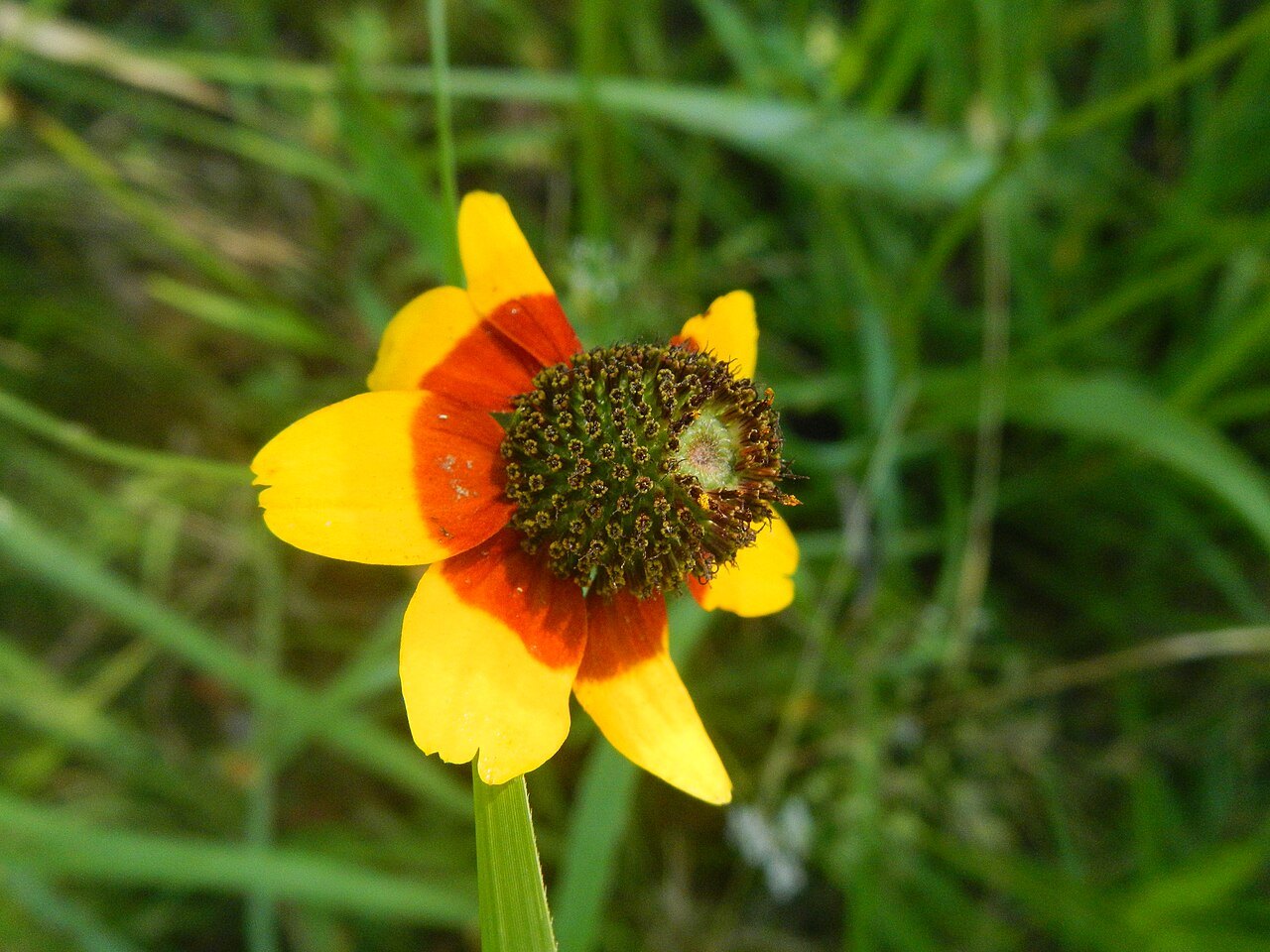
LATIN NAME: Rudbeckia amplexicaulis
COMMON NAME: Clasping Coneflower
Plant Profile
Clasping coneflower is still listed as Rudbeckia amplexicaulis in most catalogues, though it now sits alone in a genus of its own, Dracopis, and the move was made on a detail small enough to need a lens and a knife.
It is an annual reaching a metre, with simple or branched stems and oval leaves five to ten centimetres long and two to four wide, the upper ones clasping the stem at the base, which is what amplexicaulis means. That clasping base is the easiest field character, and it is visible from a distance once you know to look for it.
The heads are daisy-like, with yellow to yellowish-purple florets and a dark cone in the centre. They are smaller and looser than those of the perennial coneflowers, and a plant in flower has a slightly untidy, relaxed look that suits a meadow. The purple tinge in the ray florets varies between populations and is stronger in some than in others.
Its native range is the south central United States, from Kansas and Missouri south through Oklahoma and Arkansas to Texas and Louisiana. It has escaped from gardens in France, Britain and Korea, and it is recorded as established in a few of those places.
Science & Biotechnology
The reason for the split is the chaff. In Rudbeckia the receptacular bracts sit among the disc florets; in this plant they extend beneath the ray florets as well, subtending them. That single difference was judged enough to justify a separate genus, Dracopis, which contains no other species.
The genus name comes from the Greek for a dragon or a serpent, apparently a reference to the appearance of the receptacle, and it ranks among the more obscure acts of naming in the family. The older name is more useful to a gardener, because it describes the leaf.
Coneflower is a name shared by at least four genera: Echinacea, Rudbeckia, Ratibida and Dracopis. They are not closely related within the family, and the resemblance is convergence on a raised disc that gives pollinators a landing platform and a long series of tiny florets to work through. Those florets open in rings from the outside inward, so a single head stays in flower for weeks. Other Asteraceae on the list: Crepis rigescens, Chrysanthemum multicaule and Arnica americana.
Uses & Benefits
For a meadow or an annual border it is a fast, cheap, generous plant: sown in spring, it flowers from July into September and will self-sow if a few heads are left standing. It also holds an Award of Garden Merit, which is unusual for an annual of this kind.
Records peak in May, with April and June close behind, which places flowering in late spring in its native south. Grown further north the same plants flower from midsummer, and the discrepancy is entirely a matter of accumulated heat. The peak is narrow, which is what you expect from a plant driven by day length as much as by warmth.
The seed heads are worth leaving through winter, both for the birds and for the structure. They hold their shape in frost, and a row of them against a low sun is a better use of the space than a bare bed waiting for spring.
Growing from Seed
Sow direct in autumn in mild climates or in early spring elsewhere, on the surface, since the seed needs light. Press it into the soil and water once; germination follows in two to three weeks once the ground has warmed to about eighteen degrees.
Thin to twenty-five centimetres apart. The plants are tolerant of poor soil and of drought once established, and rich ground produces tall stems that need staking and flower later. Full sun is necessary for a compact habit, and a plant in shade will reach for the light and flower a month late.
Leave the last heads to ripen if you want a permanent colony. The seed is easy to collect, keeps for two or three years in a cool dry jar, and germinates reliably, which makes this one of the simplest annuals to maintain without buying seed every year. Stored seed often germinates best in its second year, which is worth knowing before an old packet is thrown out.
Our Take
Clasping coneflower is a plant for people who like their yellow honest and their botany complicated. The flower is cheerful and ordinary; the taxonomy behind it is not, and that contrast is the reason to grow it at all. Most people who buy the seed have no idea they are sowing a monotypic genus.
Sow it in a meadow strip or the back of a dry border, let it seed, and cut the old stems in March rather than autumn. It will not survive a wet winter in heavy soil, and it does not need to, because the seed will. It is also one of the few annuals that looks better in its second year, when the self-sown seedlings arrive in a drift.
Related Reading
Readers interested in Clasping Coneflower frequently explore these as well: