


Dimorphotheca sinuata Seeds | Cape Marigold
LATIN NAME: Dimorphotheca sinuata
COMMON NAME: Cape Marigold
Plant Profile
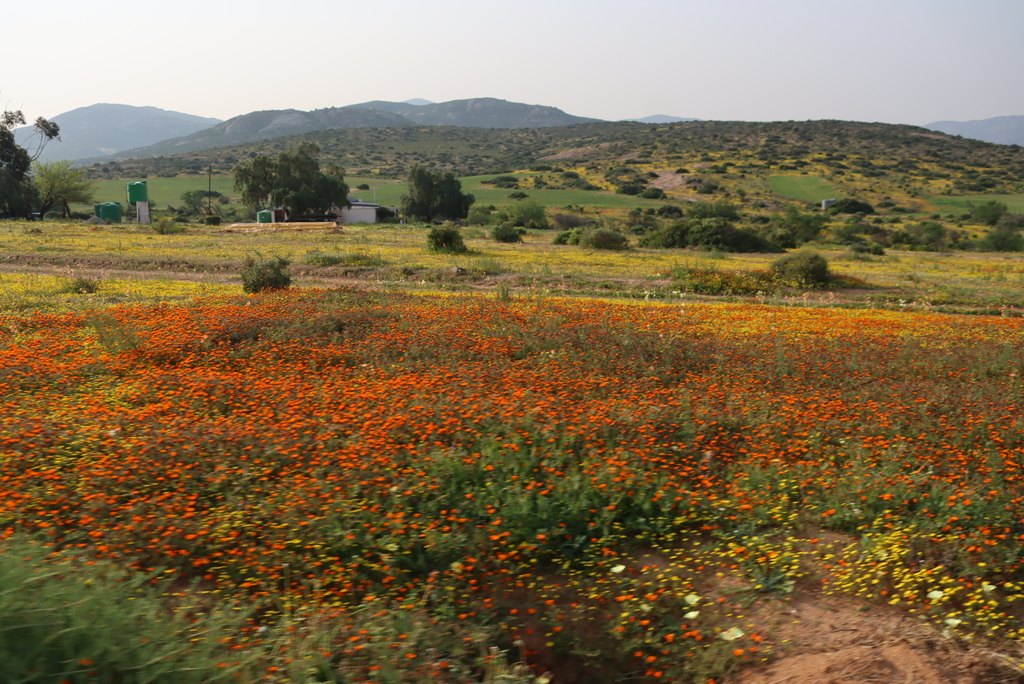
Dimorphotheca sinuata comes from South Africa and Namibia, where it grows in the winter-rainfall desert and appears in sheets after a wet winter. It is an annual 20 to 40 cm tall, with narrow, slightly toothed leaves and daisies 4 to 5 cm across in orange, apricot, yellow and cream.
The flowers have a dark blue-black ring around the centre, which contrasts with the warm petal colour and gives the plant a vivid, almost artificial look. They open in full sun and close in cloud or at dusk, and a bed of them on a bright day is one of the most saturated colours in any garden.
It is closely related to Dimorphotheca pluvialis, the white rain daisy, and the two are often grown together, since they share the same schedule and the same appetite for poor, sandy ground. The difference is in the colour: pluvialis is white above and violet beneath, sinuata is orange, apricot or yellow, and the two together make a display that lasts from early spring into summer.
The genus name means two-shaped fruit, which refers to the two kinds of seed produced by the plant, and the species name refers to the wavy leaf margins. Both are features that require a lens to see, and neither is any help in the garden.
Science & Biotechnology
Dimorphotheca is a genus of about 20 species, all southern African, and it is closely related to Osteospermum. The two are separated by the fruit and by the ray florets, which in Dimorphotheca are female and fertile while in Osteospermum they are often sterile. The dark ring around the centre is an anthocyanin band that functions as a nectar guide, and it is unusually dark for a daisy. The pigment is a high concentration of cyanidin derivatives over a background of colourless tissue, which produces the near-black appearance and makes the warm petals look even warmer.
The closing of the flower is a phototropic response, driven by cell expansion at the base of the ray florets. It protects the pollen from rain and dew, and it is the reason the plant is a poor cut flower, since a picked stem closes and stays closed.
The genus is one of the few in the Asteraceae that produces two kinds of fruit, which is where the name comes from. The outer fruits are flattened and winged, while the inner ones are thicker and unwinged, and the two are dispersed in different ways, which is an unusual strategy for a single plant.
Uses & Benefits
It is used at the front of a hot border, in a gravel garden, in a large pot and in a meadow mix, where its brilliant colour and its tolerance of poor soil are assets. It is best sown in drifts rather than rows, because the effect depends on numbers, and a single plant looks lost.
It pairs naturally with other Cape annuals, particularly Ursinia, Felicia and the white rain daisy, all of which share its schedule and its needs. In a mild, dry climate it self-sows and returns in the same place year after year, which is how it behaves in the wild.
In a cold climate it is grown as a summer annual and must be resown each spring, since it does not survive frost. In a wet climate it rots in winter, and the seed is best sown in spring rather than autumn. In a Mediterranean climate it is a winter and spring flower, sown in autumn and flowering from February.
There is no culinary or medicinal use for it. Its value is ornamental, and it ranks among the best annuals for a hot, dry, sunny position where little else will grow. It is also a good cut flower, though the stems are short and the flowers close when cut.
Growing from Seed
In a mild climate sow where they are to flower in autumn; in a cold one wait for early spring; either way, 15 to 18 °C. Cover the seed thinly, keep it damp, and the seedlings are through in a fortnight. They need thinning to 20 cm.
In a cold climate, start it indoors six weeks before the frosts end and plant out once the risk is past. It dislikes being moved, so raise it in deep cells and plant out while it is still small. Eight to ten weeks from sowing to flower, and then two months of it.
Full sun, thin sandy ground, and drainage it can rely on. Fat soil gives you leaves instead of flowers, and a wet winter kills it outright. If you want seed, leave the flowers alone; they set it freely, and a shake in autumn scatters it where you want it. In a wet autumn you can lift the plants, or treat the sowing as annual. In a dry one, the plants will self-sow and return without help, and the colony will expand along the driest, poorest ground in the garden.
Our Take
Cape marigold is one of the most vivid annuals in the catalogue and one of the easiest, provided it has sun and drainage. It is not a plant for a rich border or a wet climate, and it is not a plant for a vase. Sow it in a drift, in poor soil, in full sun, and let it seed. It will come back, and it will be the brightest thing in the garden in early summer.
Related Reading
Continue exploring with these related plants: