


Emilia sonchifolia Seeds | Lilac Tasselflower
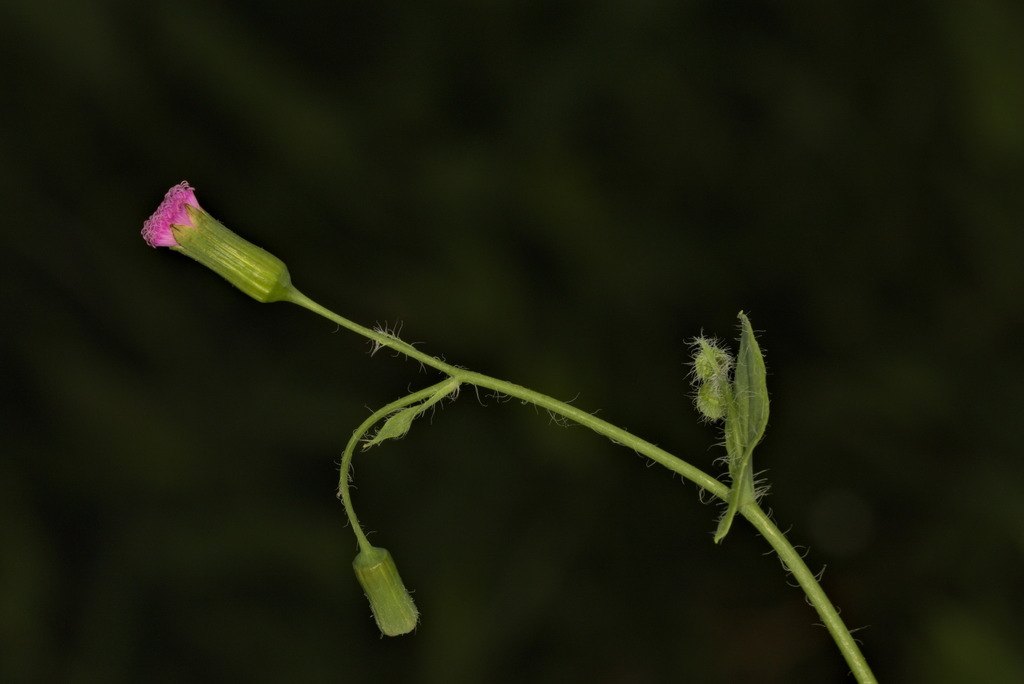
LATIN NAME: Emilia sonchifolia
COMMON NAME: Lilac Tasselflower
Plant Profile
Emilia sonchifolia is a slender annual of the Asteraceae, native to tropical Asia and now widespread across the tropics of Africa, Asia and the Americas. It grows on disturbed ground, in gardens, along roads and in cultivated fields, and it has followed human cultivation so effectively that its original range is uncertain.
It grows 30 to 60 cm tall on thin, almost leafless stems, with lobed leaves concentrated at the base and a few small leaves on the stem. The flower heads are small and unusual: rather than a daisy, each is a tight tuft of tubular florets in lilac-pink to orange-red, looking like a tiny shaving brush or a tassel, and they are borne in loose clusters over a long season.
One plant can produce several heads, and each head sets seed freely. The seed is a small achene with a pappus of white hairs, and it blows on the wind, so the plant appears in new ground so quickly. In a garden it is either a useful filler or a weed, depending on where it comes up. Near kin on the list are Ageratum conyzoides, Calocephalus brownii and Madia sativa, all Asteraceae.
Science & Biotechnology
The hepatotoxicity is caused by pyrrolizidine alkaloids, a group of compounds found in several plant families, including the Boraginaceae and the Asteraceae. The alkaloids are metabolised in the liver into reactive pyrroles that bind to DNA and proteins, causing damage that can be cumulative and, in severe cases, irreversible.
Emilia is a genus of about 100 species, most of them tropical, and it is placed in the tribe Senecioneae, the same tribe as ragwort and groundsel, both of which are also hepatotoxic. The resemblance is not accidental: the tassel flower is a reduced daisy head, with the ray florets lost and the disc florets retained, so it does not look like a daisy at all.
The red and orange forms contain different anthocyanins from the lilac ones, and the colour is under simple genetic control, so populations in different regions tend to be uniform. The plant is self-fertile and sets seed without pollinators, which is one reason it spreads so easily.
Uses & Benefits
Its value in the garden is as a filler. The thin stems and small heads sit between bigger cut flowers without crowding them, and the season is long enough to be useful from midsummer onwards. In the border it is best used in a loose, naturalistic planting where its airiness is an asset rather than a fault.
In parts of Asia and Africa the young leaves and shoots are eaten as a vegetable, boiled or stir-fried, and the plant is sold in markets in Vietnam, southern China and India. That use comes with a warning, because the plant contains pyrrolizidine alkaloids that damage the liver, and the risk is cumulative rather than acute.
In traditional medicine it is used for fever, sore throat and skin complaints, and the sap is applied to wounds in some regions. None of these uses has been validated in clinical trials, and the presence of hepatotoxic alkaloids argues for caution rather than enthusiasm.
Growing from Seed
Sow indoors six weeks before the last frost, or direct in late spring, at 20 to 25 °C. Light is required, so press the seed onto the surface and leave it uncovered. Germination takes 10 to 14 days and is usually very high. Thin or transplant to 20 to 25 cm apart. The plant tolerates poor, dry soil and needs no feeding; in rich soil it grows tall and falls over. Water while establishing, then only in dry spells.
For cut flowers, harvest when half the florets on a head have opened, and strip the lower leaves, which wilt before the flowers do. The stems last a week or more in water and are useful for filling gaps in mixed arrangements, where their fine texture sets off heavier flowers. If you do not want it to spread, cut the heads before the pappus is fully formed, because once the seed blows you will have it for years.
Our Take
Emilia is a plant with two faces: a useful, airy filler for the cutting garden, and an invasive weed of disturbed ground. In a tropical or subtropical garden it will appear without being invited, and it will keep appearing. Few plants are so welcome in one bed and so unwelcome in the next.
In a temperate one it is a half-hardy annual that needs to be sown each year. Grow it for the vase rather than the border, and cut it before the seed sets. It is not a plant to encourage in a wild garden, where it will take more space than it deserves.
Related Reading
Readers interested in Lilac Tasselflower frequently explore these as well: