


Maurandya barclayana Seeds | Mexican Viper
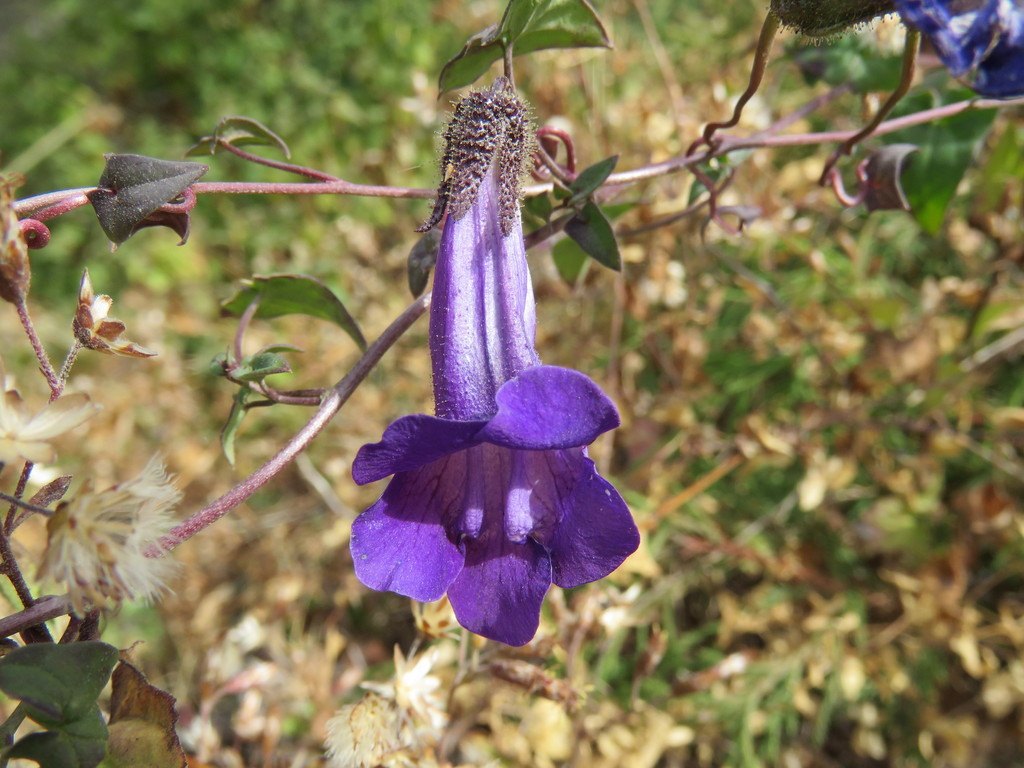
LATIN NAME: Maurandya barclayana
COMMON NAME: Mexican Viper
Plant Profile
Maurandya barclayana, also spelled barclaiana and long sold as Asarina barclayana, is an herbaceous perennial climber from Mexico that reaches 4 metres, with ivy-like leaves and white, pink or purple tubular flowers through spring and summer. Its common names, angel’s trumpet and Mexican viper, overstate and understate in equal measure.
It is a climbing, fibrous-rooted perennial whose stems usually carry adventitious roots, so the plant anchors as it climbs. The leaves are triangular-cordate to triangular-hastate, 1 to 3.5 cm long and 8 to 30 mm wide, palmately veined on petioles of 1 to 1.5 cm, with acute or indistinct basal lobes and small teeth towards the base.
The flowers are the draw: a corolla 3 to 4.5 cm long, purple in colour and lighter near the base, its lobes shorter than the tube, carried on peduncles 2 to 5 cm. The sepals are long and simple, 10 to 15 mm in flower and stretching to 20 mm in fruit.
Charles Darwin cited this plant in The Movements and Habits of Climbing Plants, his study of how vines do what they do, which makes it one of the few garden climbers with a place in the origin literature. The twining leaf-stalks he observed are still the plant’s operating system.
Science & Biotechnology
Its climbing mechanism is the interesting part: leaf-stalks and stems twine and grip, and the adventitious roots on the stems let the plant attach to any rough surface as it rises. Darwin used such climbers to argue how finely plants tune their movements, and this species twists willingly up string, wire and twiggy shrubs.
The family history adds a wrinkle: it was moved from the figwort family into the plantains, Plantaginaceae, on molecular evidence, one of the quiet reshuffles that left garden names unchanged and floras rewritten. Seed listings still show both generic names for the same vine.
Its limits are thermal: it does not tolerate frost, so in cooler temperate climates it is grown under glass in a conservatory, or alternatively as a tender annual, sown each spring and composted each autumn. In frost-free climates it is a perennial that flowers its head off on any warm wall. Plantaginaceae is well covered here, with Penstemon campanulatus, Linaria bipartita and Angelonia alongside.
Uses & Benefits
Its garden use is the small trellis, the arch, the obelisk or the conservatory wall: a climber of modest leaf and continuous trumpet, needing support but not bulk. It requires a sheltered position in full sun, and it rewards the shelter with months of white, pink and purple, in that order of willingness depending on the strain.
As a tender annual in temperate gardens it does the season’s work cheaply: sown in spring, it can cover a couple of metres by late summer and flower without deadheading, and its small footprint makes it a good companion over shrubs that have finished their own show.
It has gained the Royal Horticultural Society’s Award of Garden Merit, which is the trade’s shorthand for reliability under trial. For pollinators the tubular flowers are built for long-tongued visitors, and in its native Mexico hummingbirds work the genus; in European gardens, bees and hoverflies take what they can reach.
Growing from Seed
Sow in spring at warm temperatures, about a centimetre deep in moist compost, and germination follows in two to three weeks at steady warmth. The seedlings climb almost immediately, so insert a thin cane per pot at pricking-out time and let each seedling wind itself rather than tying it.
Grow them cool and bright, and plant out only after all frost risk has passed, into a sheltered position in full sun. Leave 30 cm between plants and give them something thin to twist around from the first week; a climber that finds nothing to grip wastes a month bushing out.
Through the season it needs watering in dry spells and nothing else, since the flowering is self-sustaining. For a second year, either lift the plant to a frost-free conservatory in autumn or take softwood cuttings, which root readily and carry the same trumpet line on young stock the following spring.
Our Take
Mexican viper is the climber for gardeners who want Darwin’s curiosity on their fence: a twiner with adventitious roots, trumpets from white to purple, and a constitution built for warmth, shelter and sun. It asks for a string and a frost-free season, no more.
Sow it where you can watch it work, and it will grip, climb and flower without a single intervention. The annual version is disposable; the conservatory version is for keeps, and its AGM stands behind both. Few climbers of any price give four metres of trumpet from one spring sowing.
Related Reading
Readers interested in Mexican Viper frequently explore these as well: