


Linaria bipartita Seeds | Clovenlip Toadflax
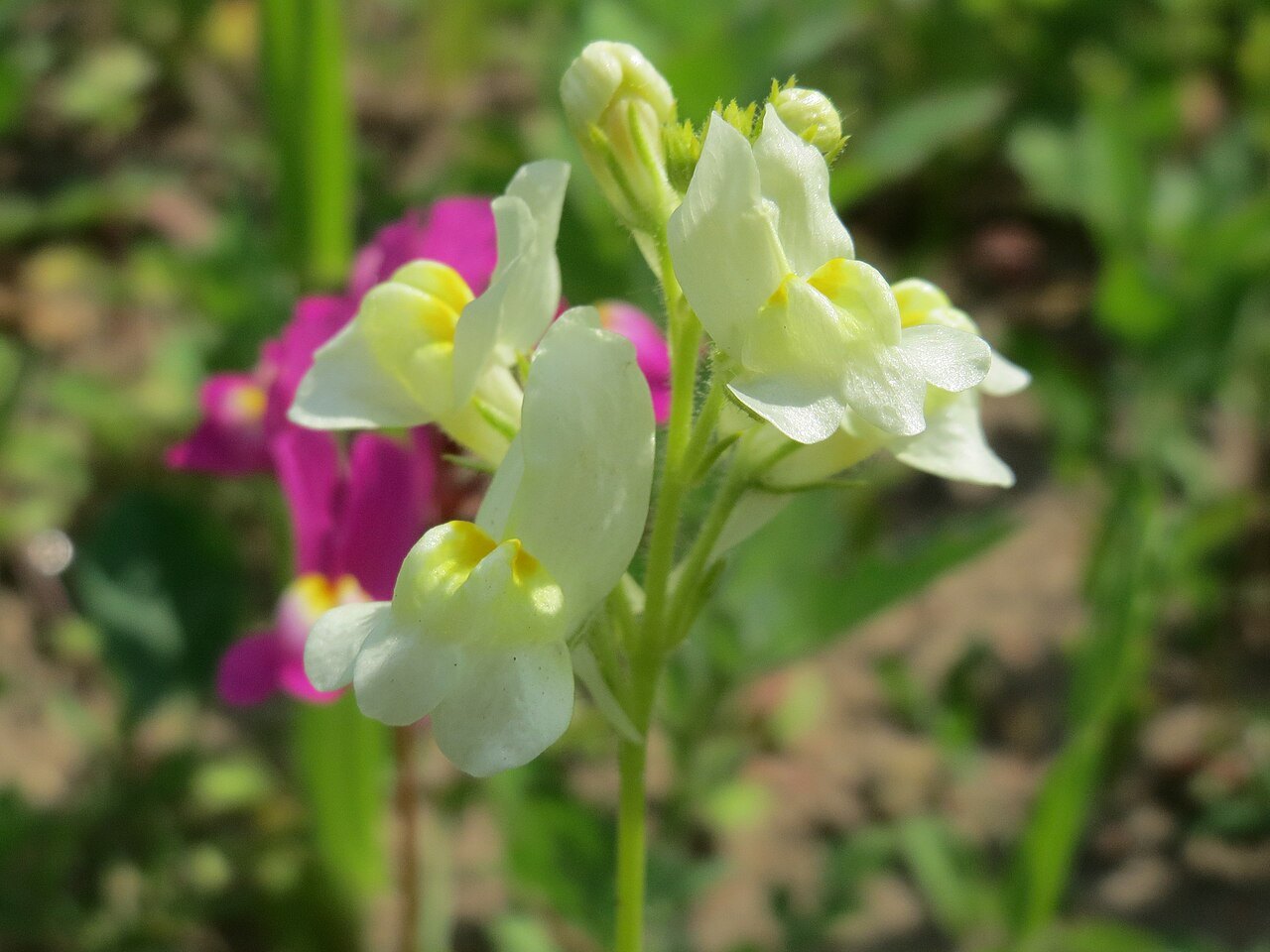
LATIN NAME: Linaria bipartita
COMMON NAME: Clovenlip Toadflax
Plant Profile
Linaria bipartita is a small annual of the plantain family, native and endemic to Morocco, where it grows on dry hillsides and in cultivated ground in the Atlas region and along the coast. It is 20 to 30 cm tall, with narrow, grey-green leaves and a mass of small two-lipped flowers in violet, pink, white and bicolour.
Each flower is 1 to 1.5 cm long, with an upper lip of two lobes and a lower lip of three, and a long spur projecting backwards from the base. The spur holds nectar, and it is the reason the flower can only be worked by insects with a tongue long enough to reach it, which in Morocco means long-tongued bees.
The species name bipartita refers to the divided lip, which is the feature that distinguishes it from the common yellow toadflax, Linaria vulgaris. It is closely related to that species and to the purple toadflax, L. purpurea, both of which are widespread European weeds, and it shares their habit of producing a great deal of seed.
Science & Biotechnology
Linaria is a genus of about 150 species in the Plantaginaceae, the plantain family, and it was formerly placed in the Scrophulariaceae before molecular work moved it. The genus is characterised by the spurred flower and by the capsule fruit, which opens by pores or by valves to release small, winged seeds.
The spur is a nectar-holding structure formed by an extension of the lower lip, and its length is matched to the tongue length of the local pollinators. In L. bipartita the spur is short enough for medium-tongued bees, while in some related species it is long enough to exclude all but a single bee species, which is a textbook example of co-evolution. It sits among Linaria vulgaris, Penstemon digitalis and Veronica polita, all Plantaginaceae.
The genus is also known for its chromosome diversity, with counts ranging from 2n = 12 to 2n = 24, and for its ability to hybridise across species boundaries. That flexibility has made Linaria a model for the study of speciation, particularly in the work of the botanist David Valentine on the British species. The species is treated by some authorities as a synonym of Linaria incarnata, an Iberian plant, and the boundary between the two has moved several times. For gardeners the distinction hardly matters, since both are grown the same way.
Uses & Benefits
It is a bedding and edging plant, used at the front of a border, in containers and in the gaps between paving stones, where its low habit and its long season are assets. It flowers from early summer until autumn, and it needs no deadheading to keep going.
The colours are soft and slightly old-fashioned, and they mix well with other annuals of the same scale, particularly nemesia, diascia and lobelia. It is not a plant that makes a statement on its own; it is a plant that fills space gracefully and keeps flowering while other things fade.
It is not edible, and it contains linarin and other glycosides that make it unpalatable to livestock. It has no medicinal use in Western practice, though other Linaria species have been used as diuretics and purgatives in folk medicine, with predictable results.
It is often sold as Linaria maroccana, a closely related Moroccan species with larger flowers and a wider colour range, and the two are confused in the trade. The true L. bipartita has smaller flowers and a more open habit, and it is the better plant for a wild garden, while the maroccana forms are the ones bred for bedding.
Growing from Seed
Sow indoors six to eight weeks before the last frost at 15 to 18 °C, on the surface and only just covered, since the seed needs light. Nothing shows for a fortnight, and then most of it comes at once.
Pot them on singly, at 12 to 15 °C. Plant out after the last frost, 20 cm apart, in full sun. The plant tolerates poor, dry soil and needs no feeding; rich soil produces soft growth and fewer flowers. Flowering begins about ten weeks from sowing and continues until frost. Deadhead if you do not want self-sowing, or leave the last stems to set seed and shake them where you want the plant next year. In a mild climate it self-sows freely, and in a cold one it must be resown each spring.
Our Take
Clovenlip toadflax is one of those plants that nobody grows deliberately and everybody likes when they see it. It is easy, generous and long-flowering, and its colours are soft enough to mix with anything. Grow it at the front of a border or in a container, and let a few stems go to seed. It will come back without being asked, and it will fill the gaps that other annuals leave.
Related Reading
If Clovenlip Toadflax appeals to you, these related plants are worth a look: