


Veronica polita Seeds | Field Speedwell
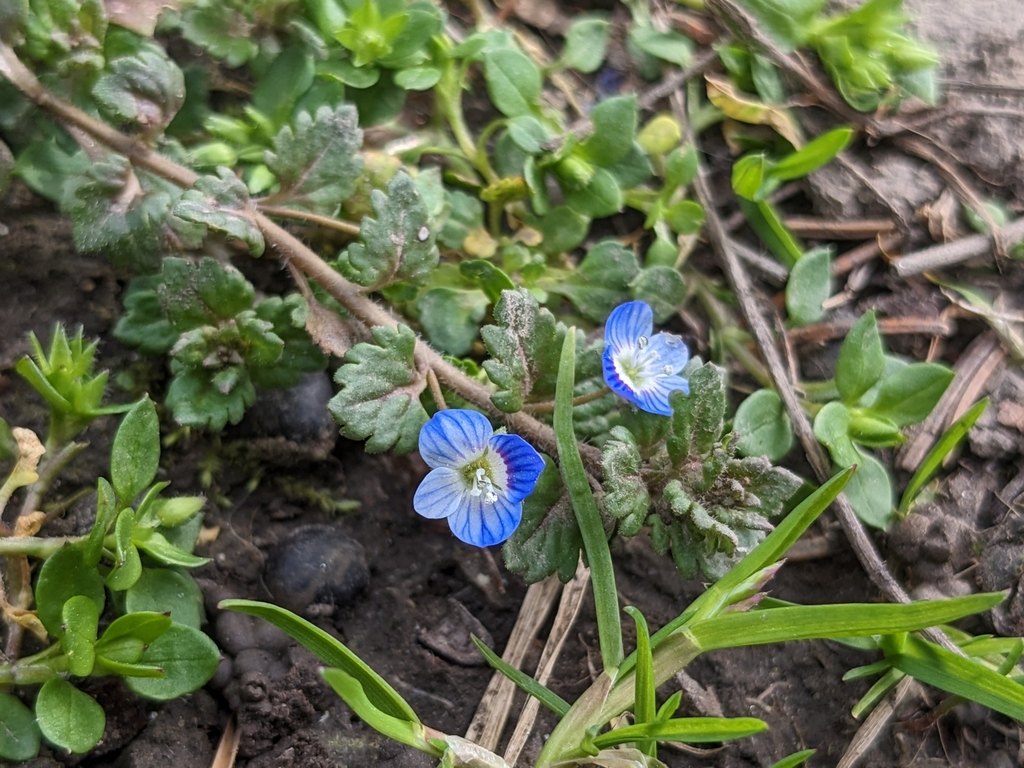
LATIN NAME: Veronica polita
COMMON NAME: Field Speedwell
Plant Profile
Grey field-speedwell is a sprawling annual with dull green, toothed leaves that are broadest at the base, and small bold-blue flowers 4 to 8 mm across, occasionally 12 mm, usually with the lowest part whitened. It was named by Elias Magnus Fries in 1819, which is late for such a common European plant, and the delay is a measure of how easily the speedwells were confused.
It is native to Europe, southwestern Asia, North Africa and the Arabian Peninsula, and it has been carried almost everywhere else as a weed of cultivation. In Turkey it grows on bare soil in open forest, steppe, cultivated land and roadsides from sea level to 1,800 m; in North America it turns up in fields, lawns, calcareous soils and ruderal ground below 600 m.
Two subspecies are accepted. Polita is the European and Mediterranean plant; lilacina is native to Japan, Korea and the western Himalayas. The distinction is largely geographic, and a plant in a garden in Manchester belongs to the first, while one on a path in Kyoto belongs to the second, and neither is a separate species in any useful sense.
Science & Biotechnology
The identification rests on the fruit, and it is worth learning because three speedwells grow together in most European gardens. Veronica polita has a capsule whose two lobes are parallel and whose surface carries both long and short hairs. V. agrestis has a fruit with long hairs only, fresher green leaves, and the lowermost leaves elongated.
Veronica persica, the commonest of the three, has flower stalks much longer than the leaves and fruit lobes that diverge in a V. That single character, visible at arm’s length, separates the garden weed from the field weeds, and it is more reliable than flower size.
The species is susceptible to downy mildew caused by Peronospora agrestis, an oomycete rather than a fungus. In a damp spring a patch can go grey and mouldy within a week, and the infection spreads fastest where plants are crowded. It ranks among the few diseases that reliably affects a plant most gardeners never notice.
Uses & Benefits
It has no ornamental value and no culinary use, and it is not sold. What it has is diagnostic value. Grey field-speedwell prefers cultivated, disturbed, usually calcareous ground, and a lawn or path where it appears is telling you that the soil is compacted, the turf is thin and the pH is above neutral.
In a garden it is easy to remove: it is an annual with a shallow root and it pulls cleanly. The mistake is to let it set seed, because a single plant produces a hundred capsules and the seed bank lasts for years. Hoe it in April and again in June and the population collapses.
For wildlife it is marginal. The flowers are visited by small bees and hoverflies when little else is open, which in a late cold spring is worth something, and the seed is eaten by a few ground-feeding birds. It is not a plant to encourage, but it is not one to declare war on either. The same family turns up again in Veronica spicata, Linaria bipartita and Angelonia.
Growing from Seed
It germinates when it likes, which is the whole difficulty. There is no dormancy to break and no treatment that improves the result: scatter seed on bare soil in spring or autumn and it will come up in two to three weeks at almost any temperature above 5 °C.
In a pot it is easy to raise, and useful if you want to study the fruit characters. Sow on the surface, cover lightly, keep damp, and grow on cool and bright. The plants are small enough that a 9 cm pot will hold three, and they will flower in eight weeks from sowing.
If you are growing it deliberately, isolate it. Veronica species hybridise and the seed strains in cultivation are muddled, so a plant raised from garden seed may be neither polita nor agrestis but something between them. Collect from wild plants if the identity matters, and record the soil and the associate species at the same time.
Our Take
It is a weed, and the honest way to write about it is as a weed with a use. Learn the three speedwells and you can read a garden’s soil history from the path: persica in rich disturbed ground, polita on thin calcareous soil, agrestis on cultivated land that has been worked for a long time.
Pull it, but look at it first. A plant that grows in a crack in a wall in February, flowers at 4 mm and sets a hundred seeds before the first mowing is doing something right, even if the something is only being better at being a weed than the grass is at being a lawn.
Related Reading
If Field Speedwell appeals to you, these related plants are worth a look: