


Veronica spicata Seeds | Spiked Speedwell
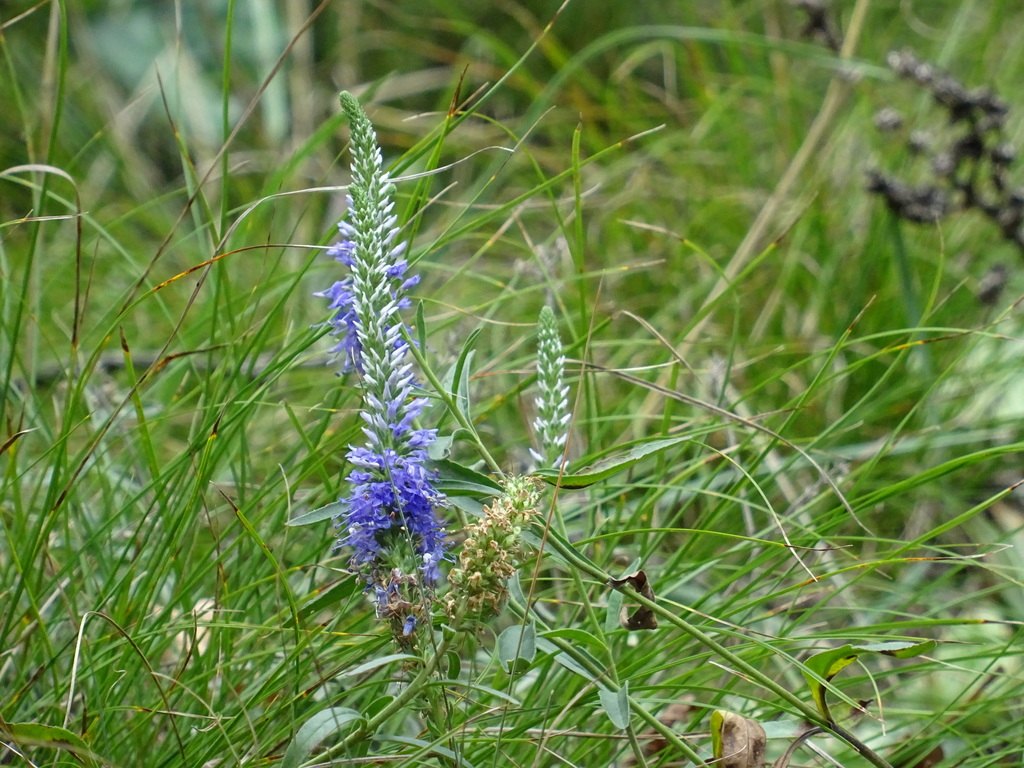
LATIN NAME: Veronica spicata
COMMON NAME: Spiked Speedwell
Plant Profile
Spiked speedwell is one of the few plants whose common name is also a field description. Veronica spicata carries a spike a foot long, packed with flowers that open from the bottom upward, so that a single stem is in bloom for six weeks and changes colour subtly across that time as the older flowers fade.
Plants run from thirty centimetres to nearly a metre, with opposite, toothed, narrowly oblong leaves that are hairy on both surfaces and darker than the flowers. The stems are stiff enough to stand without support in ordinary garden conditions, though a plant in rich soil will lean by the end of July.
Colour in the wild is a clear blue-violet, occasionally pink, and very rarely white. The garden selections have taken those three and pushed them: ‘Royal Candles’ for deep blue, ‘Red Fox’ for a pink that the catalogue calls red, and ‘Noah Williams’ for white. All three are worth growing and all three are the same species.
It is the county flower of Montgomeryshire in Wales, which is a modest distinction until you see a hillside of it in July. In Britain it became a protected species in 1975 under the Conservation of Wild Creatures and Wild Plants Act, a status that reflects a real decline on chalk and limestone grassland rather than any rarity in Europe as a whole. The same family turns up again in Veronica polita, Penstemon campanulatus and Linaria bipartita.
Science & Biotechnology
The flower has two stamens and no more, projecting from the tube like a pair of horns, and that reduction is the family’s signature. What look like four petals are four lobes of a single tube, and the lower one is usually narrower and marked with darker veins, which is where a bee aims.
The genus has been split and rejoined more than once. Russian and central European authors have placed this species in Pseudolysimachion on the basis of the spike, the capsule and the chromosome number, and the name still appears in floras. Molecular work does not support the split, and most authorities have returned it to Veronica.
Veronica itself is named for the saint, not for any feature of the plant, and no one has produced a better explanation in four centuries. The epithet spicata simply means spiked, which brings the binomial back to the field character where it started.
Uses & Benefits
Its garden use is the front of a border and the sunny dry bank, where the blue spires work against grey foliage and stone. It associates well with silver-leaved plants and with the late grasses that come up behind it, and it ranks among the most reliable blue flowers for a chalky soil.
Cut, the spikes last four or five days and continue to open in water, which makes them more useful than their reputation suggests. They are not a florist’s flower, but a bunch of spiked speedwell on a kitchen table in July is a better use of the plant than most people make of it.
There is a long medicinal history attached to the genus, mostly to the medicinal speedwell, and very little of it stands up to examination. Spiked speedwell itself has no current use in medicine, no food value and no toxicity of note, which in a garden plant is a recommendation rather than a gap.
Growing from Seed
Sow in late winter at eighteen to twenty degrees, on the surface of a loam-based compost, and cover very lightly because the seed needs light. Germination takes two to three weeks and is usually heavy; a packet that produces ten seedlings from a hundred seeds was probably stored warm.
Prick out into individual cells as soon as the first true leaves are clear, because the seedlings make a deep taproot quickly and resent being moved after that. Grow on cool and bright, and plant out in autumn rather than spring, so the crown is established before the first winter.
Space at thirty centimetres. Cut the spent spikes back to the basal rosette and a second, smaller flush follows in September, which is more than most perennials manage. Divide established clumps every third year in early spring; old plants go woody in the centre and flower on the outside only.
Our Take
Spiked speedwell is the sort of plant that gets taken for granted because it is easy. It comes through winter, it flowers in the worst of the summer drought, it divides without complaint, and it does all of this on ground where a delphinium would fail in the first season.
The blue is the reason to grow it, and the pink and white selections are pleasant rather than necessary. One clump of ‘Royal Candles’ at the edge of a path, seen from above every morning in July, is worth more than a border of things that need staking.
Related Reading
Gardeners who grow Spiked Speedwell often pair it with these related subjects: