


Penstemon digitalis Seeds | Foxglove Beardtongue
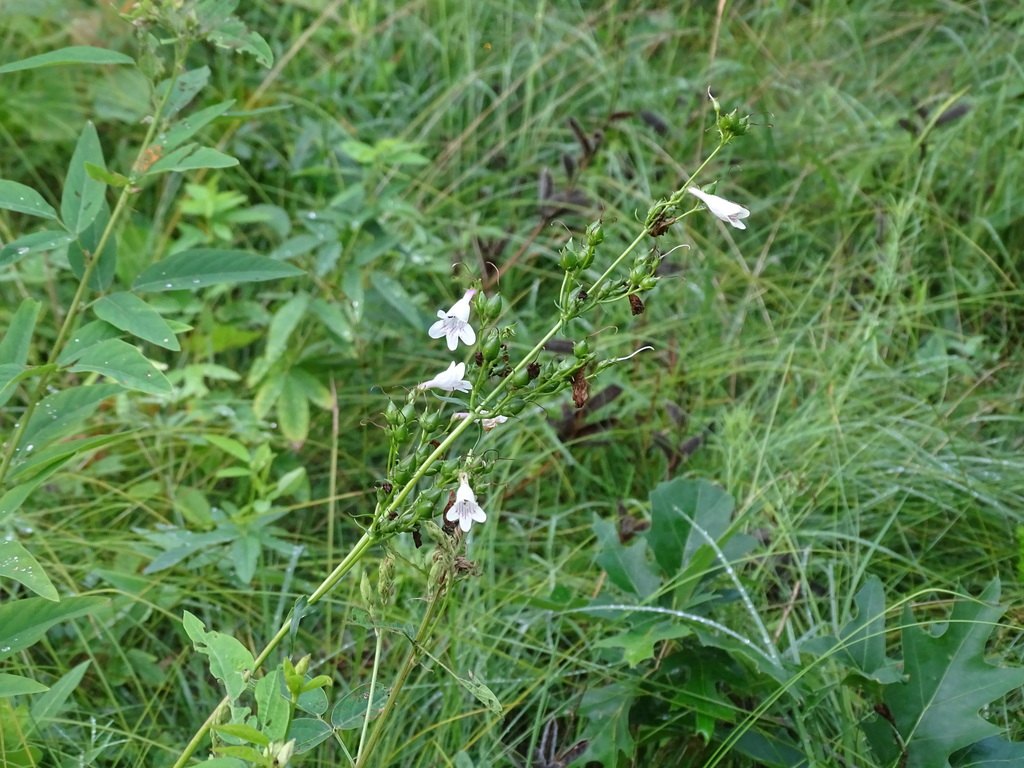
LATIN NAME: Penstemon digitalis
COMMON NAME: Foxglove Beardtongue
Plant Profile
Foxglove beardtongue is a clump-forming perennial of the central United States, 90 cm to 1.5 m in flower, with glossy opposite leaves and slender stems washed purple. It emerges as a flat basal rosette that sits through the winter, then sends up stems in April. The specific epithet refers to Digitalis, the foxglove, and the likeness is in the flower shape rather than the size.
The flowers are white, 3 cm long, two-lipped and tubular, borne in pairs along a panicle that takes up the top third of the plant. Look inside the mouth and there is a sterile fifth stamen, the staminode, bearded with fine hairs; that is the beardtongue, and every species in the genus has one. The tube is dusted with tiny white hairs on the outside.
Francis Pennell, who monographed the genus, held that it is native to the Mississippi basin and that its occurrences in Canada and the eastern states are introductions. If he was right, it has been spreading itself for two centuries, because it is now the most widespread Penstemon east of the Mississippi.
Science & Biotechnology
The genus Penstemon is the largest in North America, with about 270 species, and its genome sizes were until recently almost unknown. A flow cytometry survey covering 40 percent of the genus found that Penstemon digitalis has one of the largest genomes in it, which is useful for sorting out relationships and awkward for anyone trying to sequence it cheaply.
Pollination is done by bumblebees and by hummingbirds, and the bearded staminode appears to guide the bee’s tongue into the tube rather than to block it. The plant is a roadside subject in the Midwest for the plain reason that it is showy, cheap and indifferent to poor soil, and the American Penstemon Society recommends it from the Atlantic to the Pacific Northwest.
Pennell described a second species, Penstemon alluviorum, from riverbank ground in 1933; the name means of the alluvium. Flora of the Southeastern United States still recognises it, while the major nomenclatural databases sink it into P. digitalis. The plants in the field do not help, because the differences are matters of degree. Other Plantaginaceae on the list: Penstemon eatonii, Penstemon campanulatus and Veronica spicata.
Uses & Benefits
The cultivar Husker Red was selected at the University of Nebraska for foliage so dark it reads as maroon, with white flowers faintly flushed pink. The Perennial Plant Association made it Plant of the Year in 1996, and it has been planted in more parking-lot islands than any other penstemon since. The foliage colour is strongest in spring and fades in summer heat.
Grow it in a meadow, a gravel garden or the middle of a border, where the white flowers carry in low evening light. The seed capsules stay on the stems into winter and are worth leaving, which the Iowa Department of Transportation has been pointing out for years in its roadside plant literature.
It tolerates deer, drought and poor soil, and it ranks among the few white perennials that does not look dirty against green. Cut it back after the first flush and it will often throw a smaller second set of flowers in September, on shorter stems and with less of the purple.
Growing from Seed
Sow in late winter on the surface, because the seed needs light, and give it four to six weeks of cold before warmth. A cold frame or a spell in the refrigerator both work. Germination takes two to four weeks at 18 to 21 °C, and the seedlings are slow at first, making a rosette rather than a stem in their first year.
Plant out in spring into soil that drains, in full sun. Drainage is the whole thing: the crown rots in wet winter clay, and a plant that survives its first summer will die in its second February. Add grit under the crown if your soil holds water, and plant on a slight mound rather than in a hollow.
Space them 30 cm apart. The first flowering is usually the second summer, and it is worth the wait: a well-grown clump carries a hundred stems. Do not cut the old foliage in autumn; the rosette is what carries the plant through winter, and a hard tidy-up in November kills more of them than frost does.
Our Take
It is short-lived by perennial standards, three or four years on average, and it does not divide well. That would be a fault if it did not seed itself so reliably, and the seedlings are the plant. Let a few capsules ripen where you want them and pull the rest; a patch renews itself without any help.
The one disappointment is the red foliage. In a hot summer, or in shade, Husker Red is green with red edges by July, and the effect people buy it for is over by the solstice. Plant it for the flowers in June and treat the spring colour as a bonus, and it will not let you down.
Related Reading
Gardeners who grow Foxglove Beardtongue often pair it with these related subjects: