


Oxypetalum caeruleum Seeds | Tweedia
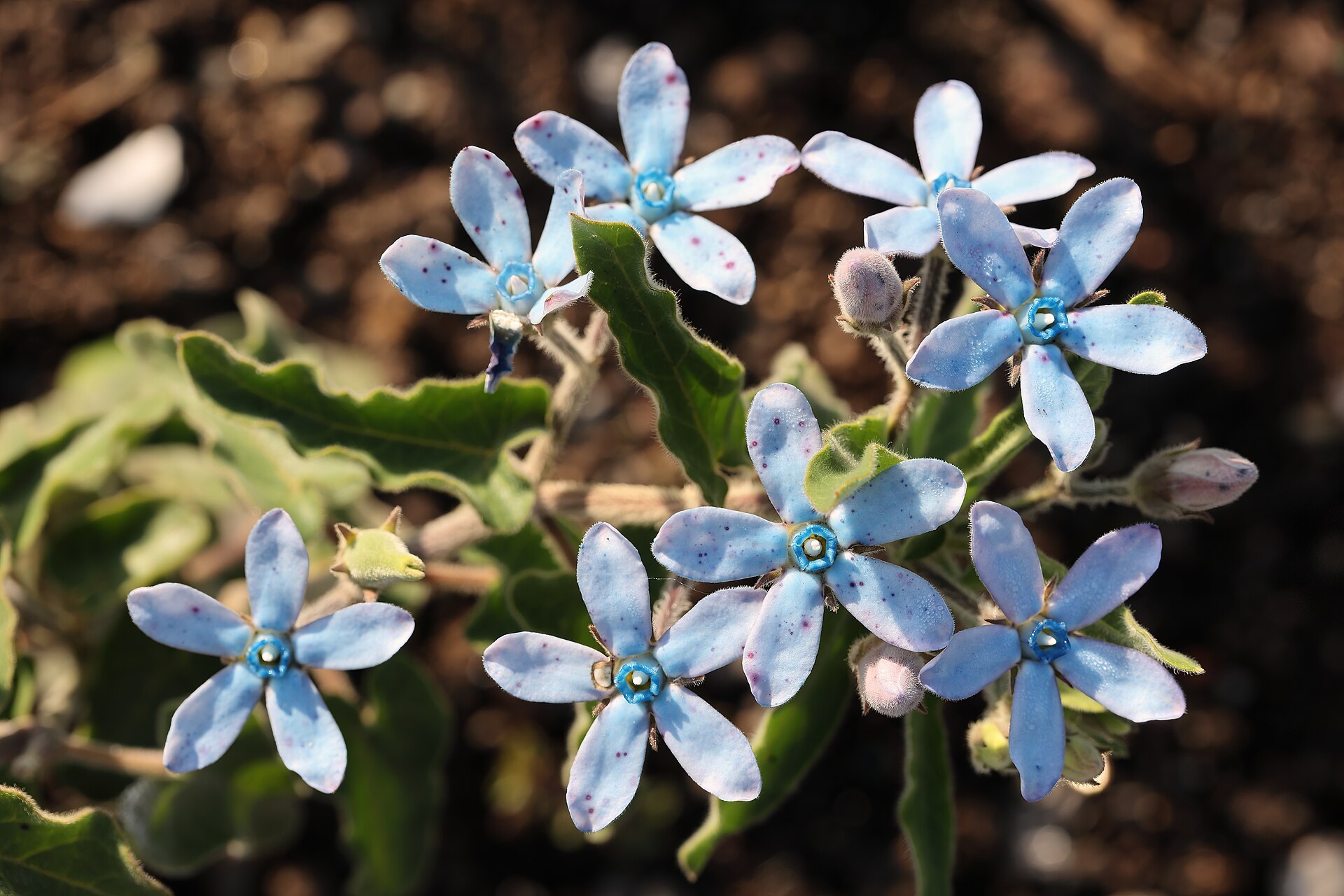
LATIN NAME: Oxypetalum caeruleum
COMMON NAME: Tweedia
Plant Profile
Oxypetalum caeruleum is a plant with two names and a spelling problem. It is sold as tweedia after the old genus Tweedia, and its specific epithet appears in both caeruleum and coeruleum in the literature, an orthographic variant that has never been settled to everyone’s satisfaction.
It is a straggling evergreen perennial reaching a metre or more, with heart-shaped, grey-green, downy leaves and star-shaped flowers of an unusually clear pale blue. The flowers age to purple, and a plant in full flight carries dozens at once.
Its native range runs from southern Brazil into Uruguay, in open ground that is warm, bright and well drained. In cultivation it is grown as a cut flower, a container climber, or an annual where frost arrives before the season ends.
Two colour forms are in the trade: Alba with white flowers, and Rosea with pink. Both are less vigorous than the type, and the blue form remains the reason anyone grows the plant at all. It is a true powder blue rather than a lavender or a violet, and it photographs badly, so the catalogues always undersell it.
Science & Biotechnology
True blue is rare in flowers, and this one is rarer than most. The colour comes from delphinidin-based anthocyanins held at a mildly alkaline pH in the vacuole, with copigments that shift the hue away from red. Remove the copigments and the same pigment reads purple. Gardeners who grow the plant for its colour rarely realise how narrow that chemical window is.
It belongs to the milkweed subfamily of Apocynaceae, and it shares the group’s signature: milky latex in every stem, and pollen gathered into waxy masses called pollinia rather than shed as loose grains. A visiting insect hooks a pollinium onto a leg and carries the whole packet to the next flower.
The fruit is a pair of boat-shaped follicles up to thirty centimetres long, filled with seed that carries a parachute of down. In its native range the pods dry and split, and the seed leaves on the wind, so the plant turns up in odd places where it has never been planted.
Uses & Benefits
For cut flower work the pale blue is close to indispensable, because so few flowers offer it. The stems are seared or dipped in boiling water to stop the latex bleeding, and the flowers last a week in the vase without any conditioning beyond that.
Records peak in October and November, with a secondary scattering in January and February, which reflects a southern-hemisphere spring flowering that translates into autumn colour when the plant is grown in the north as an annual. A plant that flowers in its own spring and again in an alien autumn is behaving exactly as a short-day species should.
It holds an Award of Garden Merit, and its garden use is narrow but secure: a warm wall, a tall container, or a tripod in a sheltered corner. It will climb if given something to grip, and it will sprawl over a support if it is not, which is acceptable in a pot and messy in a border. It shares the family with Gomphocarpus physocarpus, Asclepias tuberosa and Asclepias verticillata.
Growing from Seed
Sow fresh seed at eighteen to twenty degrees, on the surface of a gritty mix, and cover it lightly. Germination takes two to three weeks. The seed is short-lived, and old packets germinate badly, so buy from a supplier who turns stock over. Sow more than you need, because even a good packet carries a proportion of empty seed.
The seedlings make a deep taproot quickly, so use deep cells and move them early. Disturbing the root later sets a plant back by a month, which in a short season means no flowers at all. Grow them on in full light and keep them on the dry side.
Plant out after the last frost in a warm, sunny, sheltered position with sharp drainage. Pinch the leading shoot once to encourage branching, provide a support early rather than late, and water sparingly once established. In cold gardens, take cuttings in late summer or treat it as an annual.
Our Take
Tweedia is worth growing for one reason: the colour. There is no other hardy-ish climber in the catalogue that produces that particular powder blue, and a single flower brought indoors is enough to justify a plant. Nothing else in the catalogue comes near that colour, and nothing else is quite so ordinary in every other respect.
The rest of it is ordinary. It is fussy about roots, tender in frost, and it needs support before it needs anything else. Treat it as an annual, sow it fresh each spring, and you will never be disappointed by a plant that was only ever meant to give one season.
Related Reading
If Tweedia appeals to you, these related plants are worth a look: