


Asclepias verticillata Seeds | Whorled Milkweed
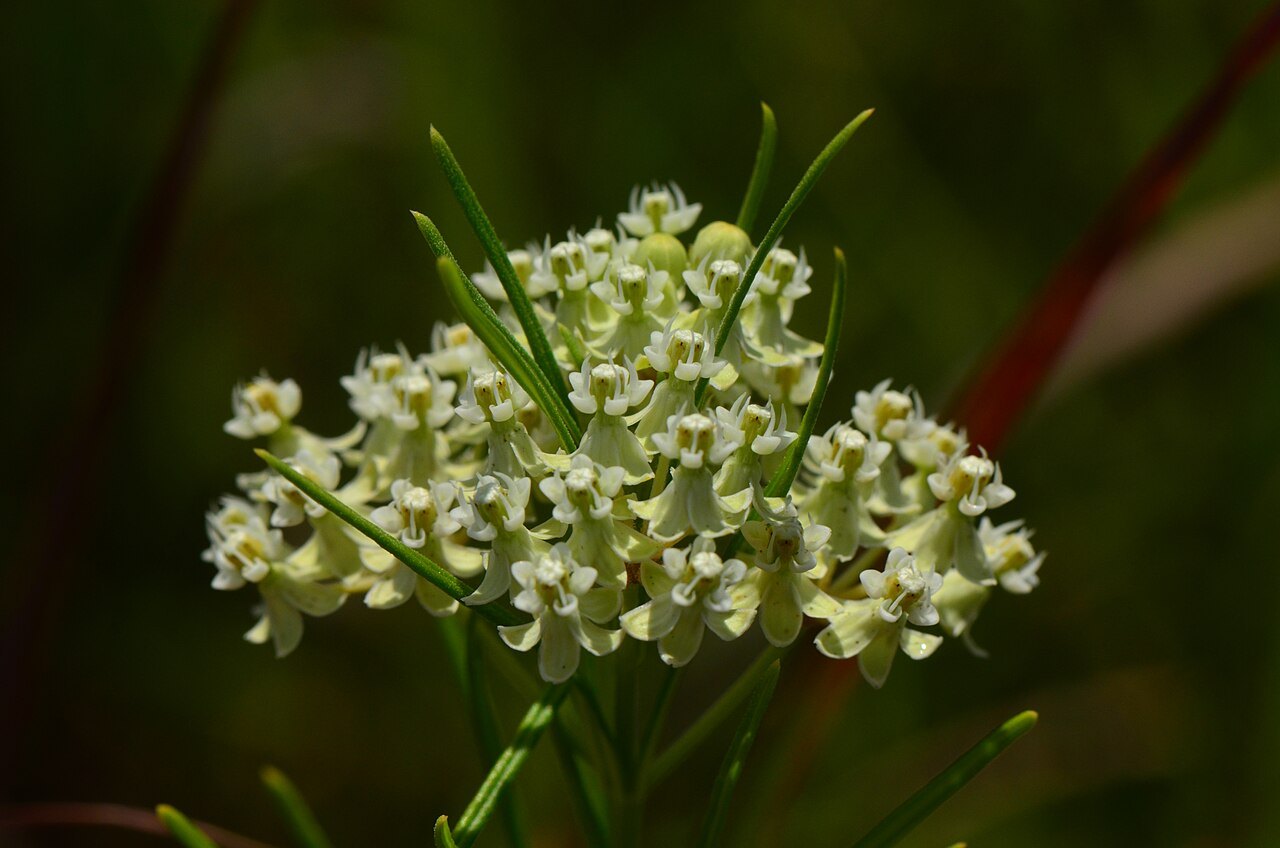
LATIN NAME: Asclepias verticillata
COMMON NAME: Whorled Milkweed
Plant Profile
Whorled milkweed, horsetail milkweed, eastern whorled milkweed: the names describe the foliage, which is the least milkweed-like of any Asclepias in the east. The leaves are very narrow and linear, arranged in whorls of four to six at short intervals up a single stem, so the plant reads as a green bottlebrush rather than a broad-leaved perennial.
It is native across most of eastern North America and into the Canadian prairies, from Manitoba and Ontario south to Texas and east to Florida, with scattered records west to Arizona and Montana. It grows in sandy soil in loblolly pine plantations, upland pine-hardwood communities and glades, and along roadsides where the ground is thin.
The stem is single, 15 cm to 90 cm tall depending on the site, and the inflorescence is an umbel of seven to twenty greenish-white flowers, fragrant and produced from June to September with a peak in August. The epithet verticillata refers to the whorled leaves and nothing else.
Science & Biotechnology
The plant can reproduce vegetatively and does not depend on pollinators to persist, which is unusual for a milkweed and explains how it survives in places where insect activity is low. It still produces nectar, mostly in the early evening, and the visitors are wasps, honeybees and moths, including the cabbage white.
Like other milkweeds it is a host for the monarch, whose caterpillars feed on the leaves and sequester the cardenolides that make both plant and butterfly unpalatable. The concentration in this species is high, and it is the reason the plant is dangerous to livestock: horses and cattle that eat it in hay show neurological signs, and it ranks among the species that farmers are told to learn.
Fire is the third part of its biology. It grows in habitats that burned regularly, it persists through burns, and it increases in frequency under repeated prescribed fire. The tuberous root survives the heat and the plant resprouts into ground that has been cleared of competitors, which is a strategy it shares with a great many prairie species.
Uses & Benefits
Its garden use is late summer and drought. The narrow leaves give it a texture that no other milkweed has, the flowers are subtle rather than showy, and the plant stands in sand where little else will. In a gravel garden or a prairie strip it looks deliberate; in a rich border it looks like a weed that got in.
The medicinal record belongs to other people. The Choctaw used it against snakebite, the Lakota and Hopi used it to increase milk in nursing mothers, and the Navajo used it for nose and throat complaints. Those uses are recorded, not recommended, and the plant is toxic enough that the distinction is not academic.
For pollinators it is a modest plant with a specialist’s value. The nectar is produced in the evening, which suits moths more than butterflies, and the flowers are small enough that only short-tongued insects can work them easily. A patch in August is a night shift rather than a day shift. The rest of the Apocynaceae here runs to Asclepias incarnata, Tabernaemontana alternifolia and Cynanchum paniculatum.
Growing from Seed
Milkweed seed needs cold and it needs patience. Mix it with damp sand and hold it at 4 °C for four to six weeks, or sow in autumn and leave the tray outside. Sow 5 mm deep at 20 to 24 °C after the cold period, and expect germination in two to four weeks, unevenly.
The seedlings are slow and should be grown on in deep pots, because the root goes down before the shoot goes up. A plant that is pot-bound at 10 cm will flower in its second year; one that is planted out too small may not appear above ground until June and will look like a failure.
Plant out into sand or very well-drained soil in full sun, 30 cm apart, and water only in the first season. Do not add compost: rich ground produces soft stems that flop and fewer flowers. Once established, the plant spreads by rhizome and by seed, and it will move around the garden to wherever the soil suits it.
Our Take
It is a plant for a specific place and that place is poor sand. Given that, it ranks among the most interesting milkweeds to grow, because it does not look like one, and because the evening nectar brings in moths that a border of day-flowering plants never sees.
Keep it away from hay ground and from anything that grazes. The toxicity is real, the plant is palatable when dried in hay, and there is no upside to having it in a field. In a garden with a fence and no livestock, the risk is manageable and the plant is worth it.
Related Reading
Continue exploring with these related plants: