


Asclepias curassavica Seeds | Bloodflower
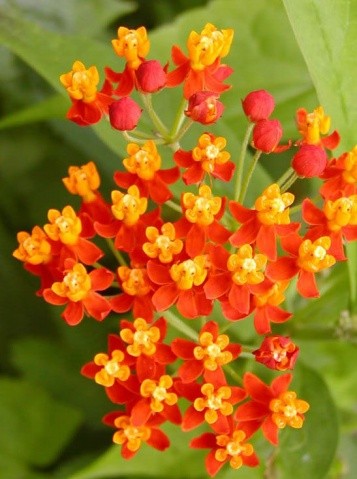
LATIN NAME: Asclepias curassavica
COMMON NAME: Bloodflower, Tropical Milkweed
Plant Profile
Bloodflower is a tropical milkweed, grown as an annual in cold gardens and as a weedy evergreen shrub in warm ones. Plants reach 60-100 cm, with narrow lance-shaped leaves and flat umbels of orange and red flowers that look almost lacquered. The contrast between the orange corona and the red reflexed petals is stronger than in any other commonly grown milkweed.
Flowering begins within three months of sowing and continues until cold, followed by spindle-shaped pods that split to release seeds with a coma of white silk. The plant is short-lived even where it is hardy, and a population in a warm garden renews itself from self-sown seed rather than from the original plants.
It is native to tropical South America and the Caribbean and has naturalised across the tropics, including parts of the southern United States, where it is now the subject of a conservation argument rather than a gardening one.
Science & Biotechnology
Milkweeds defend themselves with cardenolides, a class of steroids that inhibit the sodium-potassium pump and are toxic to most vertebrate herbivores. Asclepias curassavica carries a particularly strong cocktail, including calotropin and asclepiadin, and monarch butterflies sequester these compounds from the leaves, becoming unpalatable to birds in the process.
The sequestration is the reason tropical milkweed is both valuable and controversial. In warm climates it keeps leaves through winter, which encourages monarchs to break diapause and breed instead of migrating, and it can carry the protozoan parasite Ophryocystis elektroscirrha at higher rates than native milkweeds. The usual advice in Florida and California is to cut plants to the ground in autumn to interrupt the cycle.
Latex is the other defence. Every broken leaf bleeds white sap that gums up the mouthparts of small insects; the monarch caterpillar has learned to cut the leaf vein before feeding, draining the latex away from its meal.
Uses & Benefits
In a cold garden it is simply a fast, bright annual that flowers in its first summer and feeds butterflies. Grow it in a pot on a sunny terrace, where the scent and the constant movement of insects can be enjoyed at close range. In warm gardens it makes a loose, self-sowing colony at the back of a border, and it is one of the few plants that will flower through a hot dry August.
Cut stems last a week in water but bleed latex, so sear the ends before arranging. The plant is toxic to livestock and to pets that chew it, and the sap can irritate skin. Commercial seed is sold mainly to butterfly gardeners, and demand in North America is driven almost entirely by monarch conservation interest.
Growing from Seed
Sow at 20-25°C, pressing the seed into the surface, since light helps. Germination is fast, often seven to fourteen days on fresh seed; a few weeks of cold stratification improves the result with older seed. The seedlings have a taproot and resent disturbance, so sow in individual cells rather than a communal tray.
Plant out after the last frost in full sun, at 30-40 cm apart, in any well-drained soil. Water through the first month and then only in drought; rich feeding produces leaf at the expense of flower. In cold gardens, save seed from the earliest pods, since later ones may not ripen. In warm ones, cut the plants back in late autumn to reduce disease carry-over and encourage the migratory generation to move on.
Our Take
A brilliant annual for a hot summer and a real nectar stop for butterflies, best grown in a pot where its toxicity and its vigour are both contained.
Related Reading
Gardeners who grow Bloodflower often pair it with these related subjects: