


Nigella hispanica Seeds | Spanish Love-in-a-Mist
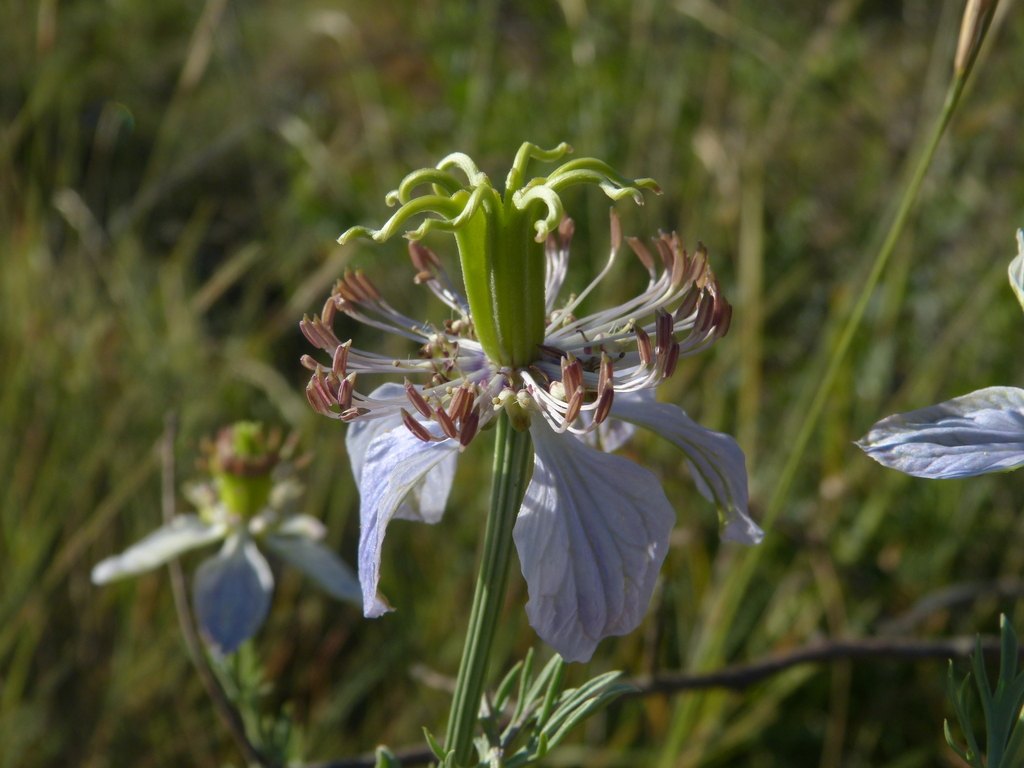
LATIN NAME: Nigella hispanica
COMMON NAME: Spanish Love-in-a-Mist
Plant Profile
Nigella hispanica comes from Spain, Portugal and North Africa, where it grows on dry hillsides and in cultivated ground. It is an annual 40 to 60 cm tall, with finely divided, feathery leaves and flowers that are larger and more open than those of the common love-in-a-mist, N. damascena.
The flowers are 4 to 5 cm across, with five broad petals in deep violet-blue or white and a centre of dark burgundy stamens, and they open wide rather than sitting inside a ruff of bracts. That openness is the quickest way to tell this species from N. damascena, whose flowers are half hidden in thread. The pods that follow are large, green and topped with spreading horns.
The species is less well known than N. damascena, which is the plant usually sold as love-in-a-mist, but it is larger, more colourful and longer-flowering. It is also more heat-tolerant, which makes it a better choice for a warm climate, and it ranks among the best annuals for a dry, sunny border.
The seed pods are large, green and striped with red, and they are used in dried arrangements as well as in the garden. They last for months if they are cut before they split, and they are one of the few seed heads that are as attractive as the flower.
Science & Biotechnology
Nigella is a genus of about 15 species in the Ranunculaceae, and it ranks among the few members of the family that is annual rather than perennial. The genus is characterised by finely divided leaves and by the inflated capsule, which is the source of the common name. Five species turn up in Britain, and only one of them is the familiar damascena.
The dark centre of the flower is a mass of stamens, and the petals are modified sepals. That is why the flower looks different from a buttercup, which has true petals, and why the genus was once placed in a separate family. The base chromosome number is x = 6 and this species has 12, with ten pairs of 45S rDNA sites, the most in the genus. Bees and flies do the pollination, and the plant is self-compatible, so it self-sows so reliably.
The blue-purple colour is produced by delphinidin anthocyanins, and it is one of the most intense blues in the Ranunculaceae. The pigment is stable in heat, so the flowers hold their colour in sun better than those of a delphinium.
Uses & Benefits
It is used at the front or middle of a border, in a cutting garden and in a meadow mix, where its feathery foliage and its large flowers are shown to best advantage. It is also a good cut flower, and the seed pods are useful in fresh and dried arrangements.
The flowers are visited by bees and by hoverflies, and the plant is a good source of early-summer nectar. It is not edible, and the seed is toxic if eaten in quantity, though it is used as a spice in some cuisines in small amounts.
The seed of related species is used as a spice, under the name black cumin or kalonji, and it has a peppery, slightly bitter flavour. The ornamental species is not grown for that purpose, and the seed should not be eaten without knowing which species it came from.
In a garden the plant is grown for ornament, and its value is in its colour and its seed heads. It ranks among the few annuals that looks good after it has finished flowering, which is more than can be said for most bedding plants. Near kin on the list are Nigella damascena, Nigella sativa and Nigella orientalis, all Ranunculaceae.
Growing from Seed
Sow direct in early spring or autumn at 15 to 18 °C, covering the seed lightly. The seed germinates in under three weeks at summer temperatures. The seed is big enough to sow by hand, and the seedlings are quick to follow.
Thin the seedlings to 20 cm, or set plants out at that spacing. The plant tolerates poor, dry soil and needs no feeding. It flowers ten to twelve weeks from sowing and continues for two months. Water the first season and then only when the ground cracks. Leave off the feed, because rich soil means soft growth and fewer flowers. For dried arrangements, cut the seed pods when they are fully formed but before they split, and hang them upside down in a dark, airy room.
Let a few pods set seed if you want the plant to return, and shake the seed where you want it in autumn. Where winters are mild it seeds itself about; where they are not, you sow it again each spring.
Our Take
Spanish love-in-a-mist is a better plant than the common nigella, and it deserves to be more widely grown. It is larger, more colourful, more heat-tolerant, and its seed pods are superb in dried arrangements. Sow it in a sunny border, let it self-sow, and cut the pods for the house. It ranks among the easiest and most rewarding annuals you can grow.
Related Reading
Continue exploring with these related plants: