


Nigella orientalis Seeds | Yellow Fennel Flower
LATIN NAME: Nigella orientalis
COMMON NAME: Yellow Fennel Flower
Plant Profile
Yellow fennel flower is the odd one in a genus of blues. Nigella orientalis is an annual of fifty centimetres to a metre from southeastern Europe and western Asia, with the fine, fennel-like foliage that gives the genus its common name and flowers of a clear, unclouded yellow that no other Nigella offers. The blooms are smaller than those of love-in-a-mist and stand well clear of the foliage on stiff stalks.
The plant is upright and airy, branching near the top into wiry stems that carry the flowers on long stalks above the foliage. The flowers are surrounded by a ruff of thread-like leaves, as in its blue relatives, but the effect is lighter and less misty, more like a star than a nest.
The native range runs from Bulgaria and Greece through European Turkey, the Aegean islands and the Anatolian interior to the Caucasus, Lebanon and northern Iran. It grows in cornfields and on dry calcareous hills, and it reaches the northern edge of its range as a casual of disturbed ground.
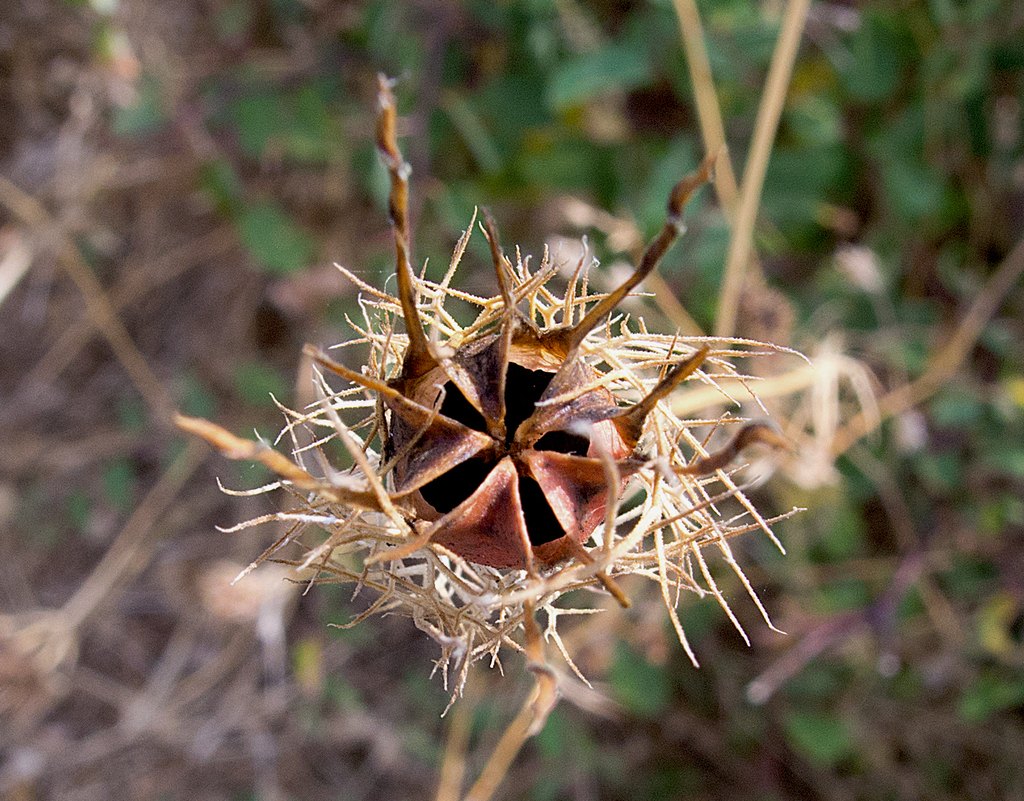
One selection, ‘Transformer’, has been picked out by the seed trade for its particularly dramatic seed pods, and it is a sign of where the plant’s real value lies: the flower is pretty, the fruit is the reason to grow it.
Science & Biotechnology
The genus is botanically odd in one specific way. What appear to be petals are sepals, coloured and petal-like, while the true petals are reduced to small two-lipped structures at the base of the stamens that function as nectaries. The yellow of this species sits in those petaloid sepals, not in a corolla.
The fruit is an inflated follicle with the carpels fused into a single bladder that ends in a long, joined beak, and it is this structure, dried and papery, that makes the genus a staple of the dried-flower trade. In this species the pods are upright and comparatively large, with a sculptural presence the blue Nigellas do not match.
Observation records are sparse, a few dozen in total with a peak in May, which reflects a plant of rural Anatolia and the Balkan cornfields rather than one of gardens. In Britain it is a rare casual, appearing from grain imports and gone again within a season. Its Ranunculaceae company here includes Nigella damascena, Nigella hispanica and Trollius chinensis.
Uses & Benefits
The seed is edible in small quantities and has been used as a spice like its relative black cumin, though the flavour is weaker and the use is local rather than established. The foliage is not used, and the plant is not recorded as toxic, though the family contains enough dangerous members to counsel restraint.
In the garden it is a late-summer plant: sown in spring it flowers in July and August, after the blue Nigellas have finished, and the dry seed pods carry the display into September and beyond. In a cutting patch it is twice as valuable, once in flower and once dried.
The dried pods are used whole in arrangements and sprayed for winter work, and they hold their shape indefinitely. The pods of this species are larger and more angular than those of love-in-a-mist, and they are the reason ‘Transformer’ was named and sold at all.
Growing from Seed
Sow in mid-spring where the plants are to flower, or in autumn in mild climates for earlier bloom. The seed is large for an annual and needs only a light covering; germination runs one to three weeks in cool soil, and the seedlings are upright from the start with the ferny foliage already recognisable.
Thin to twenty centimetres. The plant is tap-rooted and dislikes transplanting, so a direct sowing gives stronger plants than any amount of pricking out. It wants full sun and lean, well-drained soil; rich ground produces height without flowers and a plant that flops by August.
Water until established and rarely afterwards. Cut the stems for drying when the pods have swollen but are still green, strip the leaves, and hang them upside down in a dark place; left on the plant the pods ripen, split and scatter seed that will renew the patch in spring.
Our Take
Yellow fennel flower is the Nigella for people who have grown love-in-a-mist and want the second act rather than the first. The flowers are pleasant and brief; the pods are strange, sculptural and permanent, and they are worth a row in any cutting garden.
It is also the easiest plant in its genus, asking for sun, poor soil and nothing else. Sow it directly, thin it once, and cut the pods before they split; the yellow flowers you will remember for a fortnight and the seed heads you will keep for years.
Related Reading
Readers interested in Yellow Fennel Flower frequently explore these as well: