


Trollius chinensis Seeds | Chinese Globeflower
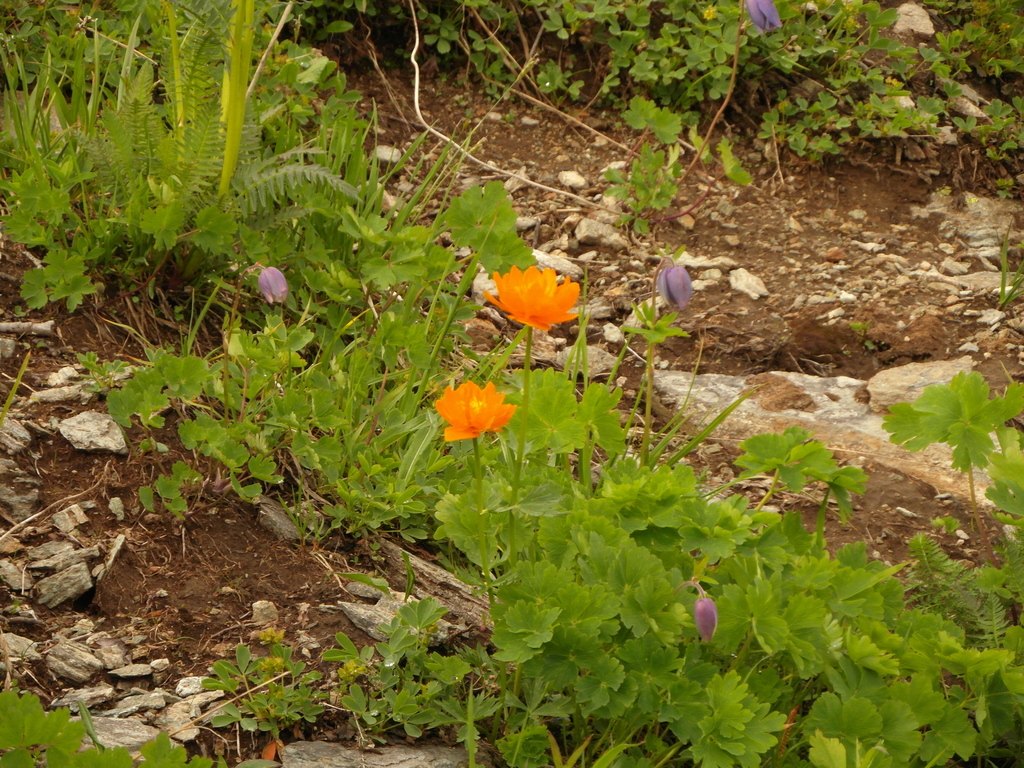
LATIN NAME: Trollius chinensis
COMMON NAME: Chinese Globeflower
Plant Profile
The Chinese globeflower is a buttercup that never quite opens. Trollius chinensis, a clumping perennial of forty to eighty centimetres from northern Asia, carries stems of round, ball-like orange flowers in early summer above deeply cut, palmate leaves, each bloom a closed sphere of overlapping sepals with a hidden centre.
What reads as petals are actually sepals, five to ten of them, cupped so tightly they enclose the true flowers: small, petal-like structures each shaped into a tiny nectar flask. The bloom never spreads flat, and its colour runs from egg-yolk yellow through deep orange, with darker orange forms common in the wild populations of northern China.
The species was described by Alexander von Bunge, the German botanist who collected around Beijing in the early 1830s. Its range runs from northern China’s Hebei, Shanxi and Inner Mongolia through Mongolia and the Russian Far East to Korea, on mountain meadows, stream edges and damp grassland slopes that are snow-covered for a third of the year.
Field records peak in June and July, matching the short northern summer. In Chinese medicine the dried flower has long been traded as a cooling remedy, and in parts of Hebei and Inner Mongolia whole meadows were cut for it, a harvest pressure that shows in the species’ patchy distribution today.
Science & Biotechnology
The closed flower is the genus’s defining invention. Sealed sepals keep nectar and pollen dry and unspoiled in wet mountain weather, and the flower is serviced by flies and small bees strong enough to force a way in. Work on the European globeflower showed the extreme version of this system: a fly genus that breeds inside the flower heads, pollinating and feeding on seed at once, and the Chinese species runs a looser version of the same arrangement.
Like most of its family it is chemically defended. The foliage carries bitter glycosides and related compounds that deter grazing, and all parts should be treated as mildly toxic raw; the medicinal use is a processed, dosed preparation, not a garden nibble. The flower’s show is pure advertisement, funded by a nectar supply that visitors pay for with pollination service.
The seed is doubly slow. Like its relative Adonis, the embryo needs a warm moist spell to mature and then a cold spell to sprout, so dry-stored seed germinates across two winters if at all. Fresh seed sown at once, or an artificial warm-then-cold sequence, is the standard route, and even then rates are uneven. Three other Ranunculaceae are catalogued alongside it: Nigella sativa, Consolida regalis and Nigella orientalis.
Uses & Benefits
In the garden it is a waterside and damp-border plant of the first rank. Clumps widen slowly and flower more heavily each year, and the orange reads strongest against dark greens and still water. It is hardy far beyond most garden perennials, taking winters well below minus twenty without protection.
The flower trade has used it as a parent. Crossing with the European globeflower produced the taller, paler hybrid strains sold as garden plants, and pure Trollius chinensis remains available as seed for growers who want the deep, saturated orange the hybrids never quite match. Stems last reasonably well in water for such a soft plant.
Its limitations are the mirror of its strengths: it needs damp, dislikes drying out, sulks in heat, and takes two to three years from seed to first flower. In return it asks for almost nothing else, and its toxicity means deer and rabbits leave established clumps alone through the season.
Growing from Seed
Sow fresh seed in summer in a shaded cold frame, or give stored seed one warm month at twenty degrees followed by three cold months before sowing in spring. Keep the tray consistently moist; drying out at any stage resets the process. Mark the pot clearly, as nothing appears the first year.
Seedlings grow slowly the first season and flower in the second or third. Plant out into humus-rich soil that holds moisture, thirty to forty centimetres apart, in sun or light shade. Mulch in dry regions. Division of established clumps in early spring is the fast route, taking sections with a bud and roots intact.
For seed, leave the heads until the follicles begin to split at the top and shake ripe seed into a bag on a dry day. It is small, shiny and short-lived in storage, best sown within a year. Clumps in damp ground usually self-sow modestly where soil stays bare and moist.
Our Take
Our take: the globeflower is the answer to a specific problem, a cold, damp corner where the usual oranges cannot be grown. Its flower colour is the hottest thing in the hardy perennial palette, and nothing about it is difficult once the sowing patience is paid.
The honest framing: this is a plant of the second and third year. First-year growers see a leaf and little more, and many give up exactly there. Sow a pot, forget it, and let the cold frame do the work; the clump that emerges is a decades-long asset.
Related Reading
Gardeners who grow Chinese Globeflower often pair it with these related subjects: