


Ranunculus asiaticus Seeds | Persian Buttercup
LATIN NAME: Ranunculus asiaticus
COMMON NAME: Persian Buttercup
Plant Profile
Ranunculus asiaticus is a tuberous perennial of the buttercup family, native to the eastern Mediterranean, southwestern Asia and northeastern Africa, including Crete, Karpathos, Rhodes, Israel, Iraq and Cyprus. It grows in rocky ground and open scrub, in a climate with wet winters and bone-dry summers, and that cycle is the key to growing it.
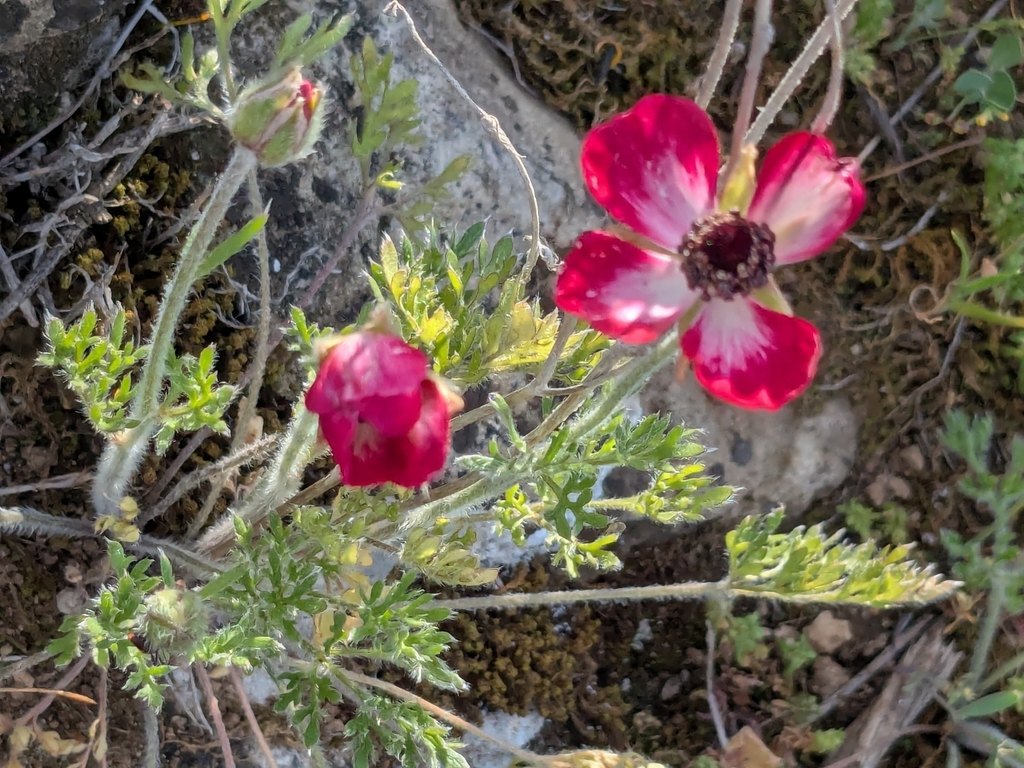
The plant grows from a cluster of claw-like tubers, each with a small growing point at the tip, and makes a rosette of deeply divided, hairy leaves 20 to 30 cm long. The flowers are 5 to 10 cm across, with many layers of thin, papery petals in white, yellow, orange, red, pink and purple, and they are borne on stems 30 to 45 cm tall in late spring.
The florist’s ranunculus sold in buckets in spring is derived from this species, selected over two centuries for larger flowers, longer stems and a wider colour range. The wild plant is smaller and looser, with five petals rather than the fifty of a modern cultivar, but it has the same papery texture and the same brilliant colour.
Science & Biotechnology
Ranunculus is a genus of about 600 species, and it ranks among the largest in the Ranunculaceae. The genus is known for its diversity of chromosome number, with counts from 2n = 14 to 2n = 64, and for its ability to hybridise, which has produced a confusing array of forms in the Mediterranean basin.
The tuber is a swollen root that stores water and carbohydrates through the dry summer, and the plant’s whole cycle is built around it: growth in winter, flowering in spring, dormancy in summer. That cycle is why the plant rots in wet summer soil: it expects to be dry when it is dormant.
The double-flowered forms are the result of a mutation that converts stamens into petals, and the degree of doubling is under simple genetic control. Modern breeding has produced series with uniform flowering time and stem length, which is what the cut flower trade requires, at the cost of the looseness that makes the wild plant charming. Alongside it in Ranunculaceae: Aquilegia flabellata, Delphinium grandiflorum and Nigella hispanica.
Uses & Benefits
It is grown for cutting, and it ranks among the best cut flowers in the spring trade: the stems are long and straight, the flowers last a week or more in water, and the colours are intense. It is also grown in containers and at the front of a border, where its early flowers fill the gap between bulbs and summer perennials.
In a mild climate it can be grown outdoors, planted in autumn and flowering in spring; in a cold one it is grown under glass or lifted and stored dry over winter. In the southern United States and in the Mediterranean it is a winter crop, flowering from February to May, and it ranks among the few cut flowers that can be produced outdoors in that season.
The plant is poisonous to livestock, and the sap can irritate skin. It is not edible, and the tubers are sometimes confused with those of other buttercups, which are also toxic. Handle them with gloves if you have sensitive skin.
Growing from Seed
Sow in autumn at 15 to 18 °C, on the surface and only just covered, since the seed needs light. Germination takes 21 to 30 days and can be uneven. Seed-grown plants flower in their second year, so most growers use tubers instead.
Soak the tubers for two hours before planting, then set them with the claws pointing down, 5 cm deep and 20 cm apart, in well-drained soil. Water sparingly until growth appears, then regularly; a wet crown is the commonest cause of failure, so plant on a slight mound and water around the plant, not over it.
Grow on at 15 to 18 °C in full sun. After flowering, let the foliage die down and lift the tubers, or leave them in the ground in a mild climate and keep them dry through summer. Store lifted tubers in dry sand in a cool, dark place until autumn.
Our Take
Ranunculus is the best cut flower of early spring and one of the most beautiful plants in the garden, but it is not a plant for a wet climate or a careless hand. It wants cool air, sharp drainage and a dry summer dormancy, and it will rot if it gets any of those wrong.
Grow it in a raised bed or a container, plant the tubers in autumn, and keep the water off the crown. The reward is a bucket of papery flowers in April that cost less than a bunch from the shop.
Related Reading
Gardeners who grow Persian Buttercup often pair it with these related subjects: