


Delphinium grandiflorum Seeds | Siberian Larkspur
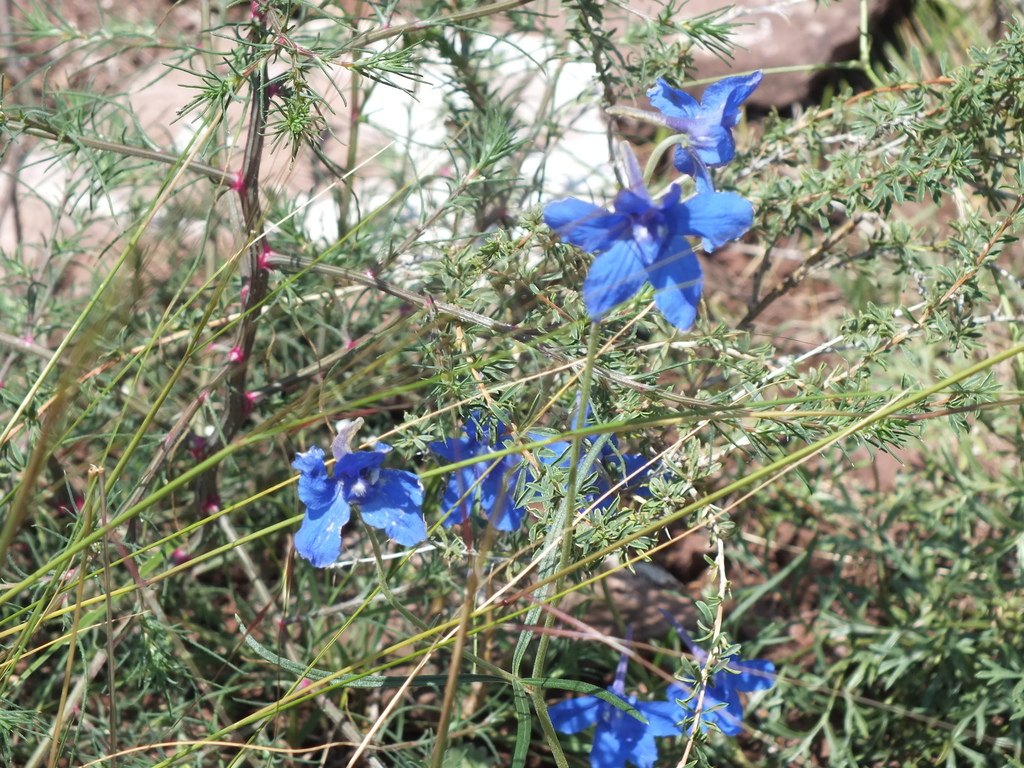
LATIN NAME: Delphinium grandiflorum
COMMON NAME: Siberian Larkspur
Plant Profile
Delphinium grandiflorum comes from Siberia, Mongolia and northern China, where it grows in steppe, on rocky slopes and along forest edges. It is a short-lived perennial 40 to 60 cm tall, with finely divided leaves and loose sprays of vivid blue flowers, each with a long spur behind it.
The flowers are 3 to 4 cm across and are carried on wiry stems that move in the wind, which gives the plant a lightness that the tall garden delphiniums lack. The colour runs from deep cobalt to pale sky blue, with a white eye in some forms, and it ranks among the purest blues in a hardy plant.
The cultivar Blue Butterfly is a compact form 30 cm high, and it is the one most often sold, since it does not need staking and it fits at the front of a border. Other selections include a white and a paler blue, but the deep blue is the one that earns its place, because it is a colour that is hard to find in a small perennial.
The species is shorter-lived than the tall hybrid delphiniums, and it is best treated as a plant that is replaced by its own seedlings every few years. That is how it behaves in the wild, where it colonises disturbed ground and disappears as the vegetation closes over it.
Science & Biotechnology
Delphinium is a genus of about 300 species in the Ranunculaceae, and it is closely related to Aconitum, the monkshoods, which share its toxicity and its spurred flowers. The genus is centred on the mountains of central Asia, with a secondary centre in western North America.
The blue colour is produced by delphinidin anthocyanins, and it ranks among the few true blues in the plant kingdom. The pigment is stabilized by copigmentation with flavones, so the colour holds in heat and does not fade to mauve as quickly as the blue of a hydrangea.
The spur is a nectar-holding structure formed by the upper sepal, and its length is matched to the tongue length of the local pollinators. In D. grandiflorum the spur is short enough for bumblebees, while in some Himalayan species it is long enough to exclude all but a single species of bee or moth.
The genus has a base chromosome number of x = 8, and the garden delphiniums are complex hybrids of several species, bred for height, flower size and colour. D. grandiflorum is one of the parents of the Belladonna group, which combines its blue colour with the taller habit of D. elatum. Three more Ranunculaceae sit in the same catalogue: Delphinium yellow, Delphinium cultorum and Nigella hispanica.
Uses & Benefits
It is used at the front or middle of a border, in a gravel garden and in a wild garden, where its wiry stems and its blue flowers are shown to best advantage. It is also a good cut flower, though the stems are short, and it ranks among the few blues that holds its colour in a vase.
The flowers are visited by bumblebees, which have the tongue length to reach the nectar in the spur. The plant is not a long-lived perennial, and it is not a plant for a rich, irrigated border, where it grows soft and dies in its second year. The plant is toxic, like all delphiniums, and it contains diterpene alkaloids that affect the heart and the nervous system. It is not edible, and it should be kept away from livestock and from children who might chew the leaves.
Its garden value is in its colour and its scale. A plant 50 cm high with flowers of that blue is worth a place in any border, and it will seed itself into the gravel and the cracks of a path without any help, which is the cheapest way to keep it.
Growing from Seed
Sow in late winter or early spring at 15 to 18 °C, covering the seed lightly. Germination takes 14 to 21 days and is improved by cold stratification; a period of three weeks in the refrigerator is the usual treatment. The seed is fine and the seedlings make very little progress at first.
Lift them into individual pots and grow on at 12 to 15 °C. Plant out in spring, 30 cm apart, in full sun and well-drained soil. The plant tolerates poor ground and needs no feeding; rich soil produces soft growth that dies in winter.
Water the first summer, then only in a real drought. Cut the flowered stems back after the first flush to encourage a second, and let a few flowers set seed for the next generation. The plant is short-lived, and it is best allowed to self-sow rather than kept going by division. In a windy site, plant it where the stems can move without breaking, or give it a light support. In a pot, use a gritty mix and water little in winter, because a wet crown rots.
Our Take
Siberian larkspur is the best small blue perennial for a windy site, and one of the easiest delphiniums to grow. Individual plants are short-lived, but they seed about, and a patch will last for years if nobody tidies it. Grow it at the front of a border, let it seed, and enjoy the blue in early summer. It is a plant that asks for little and gives a great deal.
Related Reading
Continue exploring with these related plants: