


Penstemon strictus Seeds | Rocky Mountain Penstemon
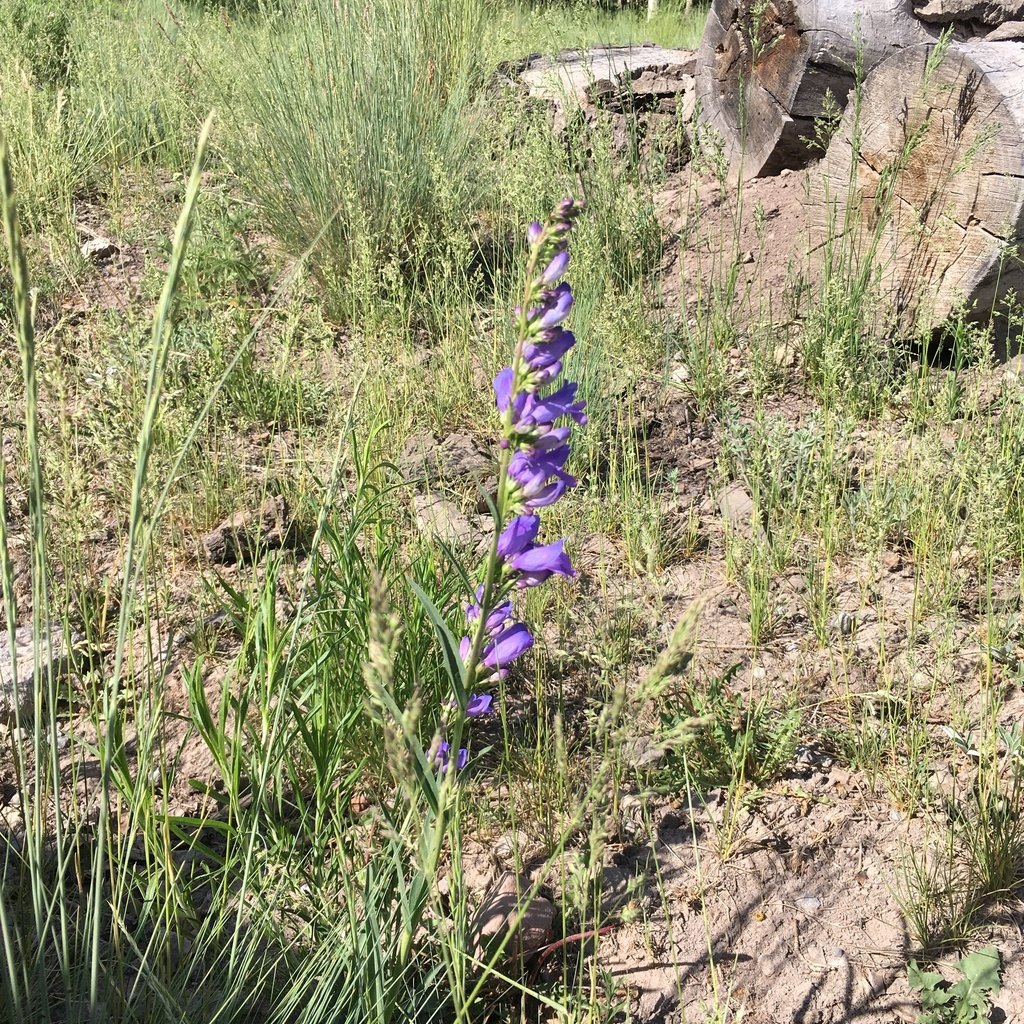
LATIN NAME: Penstemon strictus
COMMON NAME: Rocky Mountain Penstemon
Plant Profile
Rocky Mountain penstemon is a clump-forming perennial from the western slopes of the Rockies, 35 to 70 cm tall in most gardens and occasionally to 90 cm. The stems are erect or rising, mostly hairless and never glaucous, which is a useful distinction: many penstemons carry a blue-grey wax and this one does not.
Leaves are narrow and oblanceolate, widest past the middle, 5 to 15 cm long on the lower stem and 4 to 10 cm on the upper, with rough forward-facing hairs along the edges. The upper leaves are stalkless, narrower and often folded. There are four to eight pairs of leaves on a stem.
The inflorescence is a spike of four to ten whorls, and the corolla is 24 to 32 mm long, deep blue with a violet tube. The two upper petals point straight along the tube like a porch roof, which is the feature behind the common name beardtongue, though the beard is inside the flower and hard to see. Fellow Plantaginaceae members here: Penstemon eatonii, Penstemon campanulatus and Bacopa monnieri.
Science & Biotechnology
The fifth stamen is sterile and modified into a hairy pad that sits inside the throat. It is not decoration: it presses against the backs of visiting bees and helps position them so that pollen is deposited in the right place. In some penstemons the pad is a different colour from the corolla, which may guide the bee in.
The species was described by George Bentham in 1846. An earlier name, Penstemon micranthus, published by John Torrey in 1845, turned out to be illegitimate because Nuttall had already used it in 1834 for a different plant. The rules of nomenclature are unforgiving, and this is an ordinary example of how they work.
It is a plant of dry, open slopes and sagebrush country, and it survives there on winter snow and spring rain. In a garden it wants the same regime: sharp drainage, full sun, and no watering after midsummer. Wet soil in winter is what kills it, far more often than cold does.
Uses & Benefits
It is a border plant for the front or the middle, where the blue spikes can be seen against grey foliage or gravel. The colour is a true blue rather than a purple, which is rare among perennials, and it holds for three or four weeks in early summer without any staking at all.
Bees and hummingbirds work it, and the open throat makes it accessible to a wide range of insects, so it appears in pollinator mixes for the western states. It is also one of the few penstemons that is reliably perennial in a cold garden, provided the drainage is right.
The seed is easy to collect and easy to sow, and the seedlings vary in colour from deep blue to a washed lavender. That variation is worth having in a meadow and irritating in a border, which is the usual argument about seed strains and named clones, and it has no resolution.
Growing from Seed
Sow in late winter at 15 to 18 °C. The seed needs light and, in many strains, a period of cold; four weeks in the refrigerator before sowing improves germination markedly. Surface sow, press in, and expect two to four weeks. The seedlings are small and slow at first.
Plant out in spring, in full sun, on a mound of grit and compost if the soil is heavy. Space them 30 cm apart. Water them through their first summer and then stop; the taproot will find what it needs, and irrigation after the first year shortens the plant’s life.
Cut the flower spikes back after flowering if you want a tidy plant, or leave them for the seed and the winter silhouette. Divide the clumps every three or four years in early spring, when new growth is just showing. Old clumps go woody and flower poorly, and the centre dies out while the edges keep going, which is the signal to lift the whole thing and replant the vigorous pieces.
Our Take
It is the most reliable blue perennial I know for a cold, dry garden, and it costs almost nothing from seed. The flowers are not large, the plant is not long-lived, and none of that matters when it is in bloom in June against a gravel mulch.
The trick is to plant it where you would plant a thyme: full sun, thin soil, no winter wet. Given that, it will seed itself gently into the gravel and go on for years without any attention at all. The seedlings are easy to move while they are small, which is how you build a drift without buying one.
Related Reading
Readers interested in Rocky Mountain Penstemon frequently explore these as well: