


Amaranthus hypochondriacus Seeds | Prince’s Feather
LATIN NAME: Amaranthus hypochondriacus
COMMON NAME: Prince’s Feather
Plant Profile
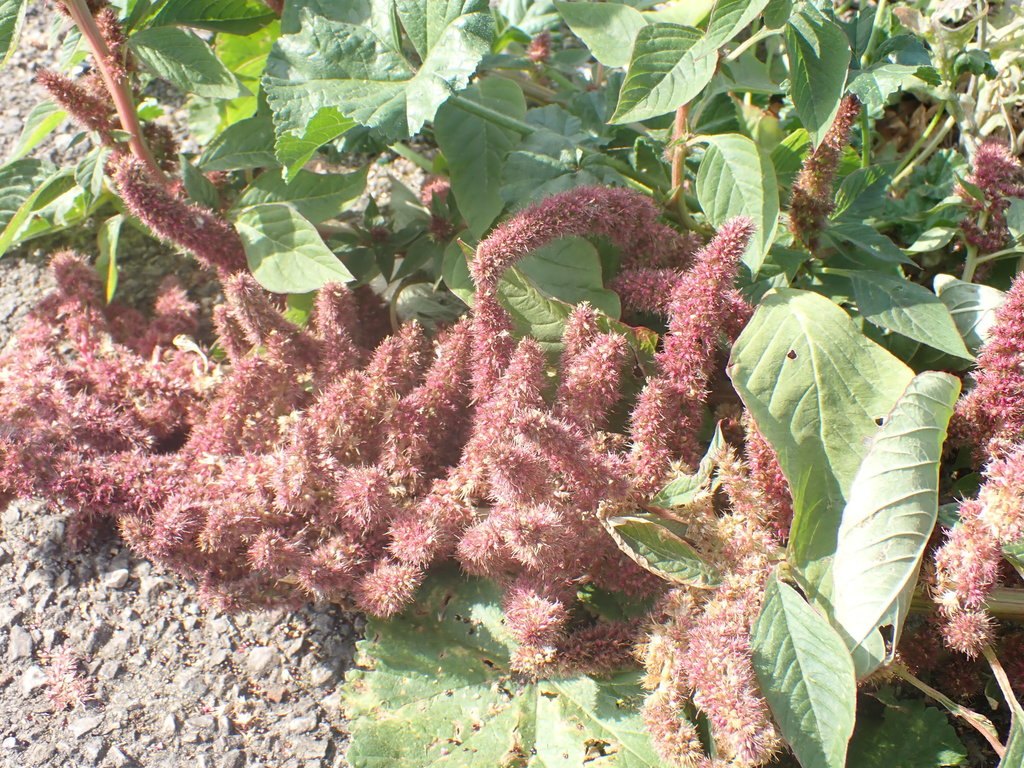
Prince’s feather, Prince-of-Wales feather, and in Spanish quelite, bledo or quintonil: the names divide neatly between the ornamental trade and the kitchen. It is a vigorous upright annual reaching 40 to 200 cm, with dense catkin-like inflorescences in summer and autumn that are usually deep purplish-red and occasionally yellow-green.
The leaves are simple and alternate with entire margins, rhombic-ovate to broadly lanceolate, 4 to 12 cm long and 2 to 7 cm wide, on long stalks. They are good to eat, which is not a claim often made for a plant sold in a bedding catalogue. The inflorescence is the ornamental feature; the leaf is the vegetable.
The fruit is a dry capsule 1.5 to 3 mm long that splits when ripe. Inside are smooth shiny seeds, subglobose to lenticular, whitish-pink or dark reddish-brown to black, 1 to 1.4 mm across. That is the grain. One head carries thousands of them, and a well-grown plant carries thousands of heads. The same family turns up again in Amaranthus spinosus, Amaranthus gangeticus and Atriplex semibaccata.
Science & Biotechnology
The species is one of three grain amaranths, and how they were domesticated is still argued. One hypothesis has a single event and a later radiation; the other has separate events in South America and Central America. Phylogenetic and geographic evidence currently favours the second, with A. hybridus possibly derived from South American stock and A. caudatus, A. hypochondriacus and A. quitensis arising in Central America and further north.
The red colour is not anthocyanin. Amaranthaceae belong to the Caryophyllales, an order that abandoned anthocyanins and uses betalains instead, and betacyanin is the pigment that gives the heads their colour. Betalains are water-soluble, so the inflorescence bleeds red into a vase and why the colour of a cooked leaf runs into the water.
The seeds contain phenolic compounds, and the plant is unusually efficient at turning poor ground into protein. A C4 species, it fixes carbon at high temperature with little water, and that combination is why it is grown as a subsistence crop across Africa and why agronomists keep returning to it when rainfall fails.
Uses & Benefits
In temperate gardens it is a half-hardy annual grown for the heads. Green Thumb is compact and green, Pygmy Torch is upright and dark red, and both hold an Award of Garden Merit. Both are also short enough to stand without staking, which matters because the species in rich soil can reach two metres and then fall over.
As food, the leaves are cooked like spinach and the seeds are used as a grain, popped or ground. The flavour of both is mild, which is the point: amaranth takes on whatever it is cooked with, and it does not need to be taught to behave. In El Salvador and across Africa it is valued for exactly that neutrality.
For cutting and drying, the heads hold colour well if picked before the seed sets, and they are heavy enough that a single stem is a whole arrangement. After the seed ripens the head shatters at a touch, so the window for a clean dried bunch is about ten days.
Growing from Seed
Sow indoors four weeks before the last frost, or direct once the soil is warm. The seed is tiny and needs light, so press it into the surface and water with a fine rose rather than covering it. At 18 to 22 °C germination takes five to ten days and is usually close to total.
Thin or plant out at 30 to 45 cm. The plant responds to fertility with height and to poor soil with colour, so a lean site is the better ornamental choice. A generous bed produces a two-metre plant with a weak stem that goes down in the first September gale and never gets up again.
Aphids find it, particularly in a dry summer, and they cluster on the young stem rather than the leaves. A jet of water is enough if it is early. For seed, wait until the lower capsules open and the head rattles, then cut and hang it over a sheet, rub out and winnow.
Our Take
As an ornamental it does one thing, which is to stand there looking improbable in late summer, and in a hot border among grasses that is enough. It is not subtle and it does not combine, so give it a place where it can be the only odd thing in view.
Grow it once as a crop and the garden role makes more sense. A single plant gives a bowl of seed and a summer of greens, and the head that did it is the same head that was standing in the border in August. Few ornamentals can be eaten and still look like that.
Related Reading
If Prince’s Feather appeals to you, these related plants are worth a look: