


Amaranthus palmeri Seeds | Palmer Amaranth
LATIN NAME: Amaranthus palmeri
COMMON NAME: Palmer Amaranth, Palmer’s Pigweed
Plant Profile
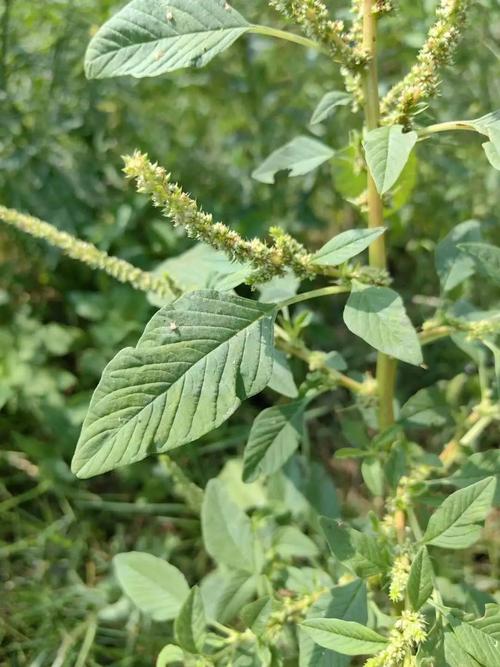
Palmer amaranth is a tall dioecious pigweed of the southwestern United States and northern Mexico, and a formidable crop weed. It is native to the Sonoran and Chihuahuan deserts and to the river valleys of Arizona, New Mexico and Sonora, where it grows on sandy ground and in disturbed washes, and it has spread across the cotton and soybean belt of the eastern states in the last fifty years. The plant reaches one to three metres, with a stout red-striped stem, long-stalked oval leaves and a coarse terminal spike of small green flowers that can be half a metre long. Male and female flowers are on separate plants, so a single female can be pollinated by wind from far away. It emerges from spring to late summer, grows with startling speed, and a mature female can shed hundreds of thousands of seed. It is now one of the most expensive weeds in North American agriculture.
Science & Biotechnology
Amaranthus palmeri is dioecious, a rarity among the pigweeds, and wind pollination across separate sexes keeps populations genetically diverse, which is one reason the species adapts so quickly to control measures. It is a C4 plant with a very high photosynthetic rate, and under good conditions a stem can lengthen by several centimetres a day, which lets it overtop a cotton crop within weeks. Seed production is extreme, commonly a quarter of a million per female and sometimes more, and the seed remains viable in the soil for several years, germinating in flushes through the season. The species has evolved resistance to glyphosate through amplification of the EPSPS gene, so resistant plants carry many copies of the target and survive doses that kill susceptible ones; populations with resistance to several herbicide groups are now widespread. Its pollen can travel hundreds of metres, carrying resistance genes between fields. The plant is also a host for insects and viruses that affect crops.
Uses & Benefits
The seed was gathered and eaten by the Pima and other peoples of the Southwest, ground into flour and used in gruel, and the young leaves are edible cooked, though the plant is not grown for food today. It is sometimes cut for hay or silage, but nitrate accumulation makes it risky for livestock, and the spines on the mature inflorescence discourage grazing. In folk medicine it has been used as a poultice and a wash. As a garden plant it is a liability rather than an ornament, though the red-stemmed form has a certain architectural presence in a wild corner. Its real significance is economic: it costs North American growers hundreds of millions of dollars a year in herbicides and lost yield. For a seed seller the important point is that it must never be confused with a culinary amaranth, and the two are not interchangeable.
Growing from Seed
Seed germinates at 25 to 35 degrees, from a shallow depth, and needs light; sow on the surface and keep moist for a week. Growth is fast in full sun and rich soil, and a plant will flower within six weeks of emergence. For study, isolate a male and a female plant to see the difference in flower structure, since the sexes are separate. Control in a garden means pulling plants before they flower, and doing it early in the morning when the stems are turgid, because a severed stem can reroot if left on damp soil. Do not compost seed heads. In arable land the species is managed with crop rotation, delayed planting, cover crops and multiple herbicide groups, and any plant that survives a treatment should be removed by hand.
Our Take
A fast, tough pigweed with separate sexes and a quarter of a million seeds per plant. Edible in theory, a disaster in a field.
Related Reading
More species in the same orbit as Palmer Amaranth: