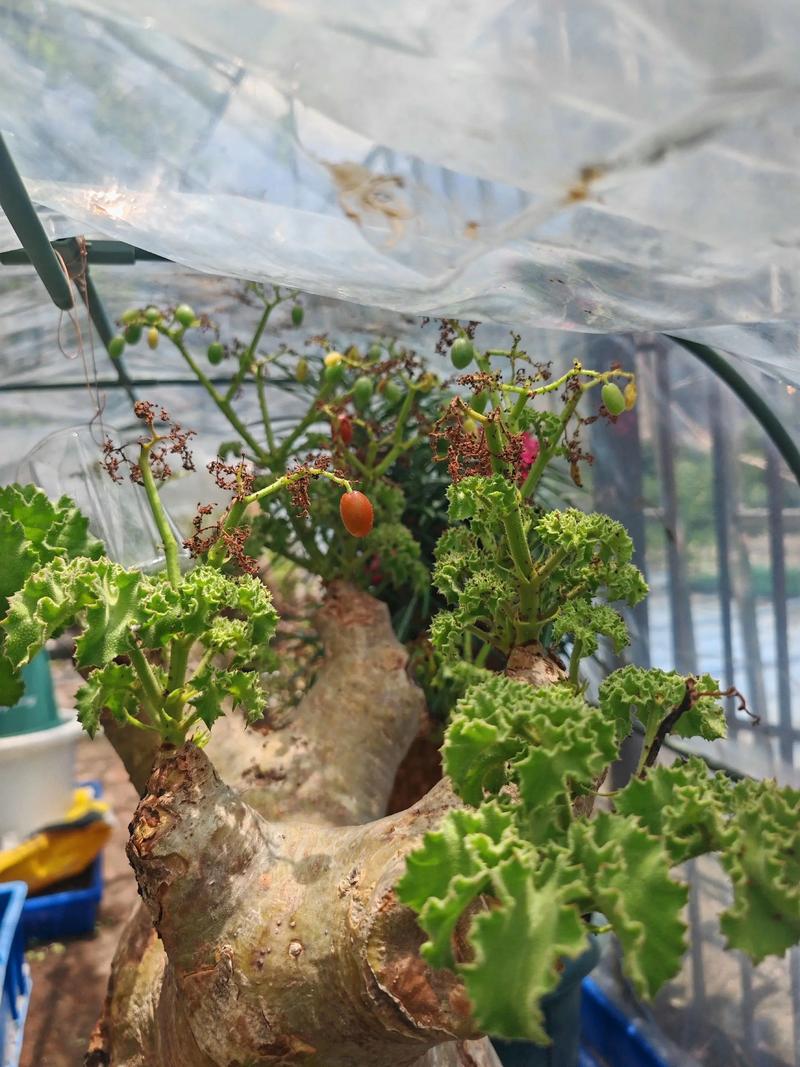
Cyphostemma juttae seed

LATIN NAME: CYPHOSTEMMA JUTTAE
COMMON NAME: Tree Grape
On the rocky slopes of the Namib mountains, the tree grape grows as a striking, caudiciform tree with the thick, pale, bottle-shaped trunk, the large, fleshy, jagged leaves carried in loose rosettes at the branch tips and the small, greenish-yellow flowers, the bright red, grape-like fruits following in dense clusters. The young plant grows into a multi-stemmed clump, to about twelve metres. Site it in full sun, in deep, fertile ground.
Scientific Research & Plant Biotechnology
The tree grape of Namibia holds a place in the studies of the succulent trees of the arid south, its swollen trunk and its fleshy leaves keeping it in view in the work on the drought storage of the caudiciform plants and the remarkable flora of the Namib. The research looks at the way the thick stem stores the water of the rare rains, the red fruit clusters ripen in the heat, and the seed biology of the hard, woody seeds.
Ecological & Economic Value & Wide Applications
In the arid garden and the dry rockery, the tree grape makes the bold, architectural specimen with the pale trunk and the fleshy green rosettes, and it asks for almost nothing but sun and drainage. The red fruit clusters feed the desert birds, the swollen trunk has carried the travellers through the dry country, and the plant makes the fine succulent specimen, the pot plant and the rock-garden centrepiece. It is a plant for the hot, dry, well-drained place.
To grow the Tree Grape from seed, scar the seed coat with a file and soak the seeds overnight in warm water.
Scar the seed coat with a file and soak the seeds overnight in warm water, and keep the young trees in the hot, sunny spot. before sowing them in pots of gritty compost, keep them lightly watered, and the young trees fill out slowly in the full sun. The fleshy leaves spread as the warmth builds.
LATIN NAME: Cyphostemma juttae
COMMON NAME: Tree Grape
The tree grape is a remarkable, handsome, slow-growing, succulent tree of the dry regions, and its thick, fleshy, peeling, pale-grey trunks and its large, toothed, bluish-green leaves, followed by the dense clusters of the small, round, grape-like fruits, have made it one of the most striking and most treasured of the succulent garden plants. It establishes itself as a tall, clean trunk, eventually twenty-five metres. It is a species of the flowering plant in the grape family, and it is native to the dry regions of the southern Africa, while it is grown as a treasured succulent, and it is known as the tree grape.
The tree grape belongs to the grape family, Vitaceae, and it is a species of the remarkable, succulent tree, native to the dry regions of the southern Africa, while it is grown as a treasured succulent, and it is known as the tree grape. It is prized for its thick, fleshy, peeling trunks and its large, toothed, bluish-green leaves.
Scientific Research & Plant Biotechnology
The tree grape has a real and distinguished place in the research. It has been studied in the horticulture, since its thick, fleshy, peeling, pale-grey trunks and its large, toothed, bluish-green leaves have made it one of the most striking and most treasured of the succulent garden plants, and researchers have examined its growth, its water storage and its cultivation, while its value as a fine succulent has drawn attention in the international horticultural press as a plant of the dry garden. The plant has also been studied in the botany and the ecology, since it is a native of the dry regions of the southern Africa, and its relationships, its distribution and its role in the wild have been examined, while the ecology of the dry-land plants has been of continuing interest, and its remarkable, swollen trunks have been of interest to the botanists. The species has also been studied in the horticulture of the dry garden and the collection, since it is a slow-growing, treasured succulent of the dry garden and the botanic collection, and researchers have examined its growth in the dry, free-draining places, while the growing of the tree grape in the collection has been of continuing interest, and its fine, fleshy form has been of value. For a plant of such remarkable form, the tree grape has a rich and continuing record of study.
Ecological & Economic Value & Wide Applications
Ecologically, the tree grape is a generous plant of the dry garden. Its dense clusters of the small, yellow-green flowers feed the bees and the many insects, and its dense clusters of the small, round, grape-like fruits feed the birds and the wildlife, while its thick, fleshy trunks give a fine, sculptural presence to the dry garden.
Its economic value is real. The tree grape is prized for its remarkable, thick, fleshy trunks and its large, toothed leaves, and its value has drawn attention in the international horticultural press as a plant of the dry garden, while its fine, sculptural, succulent form has made it a treasured plant of the botanic collection and the dry garden. For a grower, the tree grape is a rewarding and treasured succulent, and for a gardener it brings a remarkable, fleshy-trunked, succulent tree to the dry garden. The seeds are easy to start — sow them just below the surface of a pot of moist, free-draining, gritty soil, keep them lightly watered in a warm spot, and theyll be sprouting steadily, growing on into a fleshy, blue-leaved, sculptural tree.