


Atriplex semibaccata Seeds | Berry Saltbush
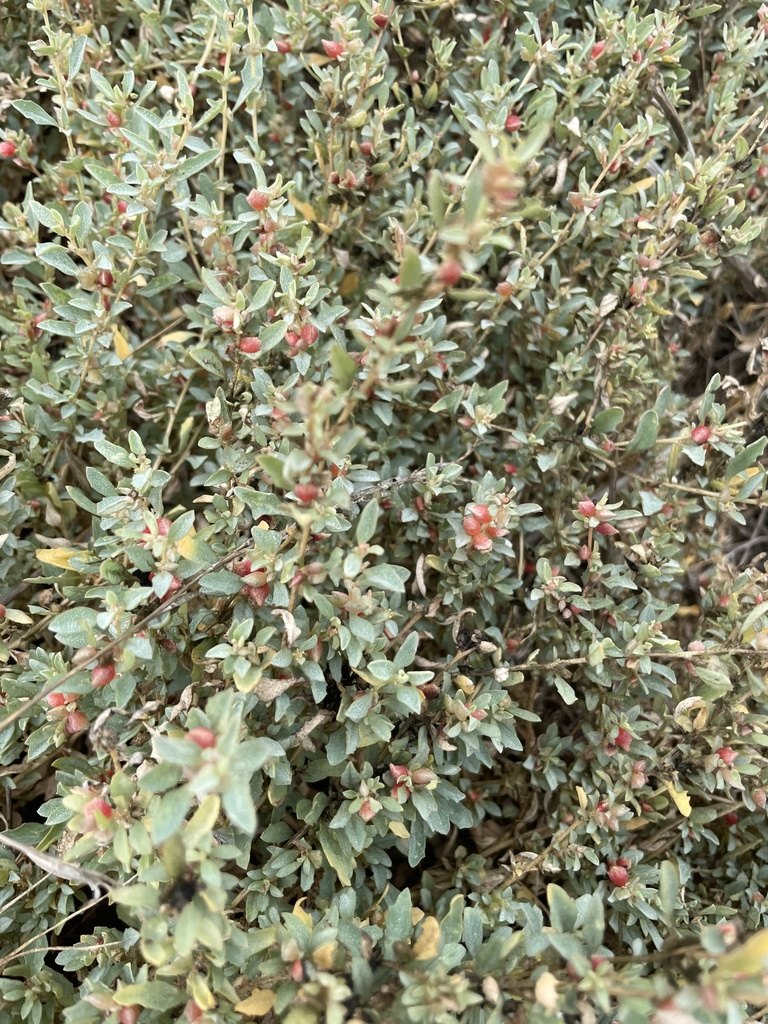
LATIN NAME: Atriplex semibaccata
COMMON NAME: Berry Saltbush
Plant Profile
Atriplex semibaccata is a low, spreading perennial of the Amaranthaceae, native to Australia and widely introduced elsewhere for saltland rehabilitation. It grows 20 to 30 cm high and up to 1.5 m across, with grey-green, mealy leaves and stems that root where they touch the ground.
The leaves are small, oblong and covered with the bladder hairs that are characteristic of the genus, which give the plant a silvery look and allow it to excrete salt. The flowers are tiny and green, and they are followed by small, fleshy fruits that turn red or orange as they ripen, which is where the name berry saltbush comes from.
Flowers of both sexes sit on one plant, the males in small terminal clusters about 1.5 mm wide and the females in the leaf axils. Such is the usual arrangement in the genus, and a single plant can start a population. The fruit is a utricle enclosed in two bracts that turn red and fleshy at maturity, and birds eat them and carry the seed. Wind carries the pollen, as in most of the family. Amaranthaceae is well covered here, with Atriplex hortensis, Halogeton arachnoideus and Salsola tragus alongside.
Science & Biotechnology
Atriplex ranks among the few genera that contain both C3 and C4 species, and the C4 pathway explains much of its success in hot, saline ground. The bladder hairs on the leaves accumulate salt and then rupture, taking it out of the tissue. The species has 18 chromosomes, leaves 5 to 30 mm long, and a habit that lies flat and spreads to 1.5 m.
The genus belongs to the Amaranthaceae now, following the absorption of the Chenopodiaceae on molecular evidence. Few reclassifications in recent plant taxonomy caused as much comment, and the consequence is that saltbush sits with amaranth and quinoa rather than with beet.
The red colour of the fruit comes from betalains, pigments found only in the Caryophyllales and never alongside anthocyanins. The same compounds colour beetroot, give the old family its English name, and serve as one of the chemical markers that unite the order. The same pigments colour pokeberry and the magenta flowers of the cactus family.
Uses & Benefits
Land rehabilitation is the main use. It goes on salt-affected land, mine spoil and eroded slopes, where deep roots and salt tolerance let it establish where nothing else will. Sheep and cattle graze it too, and few plants will grow on saline pasture and still provide feed.
In gardens it covers dry, salty or poor ground, particularly near the sea, where salt spray kills most plants. Grey foliage and red fruits earn it a place in a wild garden, and the spreading habit stabilises a bank or a path edge.
The leaves are edible in small quantities, and Aboriginal people in Australia boiled them and ate them with meat. The fruit is edible too, though small and bland, and children in some regions ate it as a snack. Birds eat it and spread the seed, and the species appears first on bare saline ground after disturbance. A bird that eats the fruit gets the seed with it, and passes it intact.
Growing from Seed
Sow in spring at 18 to 24 °C, covering the seed lightly; 21 °C is close to the optimum, and germination needs no pretreatment. The cotyledons break the surface at about eighteen days. The seed sits inside bracts that can inhibit germination, so rubbing it between your hands before sowing improves the result.
Sow direct where the plants are to grow, since the taproot resents disturbance, or raise seedlings in deep cells and plant out while small. Space plants 60 cm apart; they will spread to fill the gap within a season. The plant tolerates poor, saline and alkaline soil and needs no feeding.
Water while establishing, then leave it alone. Drought does not trouble it, and wet feet do, particularly in winter, when waterlogged soil rots the crown. A coastal garden will see it survive salt spray that kills almost everything else, which is most of its value there.
Our Take
Berry saltbush does not belong in a flower border, and nobody sells it as an ornamental. It works for a living, healing land damaged by salt and erosion, and it is worth knowing for that reason alone. Nothing else does it as cheaply. It is a plant for the edge of a car park, not for the middle of a border.
If you garden by the sea, on poor or salty ground, it ranks among the few plants that will cover the ground and hold it. Give it sun, drainage and room, and it will do a job nothing else will do. Worth knowing, even if you never plant it.
Related Reading
Gardeners who grow Berry Saltbush often pair it with these related subjects: