


Halogeton arachnoideus Seeds | Saltwort
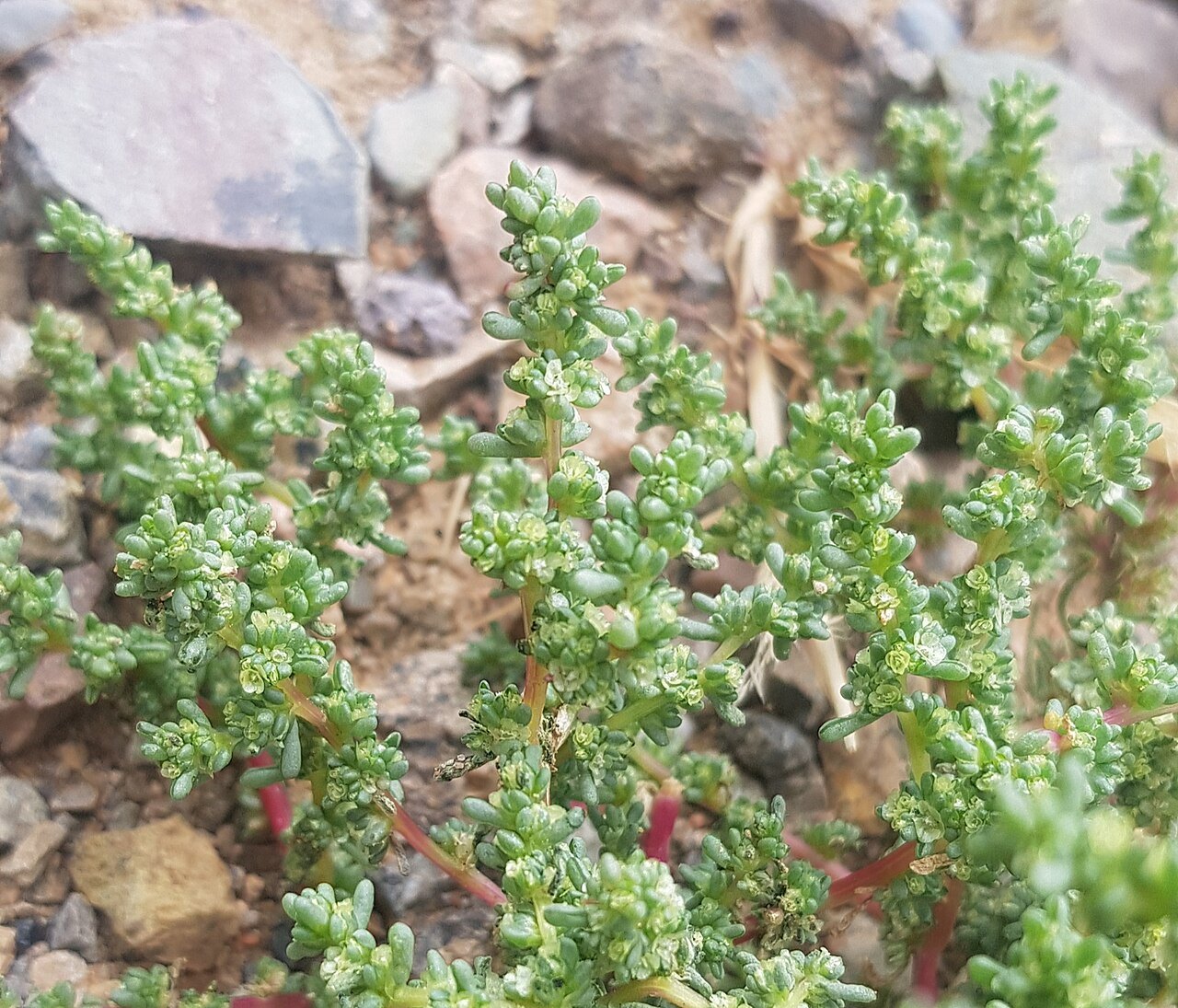
LATIN NAME: Halogeton arachnoideus
COMMON NAME: Saltwort
Plant Profile
Halogeton arachnoideus is an annual of the Central Asian deserts that begins life under a veil of white, cobweb-like hair and ends it as a small, hard, red-winged tumbleweed. In between it ranks among the few plants that can make a living on ground so salty that the surface crusts white in the sun.
The stems are pale green to almost white, branched from the base, and the leaves are short, fleshy and cylindrical, each tipped with a tiny spine. The foliage is sparse and looks half-finished, and the plant invests little in leaf area, which is the correct strategy when water is the limiting factor and the leaf is a liability.
Its range runs from the Caspian and Kazakhstan across the Tian Shan and the Mongolian steppe into northwestern China, where it is recorded from Xinjiang, Gansu, Qinghai, Ningxia, Inner Mongolia, Shaanxi and Shanxi. It grows on saline flats, dry river beds, gravelly slopes and the edges of irrigated fields. The Chinese populations sit at the eastern end of a very wide Central Asian distribution.
The genus name is Greek for salt neighbour, and the epithet refers to the cobweb hair of the young plant, not to the wings that appear later. Halogeton is a small genus, and it is best known outside Asia for the damage one of its relatives has done to sheep ranching in the American west.
Science & Biotechnology
The plant is a halophyte, and it deals with salt by taking it up and storing it rather than excluding it. The tissue becomes salty, the sap becomes concentrated, and the plant maintains its water relations in soil where an ordinary mesophyte could not extract a drop. The cost is a plant that is chemically hostile to almost everything that might eat it.
That hostility is oxalate. Species of this genus accumulate soluble oxalates in quantity, and the related Halogeton glomeratus killed thousands of sheep in the western United States in the 1940s when it spread through overgrazed salt-desert range. The mechanism is simple: soluble oxalate binds calcium in the blood, and the animal dies of hypocalcaemia.
The fruiting plant is built for wind. The perianth segments develop broad, papery wings around the fruit, the whole shoot dries and breaks off at the base, and the tumbling skeleton scatters seed as it rolls. The wings also act as a parachute, and they orient the seed so that the radicle meets the ground first. The rest of the Amaranthaceae here runs to Chenopodium album, Ptilotus exaltatus and Amaranthus hypochondriacus.
Uses & Benefits
Its chief practical use is as a pioneer on salt-affected land. It will colonise bare, crusted flats and cover them within a season, and because it concentrates salt in its tissue, harvesting and removing the plants takes salt off the site. The quantities involved are small, but the principle is used in phytoremediation trials.
As forage it is a liability rather than a crop. Sheep and cattle will eat it when nothing else is left, and that is exactly when the oxalate load is most dangerous; feeding a calcium supplement and avoiding hungry stock on dense stands are the standard precautions. It is not a plant to encourage in pasture.
In parts of its range the ash of the dried plant has been used as a source of soda for small-scale soap making and dyeing, a household chemistry that has largely disappeared. The plant is also grazed by camels, which tolerate oxalate better than sheep and which use the salt flats that other livestock avoid.
Growing from Seed
Seed is easy and needs no treatment. Sow in late spring once the soil is warm, barely cover, and keep the surface just moist until the seedlings are up; after that the plants want full sun and as little water as you can decently give them. They will not tolerate a rich, moist soil.
In a garden the plant is a curiosity for a dry, salty corner, and it is at its best in late summer when the wings colour and the whole plant turns red. It is an annual, so it must be allowed to set seed if it is to come back, and the seedlings transplant badly because of the taproot.
Do not let it seed into grazing land. A few plants on a bare bank are harmless; a dense stand in a pasture is a veterinary problem, and the seed bank persists for years. Grow it in a container or a confined bed, and cut the plants before the wings are fully formed.
Our Take
This is a plant that earns respect rather than affection. It survives where the ground is white with salt, it makes a living out of a chemistry that kills sheep, and it turns the colour of a dying fire in September. None of that is charming, and all of it is impressive. It is also a useful reminder that the word weed is a statement about land use, not about plants.
Grow it if you have a bad corner and an interest in how plants solve problems, and keep it away from anything with a mouth. The red autumn skeleton, rolling across a salt pan, is one of the better endings in the plant world. It is a short life, and it is spent entirely on the edge of what is possible.
Related Reading
Readers interested in Saltwort frequently explore these as well: