


Ptilotus exaltatus Seeds | Mulla Mulla
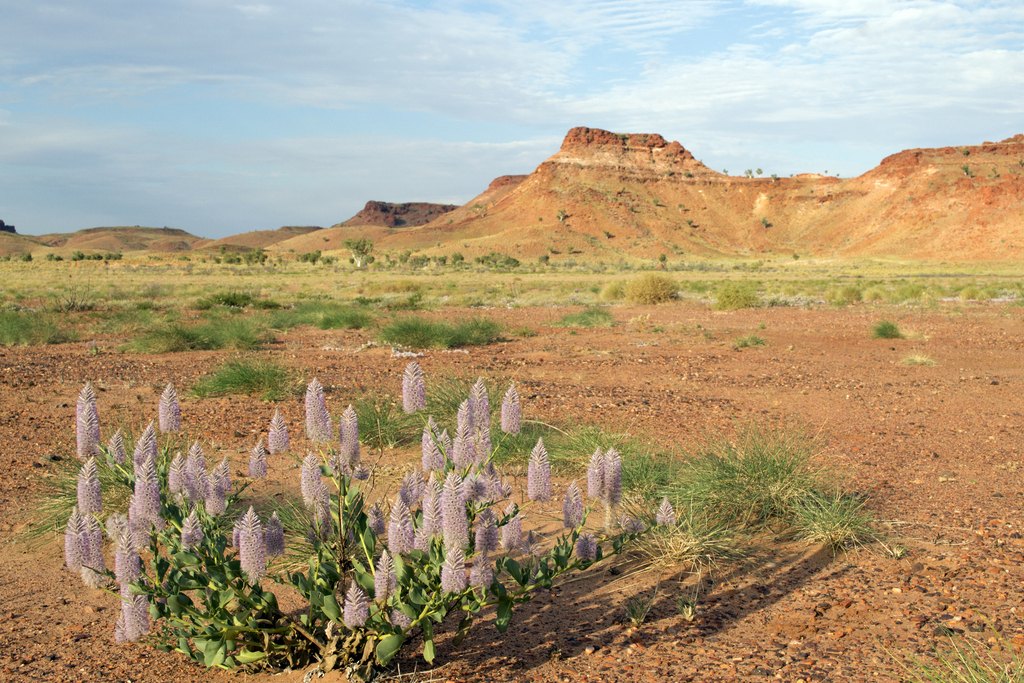
LATIN NAME: Ptilotus exaltatus
COMMON NAME: Mulla Mulla
Plant Profile
Mulla mulla is endemic to large parts of arid and semi-arid Australia, and it ranks among the plants that makes the interior look briefly hospitable after rain. It is an erect annual or short-lived perennial herb, growing to about 1 m, with a fleshy taproot that stores water through the dry months.
The stems are covered in shaggy hairs, sometimes almost hairless, and the leaves vary with their position. Basal leaves are linear, lance-shaped or spatula-shaped, 50 to 200 mm long and 20 to 60 mm wide, sometimes with dense whorled hairs. Stem leaves are narrower, 1 to 115 mm long, sometimes wavy, with a small fragile point 1 to 3 mm long.
The flowers are the reason it is grown. Pink to purple, they are packed into cylindrical spikes 20 to 200 mm long and 30 to 50 mm wide, and the whole inflorescence looks like a bottlebrush or a fox’s tail. The common names — tall mulla mulla, pink pussy-tails, lambs tail, showy foxtail — all describe the same thing.
The species was described in 1845 by Nees von Esenbeck in Lehmann’s Plantae Preissianae, and the epithet exaltatus means raised up or tall. It was long confused with P. nobilis, from which it differs in having perianth segments that are pink or purple throughout rather than mostly creamy-green.
Science & Biotechnology
It belongs to the amaranth family, which puts it alongside quinoa, amaranth and lamb’s quarters, and like several of its relatives it is adapted to heat and poor soil. The fleshy taproot is the key: it stores water and carbohydrates, and it allows the plant to survive long dry spells that would kill a shallow-rooted annual.
The hairs on the stem and leaves are another adaptation. A dense covering reduces water loss, reflects light and creates a boundary layer of still air around the plant, and it also makes the foliage unpalatable to some herbivores. Hairs are cheaper than wax, and they do both jobs at once.
The flowering strategy is opportunistic. In the wild the plant germinates after rain, flowers within a few months and sets seed before the ground dries completely, and the seed bank carries the population through years without a good season. In cultivation that means the plant can be treated as an annual in a cold climate and as a short-lived perennial where winters are mild. Near kin on the list are Salsola tragus, Iresine and Atriplex semibaccata, all Amaranthaceae.
Uses & Benefits
It is grown as an ornamental, and increasingly as a cut flower. The spikes last well in water and dry without losing colour, and they are used in the Australian native flower trade alongside kangaroo paw and banksia. Getting it to germinate at all is the commercial bottleneck.
The seed sits inside a 2 mm nut wrapped in the perianth, and that sheath blocks germination in most uncleaned seed. Removing it lifts germination by 60 to 80 per cent, and temperature and light make little difference either way.
In a garden it brings a colour that is hard to find otherwise: a clear, slightly dusty pink that reads well against grey foliage and gravel. It suits a dry border, a raised bed and a large container, and it ranks among the few plants that looks better in a hot, exposed position than in rich soil. In its native range it is grazed by livestock when young, though its value as forage is limited. Some species of Ptilotus have traditional medicinal uses, and the genus is being studied for compounds of pharmacological interest.
Growing from Seed
Sow in spring at 20 to 25 °C, on the surface and barely covered, because the seed needs light. Germination is usually within two weeks. The seedlings are delicate and should be handled by the leaf, not the stem. If germination is poor, rub the papery sheath off the seed before sowing, which is what the nurseries do.
The critical requirement is drainage. Use a compost with at least a third grit, plant into a raised bed or a slope, and never let the crown sit wet. In a cold climate, grow it in a pot that can be moved under cover for winter. Water sparingly once established. The plant is adapted to drought and resents kindness: a generous watering regime produces soft growth that rots at the base. Feed once at planting and then leave it alone.
Our Take
It is not an easy plant, and it is not a cheap one, but there is nothing else quite like it in a temperate border. Treat it as a dry-garden specialist, give it gravel and sun and neglect, and it will flower for months. Treat it like a bedding plant and it will rot in a fortnight.
Related Reading
If Mulla Mulla appeals to you, these related plants are worth a look: