


Madia sativa Seeds | Coast Tarweed
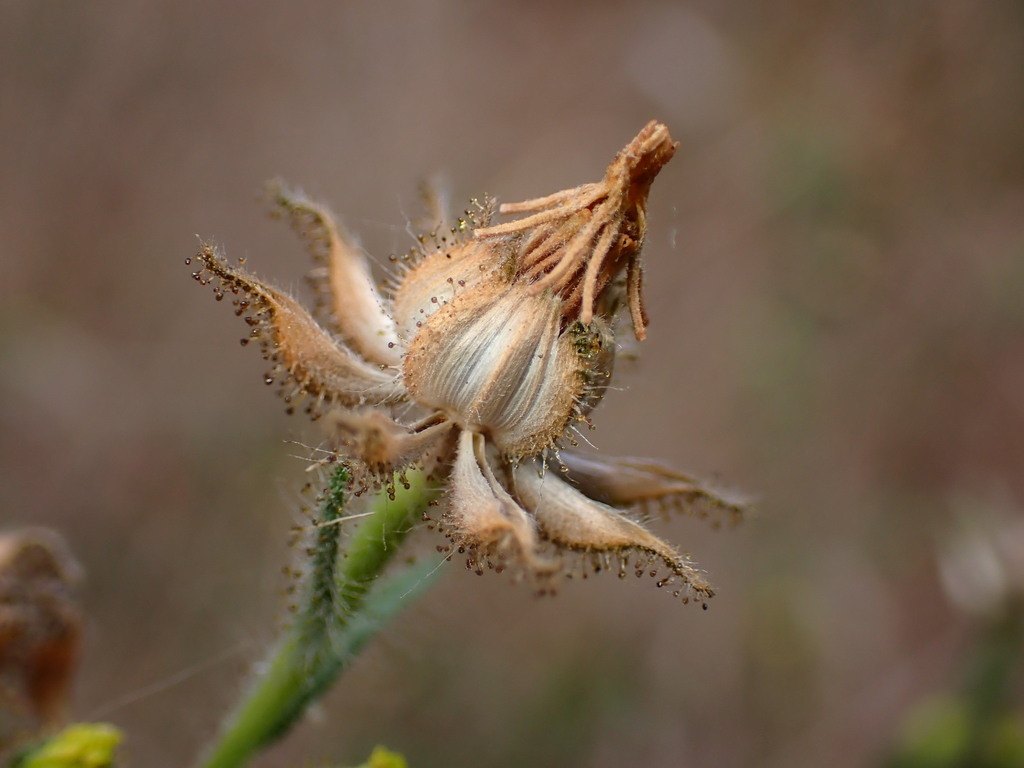
LATIN NAME: Madia sativa
COMMON NAME: Coast Tarweed
Plant Profile
Coast tarweed is an annual that refuses to stay in one size class: a plant on poor gravel may stop at twenty centimetres, while the same species on deep, moist ground runs a leafy, branching stem well past two metres. Both versions carry the same dense coat of sticky resin and the same strong, resiny smell that gives the genus its common name.
The leaves are the plain part of the plant. They are linear to lance-shaped, hairy, and arranged in pairs up the stem, with the lowest ones reaching eighteen centimetres before the flowering branches take over. Run a hand through a stand and the fingers come away tacky, which is exactly how the plant defends itself against small chewing insects.
Flowering heads sit in tight clusters, each wrapped in bristly, gland-bearing phyllaries. A head opens roughly eight short yellow ray florets around a centre of disc florets whose dark anthers give the whole inflorescence a two-tone look. After pollination comes a flat, hairless achene with no pappus, an unusually plain fruit for the family.
The native range is one of the strangest in western horticulture: a coastal band from Alaska and British Columbia down through every mountain range of California to Baja California, and then a second population on the far side of the equator in Chile and Argentina. Between the two, the plant grows on coastal grasslands, gravel bars and any disturbed open ground. The rest of the Asteraceae here runs to Gaillardia aristata, Brachyscome iberidifolia and Dimorphotheca pluvialis.
Science & Biotechnology
The tar is chemistry at work. The resin glands exude a sticky exudate that gums up aphids, caterpillars and seed attackers, and it doubles as a screen against moisture loss during the dry Pacific summer. Whole-plant extracts have been analysed for terpenoid content, and the genus drew the interest of chemists long before ecologists took notice.
The species name sativa is not decoration. This is a plant that has actually been sown as a crop, grown for the oil in its abundant small seeds, notably within its Chilean and Argentinian populations. The oil chemistry resembles that of other seed-oil asters, and the agronomic trials of earlier centuries treated it as a genuine oilseed rather than a curiosity.
The disjunct geography still draws hypotheses. A coastal annual with no obvious long-distance fruit machinery, present on both sides of the equator, invites arguments about bird transport, ancient human trade or vanished stepping-stone populations. What is certain from modern mapping is the introduction trail: the species now turns up as an established alien in western Europe and Australia.
Uses & Benefits
In the garden the plant earns its place on lean, dry, unfashionable ground, where its grey-green foliage and small yellow heads hold a summer-long display without irrigation. It mixes naturally with annual grasses and other tarweeds in a meadow matrix, and it tolerates the salt-laced air of coastal sites that defeat most annuals.
For wildlife it is a working plant. The open heads feed generalist pollinators through the late summer lull, and the seed feeds finches once the heads dry. In its native coastal grasslands it is part of the diet of small granivores, and its sticky stems even trap insects that other birds pick off.
There is a caution attached. In parts of California the tall form can dominate disturbed ground and turn a roadside into a sticky monoculture for a season, so the plant belongs where its self-sowing can be watched. Managed that way it is a memorable native annual; left to itself in rich irrigated soil, it becomes a chore.
Growing from Seed
Seed is straightforward. Sow in spring directly where the plants are to stand, pressing the achenes into the surface or covering them with only a whisper of soil, and keep the seedbed just moist until establishment. The species germinates well at ordinary spring temperatures and does not ask for stratification or scarification.
Seedlings grow quickly and honestly: the first true leaves are already faintly sticky, a fair warning of what the mature plant will feel like. Thin or transplant early, because the young root resents disturbance once it has run. Give full sun and the leanest soil you can offer, and the plant will match its size to the ration.
Flowering follows within a single season, and seed set is generous. If you want the patch to repeat itself, let a few heads ripen and scatter; if you want order, cut the stems before the achenes shed. Either way the residue is fragrant rather than unpleasant, and the sticky gloves rinse clean under warm water.
Our Take
Coast tarweed suits gardeners who want a native annual with a history: an oilseed of the Pacific coast, a botanist’s puzzle across two hemispheres, and a plant whose defences you can literally feel. It is honest about its needs, which are sun, poverty and no coddling.
Grow it at the dry front of a native bed or in a gravel sweep with annual grasses, and it will reward the neglect with months of small yellow heads. The only real mistake with this species is kindness; the second is planting it beside the path, where every passerby leaves with sticky cuffs.
Related Reading
Readers interested in Coast Tarweed frequently explore these as well: