


Gaillardia aristata Seeds | Blanket Flower
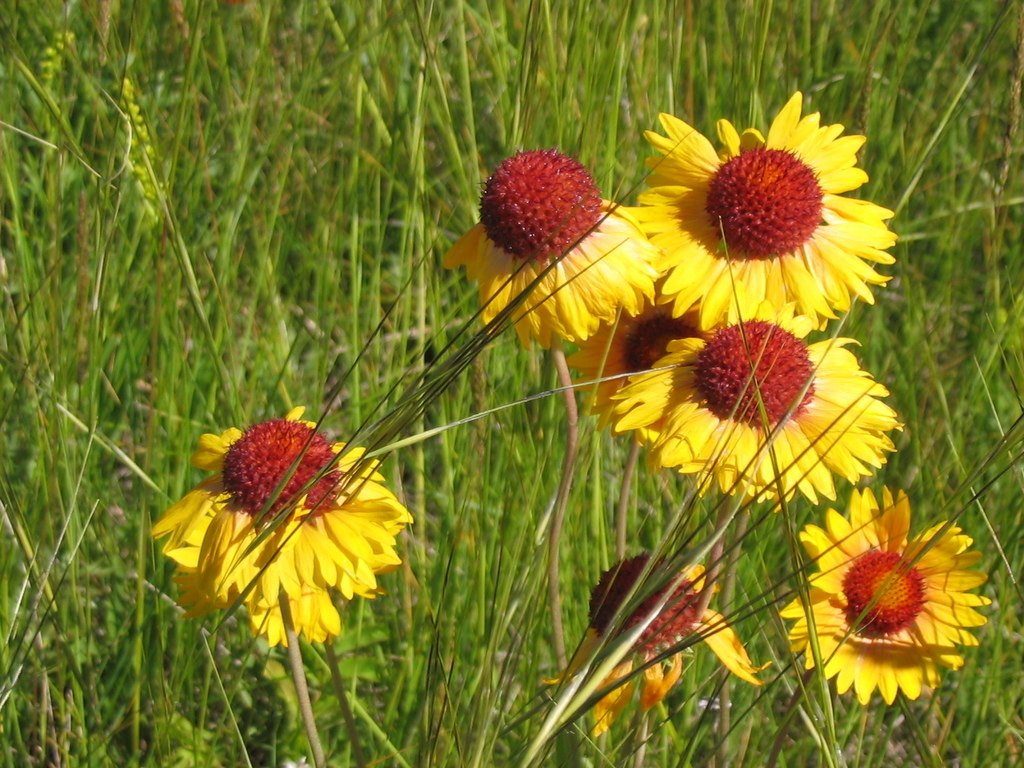
LATIN NAME: Gaillardia aristata
COMMON NAME: Blanket Flower
Plant Profile
Blanket flower is a plant of the Great Plains and the eastern foothills of the Rockies, from Alberta and British Columbia south to Colorado and New Mexico. It grows in short grass prairie, alongside sagebrush and among scattered conifers, on ground that is dry for much of the year and frozen for part of it. The first specimen was collected in 1806 by Meriwether Lewis on the expedition’s return journey, which is a better origin story than most garden plants can offer.
It makes a clump of grey-green, hairy leaves and stiff stems 40 to 70 cm high, rough to the touch. The flower head is a daisy with a raised cone of disc florets in the centre, ringed by ray florets that are yellow in the wild plant, and a cone that is purple-brown before the pollen ripens. Garden strains have pushed the reds, the banding and the doubling, so that a modern seed mix runs from pure yellow through scarlet to a mahogany that is almost black.
Each head lasts about a week, but the plant produces them in succession from early summer until frost if you deadhead. The seed heads are handsome enough to leave standing for the birds, and goldfinches will work them in October.
Science & Biotechnology
The garden blanket flowers sold today are mostly Gaillardia x grandiflora, a hybrid between this species and the annual G. pulchella that arose in European cultivation in the nineteenth century and has been reselected ever since. The hybrid combines the perennial habit of G. aristata with the broader colour range and compact habit of G. pulchella, and it is the parent of nearly every named cultivar, from the deep red Burgundy to the dwarf Goblin at 30 cm.
Gaillardia is largely self-incompatible, so seed strains vary and why a single plant in a garden sets little seed. Two or more plants of different parentage are needed for a good set, and the pollinators are bees and beetles rather than wind. The seed is an achene with a hairy pappus, and it germinates without pretreatment.
The plants are short-lived by design. In the wild they behave as early successors, colonising disturbed ground and disappearing as grass closes over them. In a garden that means two to three years from a plant, four at most, and a gap in the border unless you let it self-sow. Letting it do so is the cheapest way to keep it.
Uses & Benefits
This is the plant for the places where other perennials fail: gravel gardens, the foot of a warm wall, the front of a prairie planting, and seaside gardens where salt wind burns softer leaves. It tolerates drought, wind, poor stony soil and reflected heat, and it flowers harder under those conditions than it does in a rich border, where it grows soft and flops.
Several Indigenous nations of the Pacific Northwest and the northern plains used it medicinally, for heatstroke, headache and complaints of the chest, and the root was chewed for toothache. Whether any of these uses had a pharmacological basis is not established, but the plant does contain sesquiterpene lactones that are bitter and irritant, which is presumably why it tastes like medicine.
It is a reasonable cut flower if picked when the cone is half open; stems are stiff and the colour holds for a week. It is also one of the best perennials for bees, and it is the larval host of Schinia masoni, a moth whose adult sits on the flower head and is almost invisible against the red rays. Alongside it in Asteraceae: Gaillardia pulchella, Matricaria discoidea and Felicia amelloides.
Growing from Seed
Sow indoors six to eight weeks before the last frost at 20 to 24 °C, covering the seed lightly with vermiculite. Germination takes 14 to 21 days. Because the plant makes a taproot, it resents transplanting; sow into deep cells and move it early, or sow direct in late spring once the soil has warmed.
Space plants 30 to 40 cm apart in full sun. They will flower in the first year from an early sowing, which is unusual for a perennial and is one reason the plant is popular with growers who cannot wait.
Divide established clumps every two or three years in early spring, discarding the woody centre and replanting the young outer pieces. Without division the clump hollows out and flowering drops. Cut the stems back after the first flush in July to force a second, and leave the last heads on for seed. In humid climates watch for powdery mildew on the lower leaves and for aphids on the soft new growth.
Our Take
If you garden on sand, gravel or shallow soil over rock, this is one of the handful of perennials that will look good in August without irrigation. If you garden on rich loam and water everything, it will grow tall, flop open in the middle and flower for six weeks instead of four months. It is not a plant that responds to kindness.
Treat it mean. Put it in the worst sunny spot you have, do not feed it, and cut it back once in midsummer. Expect to replace it every few years and let the seedlings fill the gaps; that is how it lives in the wild, and it is how it lives best in a garden.
Related Reading
Gardeners who grow Blanket Flower often pair it with these related subjects: