


Matricaria discoidea Seeds | Pineapple Weed
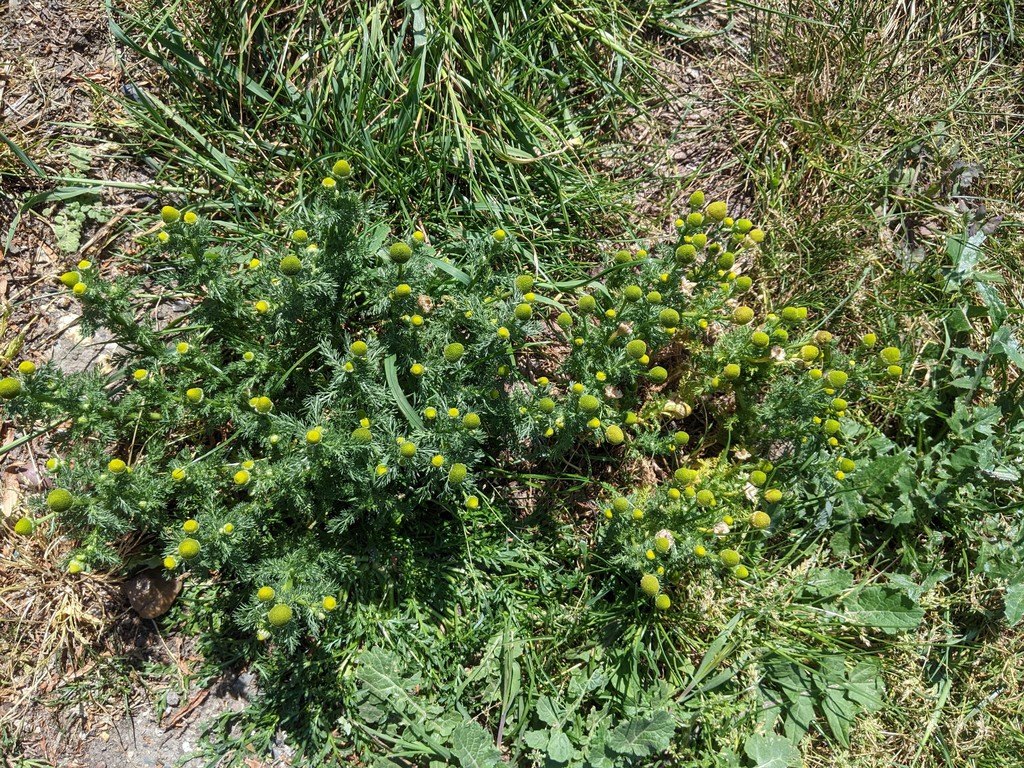
LATIN NAME: Matricaria discoidea
COMMON NAME: Pineapple Weed
Plant Profile
Pineapple weed is a small annual in the daisy family, native to North America, northern Asia and Europe, and now a common herb of fields, gardens and roadsides across the temperate world. It is low, usually under 30 cm, with finely divided feathery leaves and a habit of growing where nothing else will.
The flower heads are the giveaway. They are small dome-shaped capitula, 5 to 15 mm across, made up of densely packed yellowish-green florets and completely lacking ray florets. That absence is what gives the plant its button-like look, and it is why it is sometimes called rayless mayweed.
Each plant usually carries at least five heads, sometimes in loose clusters, on short peduncles 5 to 10 mm long. Three rows of papery bracts surround each head, with membranous margins and rounded tips, and the receptacle inside is hollow and conical.
Where it actually came from is unsettled. Some authorities treat it as native to North America, others to Siberia, and it has been introduced so widely that the original range may never be established. It now occurs across Canada and the United States and is a common weed as far north as Alaska and the Yukon.
Science & Biotechnology
Crush a head or a leaf and the smell is immediate and unmistakable: pineapple, with a green, slightly resinous edge. The aroma comes from a mixture of volatile compounds in the essential oil, and it is strong enough that the plant can be identified by smell alone on a warm day, without looking at it.
The leaf anatomy is built for a short, fast life. Stomata sit on both surfaces, about 205 per square millimetre above and 142 below, the cuticle is only around 2.6 micrometres thick, and resin ducts run through the mesophyll. Nothing about it is designed to last.
The hollow, conical receptacle is a useful character for separating this from the true chamomiles, which have a solid receptacle. That difference matters if you are picking for tea, because the plant is a close relative of German chamomile and is often used as a substitute.
It is a plant of compacted, disturbed ground: gravel, path edges, gateways, car parks. It tolerates trampling and poor fertility, and it completes its life cycle fast enough to set seed in the gap between mowing and the next mowing. That combination is why it turns up in places where the vegetation is otherwise worn away. The same family turns up again in Taraxacum laevigatum, Crepis rigescens and Chrysanthemum multicaule.
Uses & Benefits
The flowering tops make a pleasant tea, milder than German chamomile and with a distinct pineapple note. Pick the heads when they are fully open, dry them in a warm dark place, and use a teaspoon per cup. It is also used as a flavouring in some traditional drinks and desserts.
The plant has a place in folk medicine as a mild sedative and digestive, in the same way as chamomile, and it is used externally for skin complaints. The evidence is thin, and it should not be substituted for treatment, but the tradition is widespread.
For wildlife it is modest but useful: the flowers are open and shallow, available to small bees and hoverflies, and it flowers over a long period in places where little else grows. The flowering season runs from March to September, which is longer than most annuals manage.
Growing from Seed
Sow in spring on any bare, compacted ground, 2 mm deep, and keep it moist until germination, which takes one to two weeks. It needs light to germinate well, so do not bury it. It will also arrive on its own if you have gravel or a worn path.
It is not a plant for rich soil or a competitive border. Give it a strip of gravel, a gap between paving, or the edge of a car park, and it will do the rest. In a fertile bed it is outcompeted within a season.
Harvest the heads through summer, picking them early in the day when the oil is at its strongest. Leave a few to set seed and the colony will return; the seed bank persists for years, so once you have it you are unlikely to lose it.
Our Take
It is a weed that earns its keep. The tea is genuinely good, the smell is one of the small pleasures of a summer walk, and it grows where nothing else will. The only caution is identification: if you are picking for the pot, check the receptacle is hollow and the head has no white petals, and be sure the ground has not been sprayed.
Related Reading
Continue exploring with these related plants: