


Tanacetum coccineum Seeds | Painted Daisy
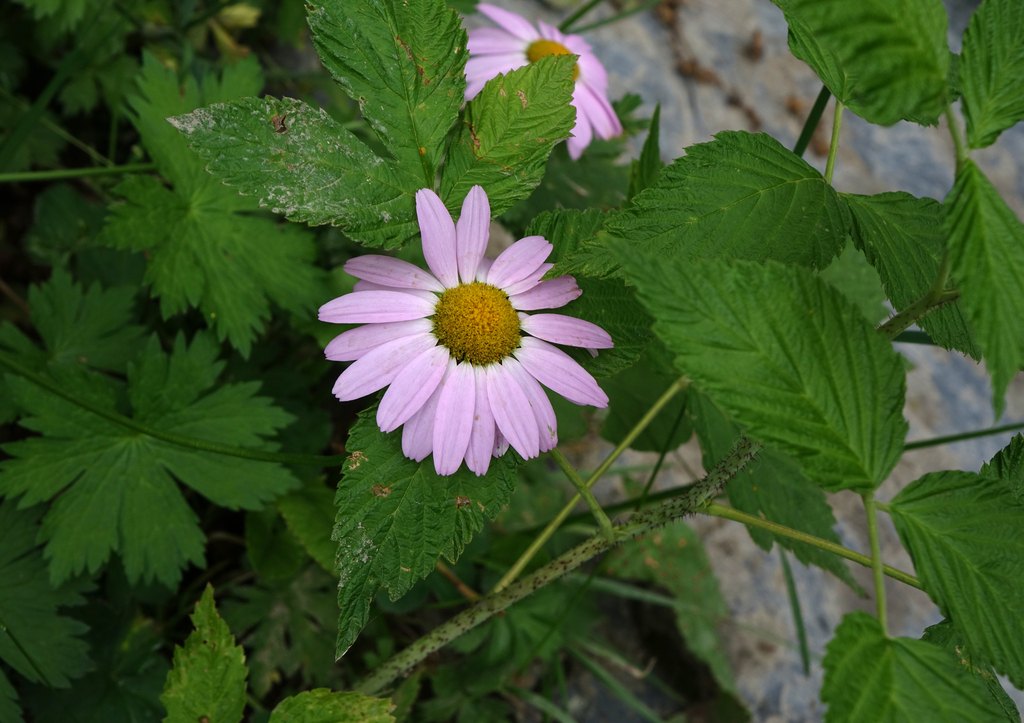
LATIN NAME: Tanacetum coccineum
COMMON NAME: Painted Daisy
Plant Profile
Painted daisy is native from eastern European Russia through the Caucasus into Turkey, Iran, Kazakhstan, Tajikistan and Uzbekistan, growing on rocky mountain slopes in hot, humid summers. It is a perennial of 20 to 60 cm, with leaves that are mostly smooth and either stalkless or on short stalks of 2 to 10 cm.
The foliage is the best thing about it out of flower. Lower leaves are larger and twice-divided into narrow, lance-shaped lobes; upper leaves are smaller and less divided. The effect is a fern, not a daisy, and a clump in April is worth looking at before a single bud has opened.
The heads are solitary, one to a stem, with pink, red or white ray florets around a flat yellow disc. Single and double forms both exist, and the doubles carry more petals at the cost of the disc. The species is a diploid with 36 chromosomes, which is a tidy number for a genus where polyploidy is common.
Science & Biotechnology
The insecticidal chemistry is the reason this plant travelled. Tanacetum coccineum produces pyrethrins, the compounds that attack the nervous system of insects on contact and break down in sunlight within hours. Ground dried flowers were sold as Persian powder, and in the Middle East it was used directly against lice.
The commercial pyrethrum crop is a different species, T. cinerariifolium, which carries a higher concentration of the same compounds. Painted daisy is the older source and the garden plant; the Dalmatian daisy is the industrial one. The distinction matters if you are buying seed for a pesticide, and not at all if you are buying it for a border.
The pyrethrins work because they hold open the sodium channels of insect nerve cells, causing repeated firing and then paralysis. Mammals clear them quickly, so they have a long history of domestic use, and why the compounds became the model for a whole class of synthetic insecticides. The plant is the origin of an industry. The Asteraceae thread continues with Tanacetum cinerariifolium, Brachyscome iberidifolia and Dimorphotheca pluvialis.
Uses & Benefits
In the garden it is a cut flower and a border plant in one. The stems are stiff, the heads are large enough to matter at 5 cm, and a row of mixed pink and red in June is one of the brighter things in a bed that has finished its tulips. It also holds up in a vase for a week if it is cut in the morning.
Companion planting claims are widespread and mostly untested. The pyrethrins are in the flower, not the root, and a plant standing in a bed is not releasing them into the soil in any quantity. What it does do is feed pollinators, and what it does not do is protect the cabbages next to it.
In Turkey it has a separate history as a medicinal plant, used in a decoction in an attempt to treat sterility. That use is traditional rather than demonstrated, and the plant is toxic enough in quantity that the difference matters. It is not a herb to experiment with.
Growing from Seed
Sow in late winter or early spring on the surface, barely covered, at 15 to 18 °C. Seedlings usually appear in a fortnight or a little more, unevenly. The seed is short-lived; a packet from last year will germinate at half the rate, and a packet from three years ago probably will not germinate at all.
Prick out into individual pots when the first true leaves appear, and grow on cool and airy. The seedlings are prone to damping off in a closed propagator, so ventilate early. Plant out in autumn or early spring, 30 cm apart, in full sun and well-drained soil; a wet winter kills more plants than frost.
Division every three years keeps the clump young, because the centre dies out while the edges stay vigorous. Lift in early spring, discard the woody middle, and replant the outer pieces with the crown just at the surface. Seed will not come true for colour, so named forms have to be divided.
Our Take
It is a plant with a double life and neither half is fashionable. As a garden daisy it is handsome for three weeks in June and invisible afterwards. As an insecticide it has been superseded by its own chemical descendants. Both facts are more interesting than the flower.
Grow it at the front of a dry border, cut it for the house, and tell people what Persian powder was. It is a better story than most perennials can offer, and the plant asks for nothing beyond sun and drainage.
Related Reading
Gardeners who grow Painted Daisy often pair it with these related subjects: