


Begonia cucullata Seeds | Wax Begonia
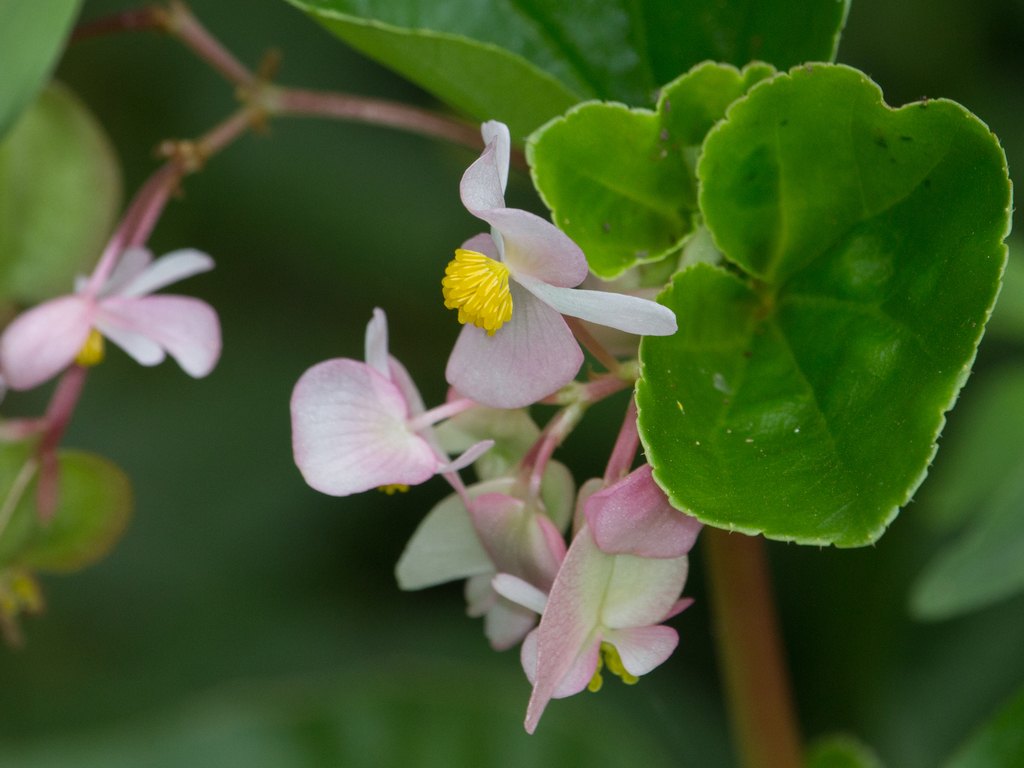
LATIN NAME: Begonia cucullata
COMMON NAME: Wax Begonia
Plant Profile
Clubbed begonia was described by Carl Ludwig Willdenow in 1805, and the epithet cucullata means hooded, referring to the shape of the leaf base. It is native to Argentina, Brazil, Paraguay and Uruguay, with the WCVP checklist adding Bolivia, and it ranks among the species behind the wax begonia that fills municipal beds every summer.
It is an upright herbaceous perennial with almost symmetrical leaves, succulent and pale green to pale reddish brown, ovate, 4 to 8 cm long and up to 6 cm wide, with a glossy, edged and toothed-crenate margin. The near-symmetry is unusual in a genus where most leaves are strongly one-sided, and it is one reason the species was easy to work with in breeding.
Flowers are red, pink or white, carried through summer and, in warm climates, all year. The fruit is a capsule with three wings, and the seed inside is dust: a single plant produces it in quantities that make the word prolific feel inadequate.
Science & Biotechnology
The wax begonia sold as Begonia × semperflorens-cultorum is a hybrid of at least five species, and B. cucullata is one of them. The name wax refers to the thick, waxy leaves of the group, which is a real anatomical feature and not a marketing word: the cuticle is heavy enough to slow water loss and to make the leaf shine.
That cross is the reason the bedding begonia exists. The species in the group come from different habitats and different altitudes, and the hybrid combines their tolerance: sun and shade, wet and dry, heat and cool. Old varieties preferred shade, newer ones cope with full sun, and the difference is largely a matter of which parents were used and how the seedlings were selected.
Outside its native range it escapes. In Florida it grows invasively from the northern and central peninsula west to the central panhandle, and it is also recorded in Georgia, in waysides, deforested ground, overgrazed pasture and waste. The seed is the mechanism; the ease of rooting from fragments is real but probably secondary in the wild.
Uses & Benefits
As a bedding plant it is close to ideal: uniform from seed, quick, tolerant of both sun and shade, and in flower from June until frost. It is also one of the few bedding plants that looks the same in a municipal roundabout and in a private garden, which is either a recommendation or the opposite depending on taste.
Indoors it wants a south or east window and a period of adjustment when it is moved. A plant brought straight from a shaded nursery bench into full sun will scorch within a day; the leaves that grew in shade cannot harden. Acclimatise over ten days and the same plant will take the light.
As a ground cover in warm climates it does the job of suppressing weeds, at the cost of being difficult to remove once established. In a frost-free garden the seedlings appear everywhere the soil is disturbed, and the plant moves from useful to ubiquitous in about three seasons. The other Begoniaceae in the catalogue are Begonia grandis, Begonia tuberhybrida and Begonia multiflora.
Growing from Seed
Begonia seed is dust and must be sown on the surface of a fine, moist, sterilised compost and never covered. Sow thinly, because a pinch contains thousands of seeds, and water from below or with a mist to avoid washing them into a corner. Light is required, and the tray should be kept humid but not sealed.
Germination takes two to three weeks at 21 to 24 °C, and the seedlings are almost invisible at first, appearing as a green haze on the compost. Prick them out when they are large enough to handle, in clumps if necessary, and grow on in a shaded frame. Do not let them dry out at any stage; a check now costs a month.
Seed strains come reasonably true for colour if they are isolated, but the species itself varies across its range and the varieties are not consistently separated. If you want the wild plant rather than the bedding one, take cuttings: a leaf or a stem section in damp perlite roots in three weeks and gives you a clone.
Our Take
The wild species is not the garden plant. It is looser, taller, less uniform, and the flowers are smaller and carried more sparsely. Grown for itself, in a pot or a warm border, it is a pleasant thing and nobody would look twice at it, which is the fate of most parents of famous hybrids.
Its real interest is genetic. Almost every wax begonia on a municipal roundabout carries some of this plant, selected over a century for heat tolerance, flower count and the waxy leaf that gave the group its name. The bedding display is the species, rearranged.
Related Reading
Continue exploring with these related plants: