


Felicia amelloides Seeds | Blue Daisy
LATIN NAME: Felicia amelloides
COMMON NAME: Blue Daisy
Plant Profile
Blue daisy comes from the southern coast of South Africa, where it grows as groundcover on sandy ground near the shore. It is a hairy, soft, usually perennial evergreen, sometimes biennial, with a woody base and an upright, regularly branched habit, about 50 cm tall and occasionally up to 1 m.
The leaves are opposite, elliptic to inversely egg-shaped, 2 to 5.5 cm long and 1 to 2.5 cm wide, though they vary a lot in size. They are stiff and leathery, with entire margins curled downwards, and they feel like sandpaper because of a covering of short bristle-like hairs. The upper surface is dark green and the underside paler.
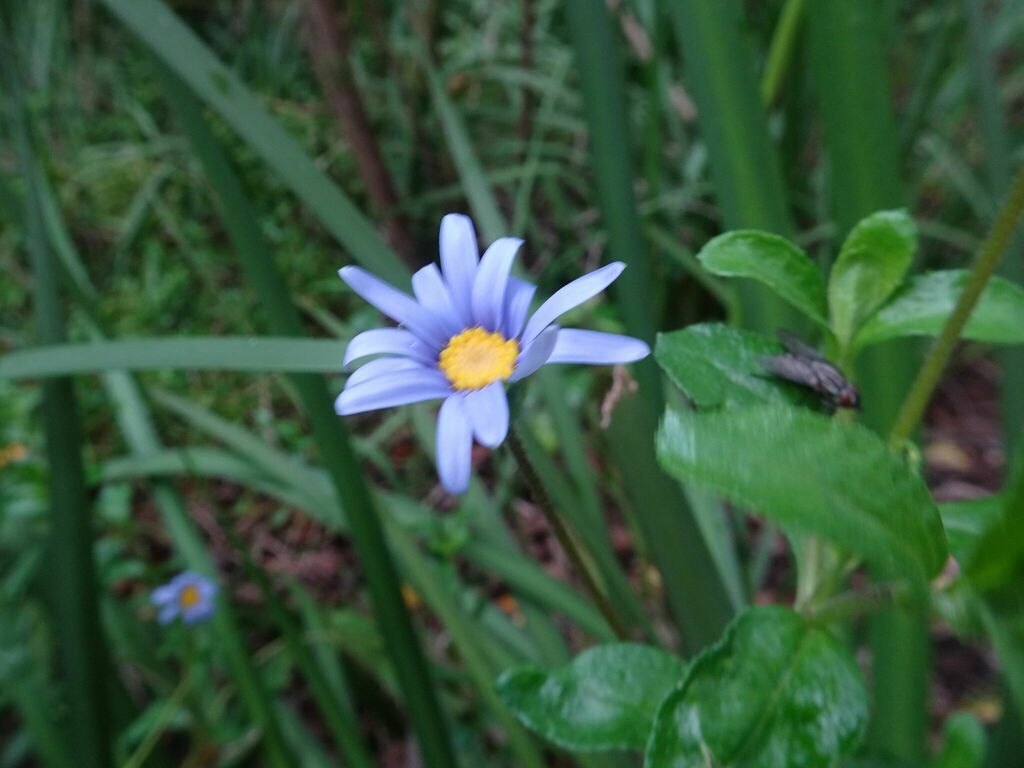
The flower heads are about 3 cm across, with a ring of blue ray florets around a yellow centre, and they are produced over a long season from spring into autumn. It was introduced to Europe in the middle of the eighteenth century and has been in cultivation more or less continuously since.
Linnaeus described it in 1763, in the second edition of Species Plantarum, and placed it in Cineraria; it was moved to Felicia later. All its leaves are opposite and entire, the branching is unusually regular, and the involucral bracts are long, which is how it is separated from its relatives.
Science & Biotechnology
The blue is real blue, not a violet that reads as blue in certain light. It comes from delphinidin-based anthocyanins, the same class of pigments that colours delphiniums and cornflowers, and it is stable across a range of temperatures, so the flowers hold their colour in heat. Each head carries about twelve bright blue female ray florets with a strap 17 mm long and 4 mm wide, around many bisexual disc florets with a yellow corolla about 4 mm long. The plant is a diploid with 2n = 18.
The sandpaper texture is a defence. The bristle hairs on the leaf surface deter small insects and reduce water loss, and they also give the plant a slightly grey cast that sets off the blue flowers. It is a common combination in plants from dry, windy coastal habitats.
Its hardiness is limited by cold and wet rather than by frost alone. The plant survives light frost in a sheltered spot, but it rots in winter wet, and in a cold climate it is best treated as an annual or grown in a pot that can be moved under cover. Three other Asteraceae are catalogued alongside it: Centaurea americana, Artemisia argyi and Xerochrysum bracteatum.
Uses & Benefits
It is a plant for the front of a border, a gravel garden, a container or a coastal garden, and it flowers for months with very little attention. The habit is lax enough that it will spill over a wall or the edge of a pot, which is where it looks best.
It is a good cut flower for small arrangements, and the stems are long enough to use in mixed bunches. The flowers last about a week in water and hold their colour as they dry. For pollinators it is useful through the late season, when the blue flowers are still open and most other plants have finished. Bees work it steadily, and it ranks among the last things in flower in a mild autumn. The seed heads that follow are fluffy white balls about 4 mm across, and they are worth leaving for the finches.
Growing from Seed
Sow in late winter or early spring at 18 to 21 °C, on the surface and lightly covered. Germination takes two to three weeks. The seed is small and the seedlings are slow at first, so prick them out carefully and grow them on in good light.
Pinch the growing tips once or twice to make a bushy plant rather than a single stem. Plant out after the last frost, 30 cm apart, in full sun and free-draining soil. In a cold climate, plant into a pot and move it under glass for winter.
Water moderately through summer and cut back lightly after the first flush to encourage a second. Do not cut into old wood in autumn: the plant needs its stems to survive the winter, and hard pruning is best done in spring once new growth is visible.
Our Take
For anyone gardening on a coast or in a mild city, this is one of the best value plants you can raise from seed. It flowers for half the year, it takes drought, and the blue is a colour that most gardens lack. Inland and cold, grow it in a pot and bring it in, because a wet winter will finish it faster than any frost.
Related Reading
If Blue Daisy appeals to you, these related plants are worth a look: