


Asperula orientalis Seeds | Oriental Woodruff
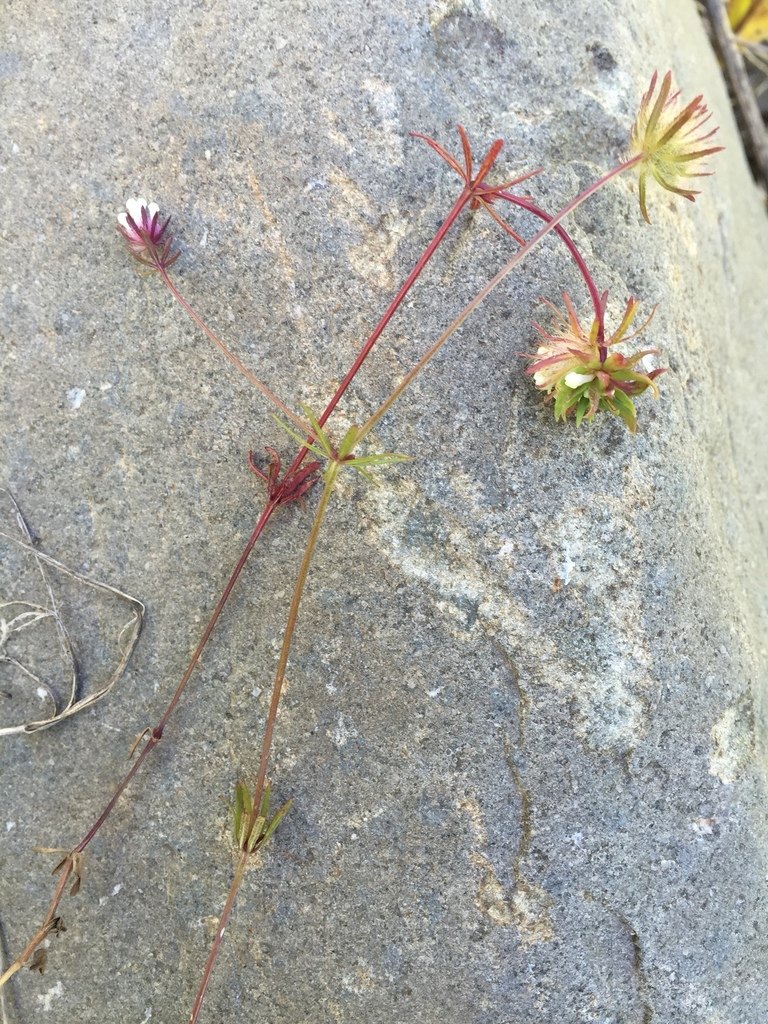
LATIN NAME: Asperula orientalis
COMMON NAME: Oriental Woodruff
Plant Profile
Oriental woodruff is an annual in a genus of perennials, and that alone makes it unusual. Asperula orientalis is a slender, branching plant of fifteen to thirty centimetres from Turkey, the Caucasus, Iran and the Levant, with whorled leaves and small clusters of pale blue four-lobed flowers.
The family identity is visible in the details. Rubiaceae carries its leaves in whorls and its flowers in fours, and this species shows both plainly: six to eight narrow leaves at each node, and flowers with four pointed lobes that give the cluster a star-like, slightly mechanical regularity.
The colour runs from white through pale to a clear sky blue, and the flowers are carried in loose cymes at the stem tips over several weeks in early summer. The plant is slight rather than showy, and its value in a garden is the lightness of the blue rather than the size of anything.
It has travelled quietly with horticulture and grain, and it is reported as naturalised in Oregon, North Dakota, the Czech Republic and Germany, always on disturbed sandy ground. The core of the range remains Anatolia and the mountains to its east and south.
Science & Biotechnology
Asperula is a genus of about two hundred species scattered from Europe to central Asia, and the taxonomic history is a long argument with Galium, the bedstraws, over whether the fruit is hairy, warty or smooth. Molecular work has settled some of the boundaries and left others open, and orientalis sits in the part of the genus where the annual habit separates it from most of its relatives.
The better-known member of the genus is sweet woodruff, whose dried foliage carries coumarin and flavours May wine in Germany. Oriental woodruff has no such use and no recorded aroma of note, and the comparison is botanical rather than practical, a matter of whorled leaves and four-petalled flowers.
Observation records are thin, about fifty in total, with a small peak in June. That scarcity reflects the plant’s habitat on mountain slopes and stony ground in the Anatolian interior, which is not a landscape that attracts many recorders, rather than any rarity of the species itself. The catalogue keeps Pentas lanceolata, Pentas and Oxypetalum caeruleum from neighbouring families.
Uses & Benefits
In the garden it is a quick annual for the front of a sunny border, a rock garden pocket or a container edge, where the fine foliage and the pale blue flower clusters lighten a planting without dominating it. It flowers about ten weeks after sowing and continues for a month or more.
It is a good bee plant for its size, visited by small solitary bees and hoverflies that work the open four-lobed flowers easily. In a wildflower-style sowing it associates well with other low annuals of dry ground, and in a border it fills the gap between spring bulbs and the first hardy geraniums.
It is not edible, not medicinal and not toxic in any recorded sense, which is the usual profile of a small Rubiaceae. Its whole value is ornamental and temporal: a few weeks of blue at a moment when the border has little else in that colour and height.
Growing from Seed
Sow in early spring at fifteen to eighteen degrees, or in autumn in a mild climate for earlier flowers. The seed is small and needs light, so press it into the surface of a gritty compost and keep it barely moist. Germination runs two to three weeks and is usually even.
The seedlings are fine and should be pricked out in small clumps rather than singly, because the stems are brittle at the base and a single seedling handled carelessly is a lost plant. Grow them cool; warmth produces tall, soft growth that florets before flowering.
Plant out at fifteen centimetres in full sun and sharp drainage, and water only until established. Let the first flowers set seed and the plant will return for a year or two wherever the ground is open, though it never becomes a nuisance in ground that carries any competition.
Our Take
Oriental woodruff is a filler in the honest sense: slight, cheap, quick and pleasant, and never the reason anyone visits a garden. It earns its place by flowering in the June gap with a blue that the perennials of that moment do not match.
Sow a packet in the cracks of a sunny wall or the edge of a gravel bed and forget about it. Where the conditions suit it will renew itself quietly for a few years, and where they do not it will at least have given you a month of blue in exchange for ten minutes of work.
Related Reading
Readers interested in Oriental Woodruff frequently explore these as well: