


Sedum forsterianum Seeds | Rock Stonecrop
LATIN NAME: Sedum forsterianum
COMMON NAME: Rock Stonecrop
Plant Profile
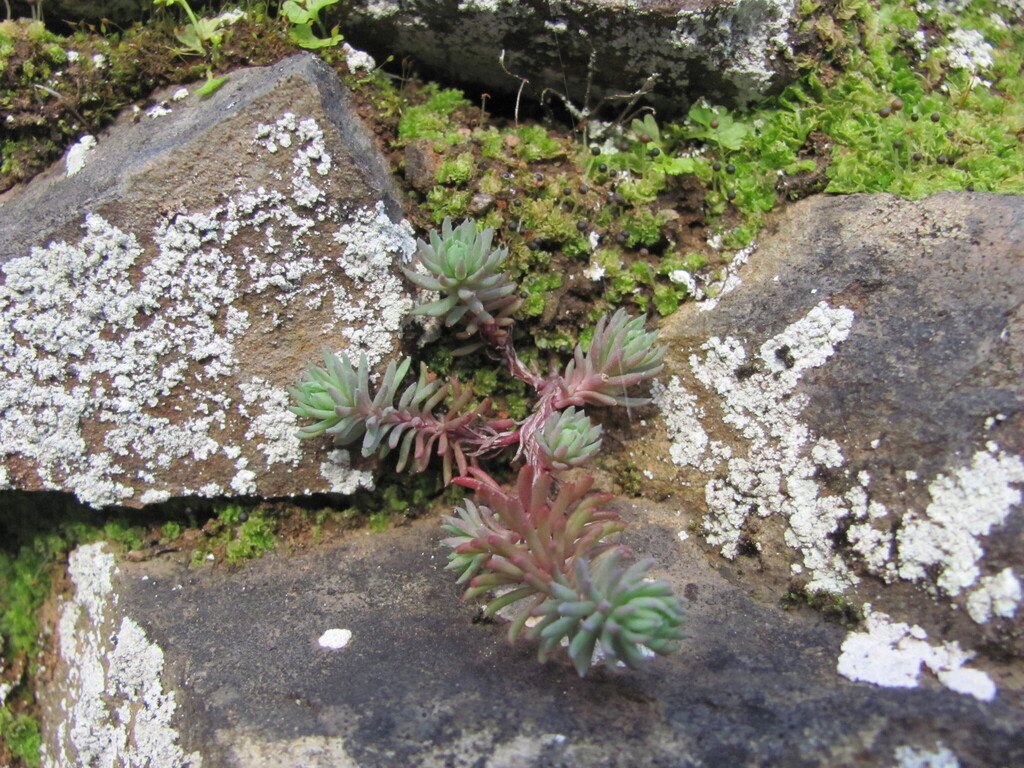
Rock stonecrop is a mat-forming evergreen with two kinds of shoot on the same plant. The non-flowering ones creep and root as they go, carrying tightly packed scale-like leaves in a cone at the tip. The flowering ones stand upright, 10 to 40 cm, and carry the flower. That division of labour is the first thing to recognise if you are trying to tell it from its relatives.
The leaves are 10 to 15 mm, linear, slightly rounded or flattened, with a small spur at the base, green or bluish-green. They stay on the stem after they die and turn brown, which gives an old mat a shabby skirt that never quite falls off. The British population is compact and slow rather than creeping; North African plants have distinctly bluish-purple foliage.
The flowers are bright yellow, usually five to seven petals and sometimes up to nine, in branching clusters whose branches curve downward in bud and straighten as the flowers open. Peak flowering is early summer. The seed capsules stand upright and split at the top. It sits among Sedum aizoon, Sedum spurium and Sedum rupestre, all Crassulaceae.
Science & Biotechnology
It was described as Sedum forsterianum and long treated as a subspecies of Sedum rupestre, now Petrosedum rupestre, and the two are still confused in gardens and in catalogues. The epithet honours Edward Forster the Younger, the English banker and botanist who worked on the British flora.
Henk ‘t Hart observed in 1978 that the named forms vary along a continuous gradient rather than falling into categories, which is the taxonomist’s way of saying the differences are real but not separable. Louis-Paul Hébert recorded that all the octoploid types occur north of the Pyrenees, so chromosome number tracks geography rather than morphology.
A natural hybrid with Petrosedum sediforme was found in Portugal and described in 2015 as Petrosedum × estrelae. That is a recent addition to a small genus, and it suggests the group is still moving: wherever two species meet on a wall or a rock outcrop, a third can appear.
Uses & Benefits
It is a plant for dry shade, which is a narrow market and a valuable one. In the wild it grows on rock and at the shaded edges of glades, often under shrubs that nurse it while it establishes and then cast the shade it wants. That is exactly the position it occupies in a garden, at the foot of a hedge or under a deciduous tree.
Use it on a wall, in a trough, between paving stones, or as a green mat under shrubs where grass will not grow. It also takes root in the grit between a path and a wall, which is the sort of place where nothing is expected and something always turns up. It tolerates drought once rooted and needs no feeding at all; rich soil makes it soft and short-lived. The yellow flowers in June are a bonus rather than the reason to plant it.
It is also edible, in the way that most stonecrops are: the leaves are crisp and slightly sour and can go in a salad, though the amount you would need to make a dish is more than a mat can spare. Eat sparingly; the family is not without its irritants.
Growing from Seed
Sow on the surface in autumn or spring, at 15 to 18 °C, and barely cover: the seed is fine and needs light. Germination takes two to four weeks and is uneven. The seedlings are tiny and slow, and a tray sown in March will not be ready to plant out until June, so autumn is easier.
Plant into sharp drainage in sun or part shade. Add grit to the hole and set the plant so the crown sits above the surrounding soil. Water until it roots, then leave it; on wet clay it rots at the collar in the first winter, and the rot spreads through the mat faster than the plant grows.
Propagation from cuttings is quicker than seed and more reliable: break off a rosette, lay it on damp grit in June, and it roots in a fortnight without any cover. Old mats can be lifted and replanted in pieces every few years, which is the only maintenance the plant asks for.
Our Take
It is not the showiest stonecrop and it will never be the reason someone visits a garden, but for the dry strip under a hedge it does more than most plants sold for shade, and it does it in winter as well as summer.
Buy it as Petrosedum if you can find it under that name; the two genera are still in transition and the plant is the same. Give it drainage, a little shade and no kindness, and it will spread into a mat that outlives the shrub above it.
Related Reading
Readers interested in Rock Stonecrop frequently explore these as well: