


Sedum selskianum Seeds | Selsk’s Stonecrop
LATIN NAME: Sedum selskianum
COMMON NAME: Selsk’s Stonecrop
Plant Profile
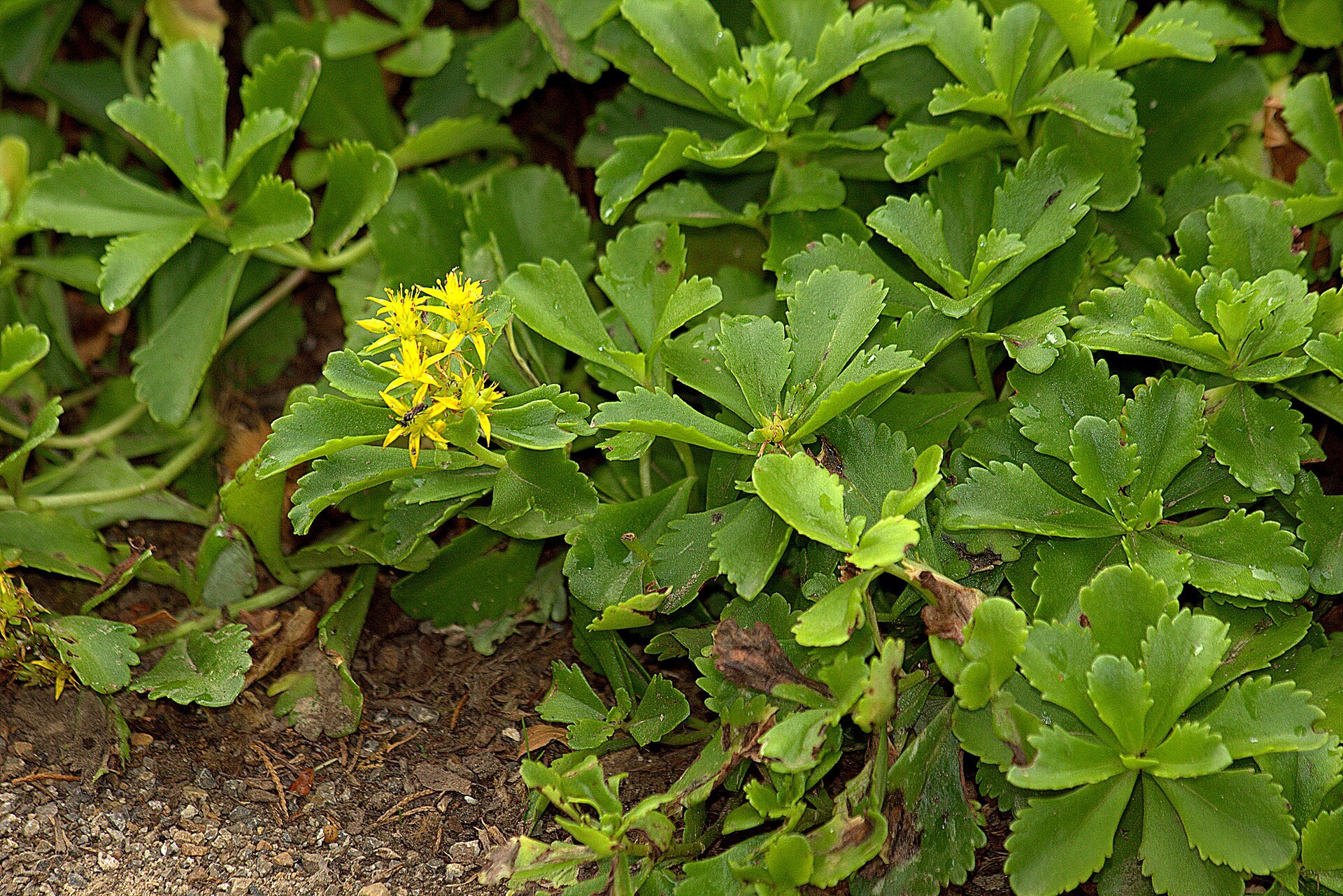
Selsk’s stonecrop is a herbaceous perennial with erect, hairy stems 15 to 50 cm tall and a thick, woody rhizome under the soil. The leaves vary more than most sedums allow: some are narrow and pointed, some elongated and oval, all with the upper part of the margin finely toothed and both surfaces finely pubescent, which gives the plant a dark, glossy green that photographs almost black in shade.
It was described in 1861 by Regel and Maack as Sedum selskianum, demoted in 1931 to a subspecies of Sedum aizoon, and then moved, in the modern classification of the family, into Phedimus. Three names for one plant, and all three still in circulation, so the same species can be bought under two genera in the same catalogue.
Within Phedimus subgenus Aizoon it is separated by one character that you can see with a hand lens: conspicuous glandular hairs. The other members of the group are glabrous or merely papillose, and the hairs on this one are tipped with a gland that catches dust and gives the stem a slightly rough, sticky feel. It shares the family with Sedum aizoon and Sedum forsterianum.
Science & Biotechnology
The inflorescence is a corymb 5 to 10 cm across, dense and flat-topped, carrying star-like flowers with five or six white petals. The petals are fused at the base for up to 2 mm and are slightly shorter than the sepals, which is the wrong way round for a flower that wants to be seen: in most sedums the petals are two or three times the length of the sepals and do the advertising themselves.
The compensation is the corymb. A flat head of fifty small flowers reads as one white disc from a distance, and the individual flower does not need to be large. The anthers are orange, which gives the head a warm centre, and the nectaries are small and yellowish; the fruit is a cluster of follicles 4 to 6 mm long, each with a great many tiny seeds.
Underneath all of it is Crassulacean acid metabolism. The stomata open at night, carbon dioxide is fixed into malate and stored in the vacuole, and by day the stomata close and the carbon is released internally for photosynthesis. In a dry, stony slope that is worth more than any amount of leaf thickness, because it lets the plant work without losing water it cannot replace.
Uses & Benefits
Its use is the front of a border, a gravel bed, a trough, or the top of a wall, where the flat white heads in mid-summer are a contrast to the run of yellow sedums that flower at the same time. It ranks among the few white-flowered stonecrops that looks deliberate rather than accidental, because the heads are large and the foliage beneath them is dark enough to set them off.
The provenance is the point for cold gardens. It comes from Amur Oblast and Primorye in the Russian Far East, from Manchuria in Heilongjiang, Jilin and Liaoning, and from the Korean peninsula, which is a continental climate with hard winters and dry spring winds. Most of the Phedimus in the trade are Mediterranean or Caucasian, and they sulk in a cold wet winter where this one does not.
It is not a plant for rich soil or shade. In a fertile border it grows soft, the stems lean, and the corymb opens facing the ground; on gravel it stays upright and compact. The difference between a good plant and a bad one here is drainage and light, not feeding.
Growing from Seed
The seed is fine dust and should be surface sown on a gritty mix of two parts compost to one part horticultural grit, pressed down but not covered, because it needs light. Keep at 15 to 20 °C, water from below, and expect germination in two to four weeks. Fresh seed germinates far better than seed kept over a year, and the seed does not store well in a warm room.
The seedlings are slow in their first season and easy to lose to damping off. Prick them out when they are 1 cm across into a mix with extra grit, space them 3 cm apart, and keep the frame airy. They will not reach flowering size until the second summer, which is normal for the genus and worth waiting for.
Plant out in full sun, on a slope if you have one, and mulch with gravel so the collar stays dry. Increase by division of the woody rhizome in early spring, just as the new shoots show, or by cuttings of firm shoots in June. Protect new growth from slugs for the first month: they take the soft tips overnight and leave the rest.
Our Take
It is a good plant that is sold under a name most growers have stopped using, which is a fair summary of the whole Phedimus problem. Ask for it as Sedum selskianum if that is what the catalogue says, and plant it knowing that the accepted name is Phedimus selskianus, because both will buy you the same thing.
For a cold garden with thin soil and a wall that needs covering, it is more reliable than the Mediterranean stonecrops that fill the benches, and the white corymbs in July are a better colour than the yellow that everything else offers. Grow it dry, grow it lean, and it will behave.
Related Reading
Continue exploring with these related plants: