


Ageratum houstonianum Seeds | Floss Flower
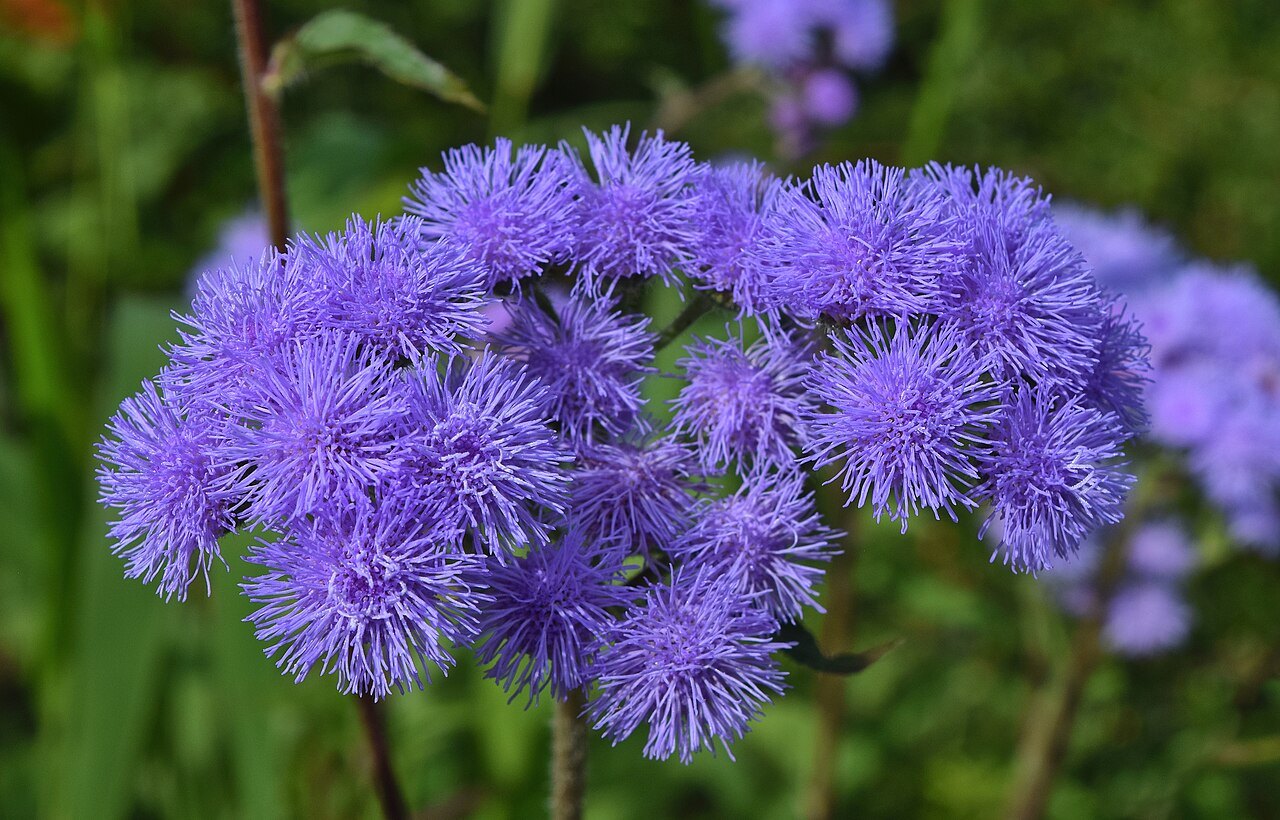
LATIN NAME: Ageratum houstonianum
COMMON NAME: Floss Flower
Plant Profile
Flossflower is a cool-season annual, or a dwarf shrub in the tropics, growing 30 cm to a metre depending on the strain, with ovate to triangular leaves 2 to 7 cm long and heads of blue flowers in dense flat-topped clusters. The ray florets are thread-like and fluffy, which is where the common name comes from, and they give the flower head a soft, cut-pile look.
The bracts beneath the head are narrow, lance-shaped, pointed, toothed only at the tip and covered in glandular hairs. Flowering runs from May to November in the northern hemisphere, which is unusually long for an annual, and it is the reason the plant is still in every municipal bedding scheme.
It is native to Guatemala, Belize and the adjacent parts of Mexico, in pastures, moist forest clearings and scrub up to about 1,000 m. It has naturalised through much of the tropics and the southern United States, and it is a weed in the United States, Australia, Europe, Africa, China, Japan, New Zealand and the Philippines. Fellow Asteraceae members here: Ageratum conyzoides, Doronicum orientale and Aster alpinus.
Science & Biotechnology
It has evolved a chemical defence that is worth more than the plant. Ageratum produces a compound with the same mode of action as methoprene, an insect growth regulator: it interferes with the corpus allatum, the organ that secretes juvenile hormone, and triggers the next moult to produce adult structures too early. In large enough doses it sterilises the insect.
That is the basis of a whole class of commercial insecticides, and it was found in a garden bedding plant first. The chemistry is not a curiosity; it is the reason the plant is left alone by most insects, and the reason an extract of it has been studied as a control agent rather than as a pesticide to spray on the plant itself.
The same family of compounds is not harmless to vertebrates. Ageratum contains pyrrolizidine alkaloids and is toxic to grazing animals, causing liver lesions, and the damage is cumulative in the way that houndstongue and ragwort damage is cumulative. A plant that is safe to handle is not necessarily safe to eat, and this one is not.
Uses & Benefits
It is a bedding plant, and a good one: compact, uniform, free-flowering, and one of the few true blues available for a summer border. Blue Horizon and Blue Danube both hold Awards of Garden Merit, and the taller strains are used as cut flowers because the stems are stiff and the colour holds.
In a garden it edges a path, fills the front of a border or sits in a balcony box, and it does so from June to the first frost without any attention beyond water. It prefers cool soil and full sun, and it wilts dramatically at midday and recovers by evening, which frightens people unnecessarily.
It attracts butterflies, which is more than most bedding plants can claim, and the blue is a useful foil for the oranges and yellows that dominate summer planting. Use it as a repeated edge rather than a block; a long ribbon of one colour reads better than a bed of it. In a pot it will flower until the frost if it is watered, and it asks for nothing else.
Growing from Seed
Sow indoors in March or early April, on the surface, at 20 to 22 °C, because the seed needs light. Germination takes ten to fourteen days and is very reliable. Do not cover the seed and do not let the tray dry out; the seedlings are small and a dry hour is enough to kill a tray.
Prick out when the first true leaves are showing and grow on at 15 to 18 °C, which keeps them stocky. Plant out after the last frost, 20 cm apart. Pinch the tips once at planting to encourage branching; unpinched plants make a single stem and flower late.
Deadhead if you want a clean look, though the plant sets little seed in a cool season. Save seed from the earliest heads if you want to select for earliness, but be aware that named strains will not come true and the dwarfs will throw tall plants. In warm climates, let it seed and it will return.
Our Take
It is easy to be snobbish about bedding plants, and Ageratum makes that difficult, because the chemistry is genuinely interesting and the blue is genuinely useful. It is also cheap, uniform and reliable in a way that few perennials manage.
The caveat is its manners in a warm climate, where it seeds itself into everything and is listed as an invasive weed across four continents. Grow it where winters kill it, deadhead it where they do not, and keep it away from anything that grazes.
Related Reading
More species in the same orbit as Floss Flower: