


Nemophila maculata Seeds | Five Spot
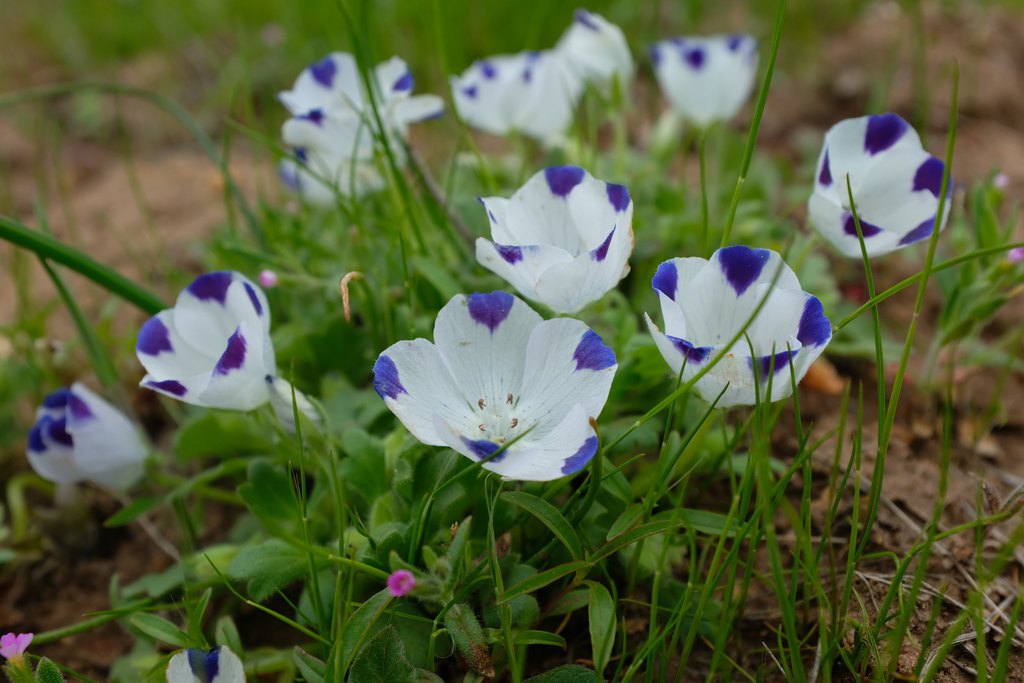
LATIN NAME: Nemophila maculata
COMMON NAME: Five Spot
Plant Profile
Fivespot is an annual herb of the waterleaf family that flowers in spring, low and spreading, with a flower you recognise across a bed: a bowl-shaped corolla, white with dark veins and dots, its lobe tips marked with a single purple spot. The five spots give the plant both its common name and its Latin one.
The corolla runs 1 to 2 cm long and up to 5 cm across, which on a small plant makes the flowers look larger than they are. The leaves are up to 3 cm long and 1.5 wide, divided into several smooth or toothed lobes, and the whole plant has the soft, unforced look of the Californian spring annuals.
The seed follows reliably: greenish-brown, smooth or shallowly pitted, up to twelve in a fruit, with the entire cycle from first flower to ripe seed compressed between spring and summer. That speed is the annual’s whole strategy and the reason it suits gardeners who sow late.
It is endemic to California, found on slopes between 20 and 1,000 metres, most common in the Sierra Nevada, the Sacramento Valley and the Coast Ranges around the San Francisco Bay Area. It grows in several plant communities: valley grassland, foothill woodland, and pine and fir forest.
Science & Biotechnology
The spots are functional, not decorative. They mark the flowers for their primary pollinators, which are solitary bees; both males and females feed on the nectar, and the females collect pollen to provision their larvae. A petal tip with a purple dot is a landing sign, and the species has built its reproduction on wild bees rather than the social colonies.
Endemism gives the distribution a hard edge. Outside California the species occurs essentially as escapes or garden records, though specimen data now lists Oregon and Utah alongside the home state, and Germany as an introduction. Within California its spread across grassland, woodland and mountain forest communities shows a plant limited by climate rhythm rather than by soil type.
The family placement has itself moved with the science: the waterleaf family, Hydrophyllaceae, is now often folded into the borage family, and Nemophila sits there beside its familiar cousin baby blue eyes, the Californian meadow annual many gardeners grow first. The two make natural companions in the same sowing.
Uses & Benefits
It is sown as an annual ornamental in traditional borders, native plant gardens and pollinator or wildlife schemes, and its best use is the mass: a drift of white bowls with spotted tips reads from a distance as one pale sheet, close up as five thousand small signals to the bees.
Paired with its relatives and the other Californian annuals, it fills the early season slot before summer bedding takes over, and it tolerates the light shade at the front of open woodland plantings better than most showy annuals, staying true to its pine and fir forest affiliations.
The wildlife case is direct: this is a plant whose pollinators are solitary bees, the group garden schemes most want to support and least often provision in spring. Sown early, it flowers exactly in the window when those bees are provisioning nests. Nearby in the classification: Phacelia campanularia, Nicotiana alata and Salpiglossis sinuata.
Growing from Seed
Sow it direct where it is to flower, in autumn in mild-winter climates or early spring elsewhere, into loose, evenly moist, well-drained soil. It requires full sun to part shade and disdains transplanting, so scatter and thin rather than move; the root run of a small annual is shorter than any recovery time.
Keep the surface moist through germination and early growth, then let the soil begin to dry between waterings as the plants harden. It is a cool-season grower by nature: sown too late into warming soil, it rushes, flowers small and finishes before it has pleased anyone.
In optimum conditions it will self-seed, and the sensible technique is to let the last plants stand until the seed sheds, then clear the skeletons and mark the patch so the seedlings are not weeded out in spring. Mulch closes the ground and ends the colony; bare soil between plants is part of its contract.
Our Take
Fivespot is a small flower for a specific pleasure: the white sheet in April, the spotted tips when you kneel, and the solitary bees working the patch while everything else is still deciding whether spring has arrived. It earns its square metre honestly, and asks only that the ground stay lean and open.
Sow it where you will walk past it daily, on the lean side, and let it seed itself. The only reliable failure is heat and rich soil, and even then the display arrives early and excuses itself politely. Mark the patch in summer so the spring seedlings survive the weeding.
Related Reading
If Five Spot appeals to you, these related plants are worth a look: