


Salpiglossis sinuata Seeds | Painted Tongue
LATIN NAME: Salpiglossis sinuata
COMMON NAME: Painted Tongue
Plant Profile
Salpiglossis sinuata has more names than most annuals: painted tongue, scalloped tube tongue, velvet trumpet flower. In Chile it is palito amargo, bitter little stick, for the taste of the leaves, or panza de burro, donkey’s paunch, for the shape of the flower. All of them are accurate.
It is an annual or short-lived perennial of about sixty centimetres, occasionally a metre, with elliptic to lance-shaped leaves four to ten centimetres long and a margin that is wavy, lobed or toothed. The stems are upright, hollow and slightly brittle, and a plant in full flower may need a discreet stake. Grown hard in poor soil it reaches half the size and carries twice the flowers of one in rich compost.
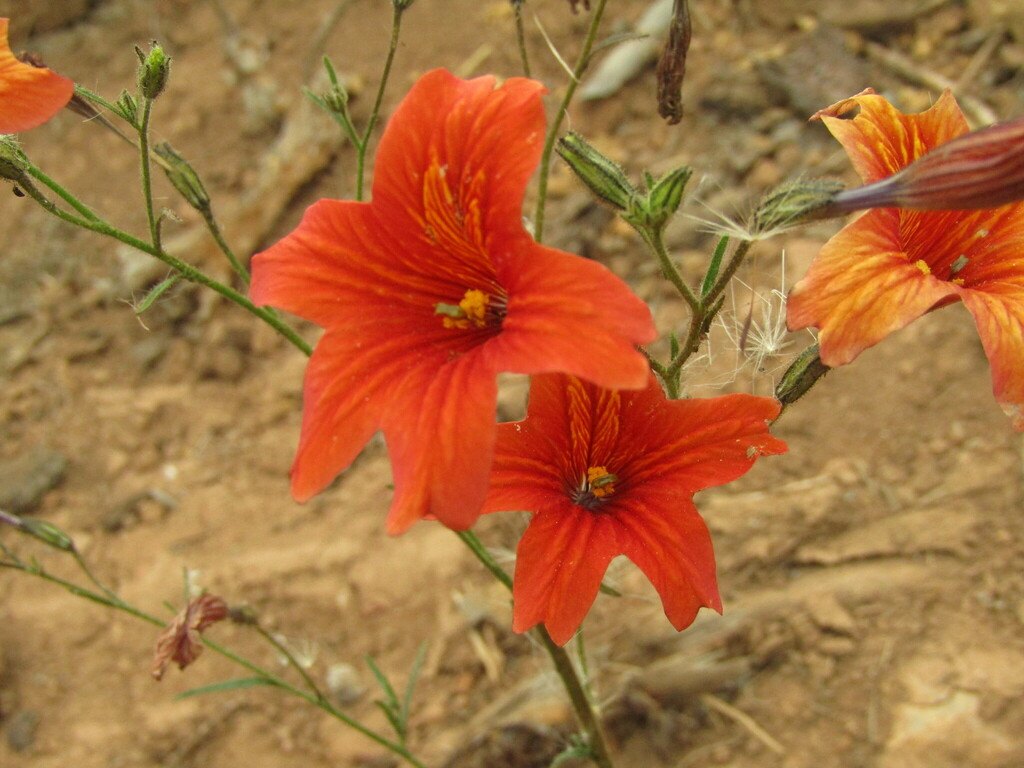
The flower is a five-lobed funnel up to seven centimetres long and five and a half across, each lobe notched at the tip, the surface velvety to the touch. Colour runs from violet to orange with darker veins striping every petal, and the throat is usually paler.
The genus name joins two Greek words, salpinx for trumpet and glossa for tongue, and refers to the shape of the corolla. The species name sinuata describes the wavy leaf margin. Only two species are recognised in the genus, and this is the one in cultivation.
Science & Biotechnology
The velvet surface is made of conical epidermal cells, the same trick that gives petunia petals their depth of colour. Light entering those cells bounces before it leaves, so the pigment reads as richer and the surface as cloth rather than paper. It also traps water, so a single heavy shower ruins the display.
The dark veins follow the vascular supply into each lobe. In pollination terms they are nectar guides, lines that lead a bee to the throat, and they are unusually precise in this species, running from the notched tip straight to the centre of the flower.
It sits in the Cestroideae, a subfamily of the nightshade family that also holds Cestrum and Schizanthus, and like most of that group it carries alkaloids. The extreme bitterness of the leaf is a chemical defence and a fair warning; the plant is not a salad. Three more Solanaceae sit in the same catalogue: Nicotiana alata, Schizanthus pinnatus and Nolana paradoxa.
Uses & Benefits
Introduced to the northern hemisphere in the 1820s, painted tongue had a vogue in Victorian bedding and never quite left. Its value now is the colour range: nothing else in the annual border produces that inked, stained-glass effect, and the deeper strains read almost black in evening light.
Records from Chile peak in November and December, which is late spring there and confirms the plant’s southern origin. In northern gardens the same rhythm appears as a long, generous late-summer flowering that continues until the first frost cuts it.
It is a cut flower of some quality, provided the stems are seared or dipped in boiling water to stop the milky bleed, and it lasts a week in the vase. The colour range makes it useful for a single-variety arrangement, and the tall strains hold their shape without wire. Victorian seedsmen listed dozens of named strains; most are gone, and the modern range is narrower than the nineteenth-century one.
Growing from Seed
Sow indoors six to eight weeks before the last frost, on the surface of a fine compost, because the seed needs light. Do not cover it; press it down and mist. Germination takes two to three weeks at around twenty degrees, and it is usually even.
Prick out early into individual cells, since the roots resent disturbance and transplants sulk. Harden off gradually over ten days and plant out only when the soil has warmed, spacing them thirty centimetres apart in full sun and soil that drains.
The flowering stems are brittle and top-heavy. Stake them early with a single cane and soft twine, before the buds open, because by August the stem has set and any later support looks like an apology. Deadhead to keep the flowers coming, and save seed from the strongest plant only. Seed from a mixed row will not come true, so buy fresh each year if a particular colour matters.
Our Take
Painted tongue is a plant for gardeners who accept a bargain: extraordinary flowers for six weeks, in exchange for regular water, a stake, and the risk of a summer storm stripping the lot in an hour. In a dry climate that bargain is easy to keep.
If you garden where July rain is normal, grow it under the eaves or in a container that can be moved. The sight of a well-grown row in full colour, backlit, with the veins showing through, is worth the fuss, and nothing else in the annual catalogue comes close to it.
Related Reading
If Painted Tongue appeals to you, these related plants are worth a look: