


Nicotiana alata Seeds | Jasmine Tobacco
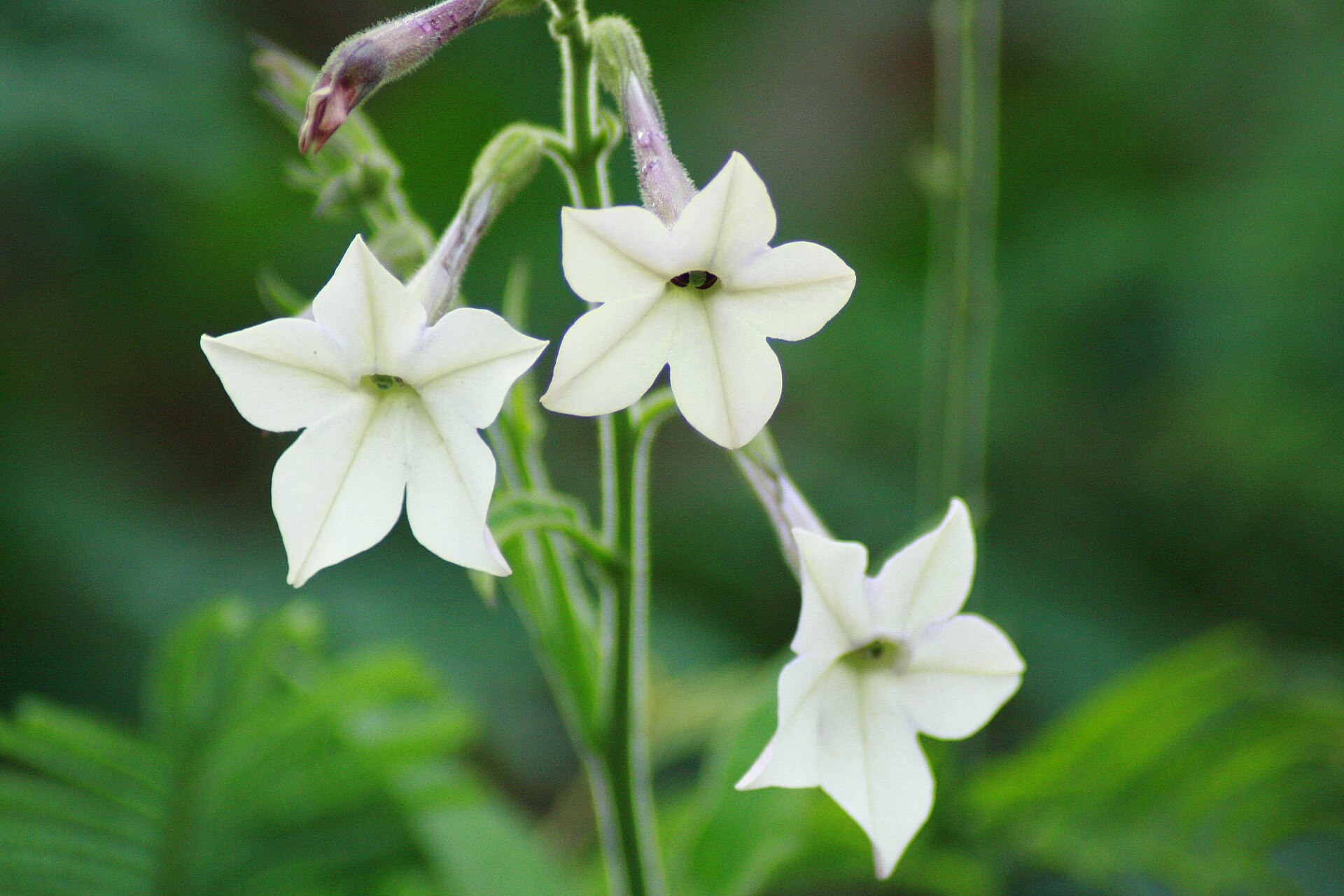
LATIN NAME: Nicotiana alata
COMMON NAME: Jasmine Tobacco
Plant Profile
Jasmine tobacco is the ornamental tobacco of summer evenings: a soft, sticky-leaved plant of thirty to sixty centimetres with loose clusters of long-tubed flowers that open in late afternoon and release their scent through the night. The common names, jasmine tobacco, sweet tobacco, winged tobacco and Persian tobacco, all circle the same two facts of fragrance and family.
The flowers may be white, yellow, pink, crimson, lime green or maroon, and a single plant sometimes carries more than one colour, especially where it has self-sown from a mixed planting. Each bloom is a narrow tube that flares into five lobes, built for a visitor with a long tongue rather than for a bee.
It is native to southern Brazil and northern Argentina, and locally naturalised in central Europe, a movement that followed the plant’s career as a garden ornamental rather than any agricultural purpose. In Iran the same species supplies narghila tobacco, broken up by hand rather than chopped like cigarette leaf, a detail that separates it sharply from industrial tobacco production.
Its habit is informal to the point of laxity: stems lean, leaves droop, and the whole plant looks better spilling over a pot edge or through a low companion than standing to attention in a bed. That looseness is part of the charm, and staking it too firmly spoils the effect.
Science & Biotechnology
The pollination system is tightly specific in design though not in practice. Long-tubed, pale, night-scented flowers are the classic hawk-moth signature, and Nicotiana is the textbook example: scent volatiles peak after dusk, the tube matches moth proboscis length, and the pale limb stays visible in moonlight.
The chemistry is the other half of the family story. All parts of the plant are poisonous, and nicotine, the alkaloid that made tobacco a global crop, is the reason. In the plant it is a defence against herbivores, effective enough that gardeners once used tobacco infusions as an insecticide before synthetic products took over.
The evening opening is a circadian programme, not a response to darkness: buds are triggered by an internal clock that anticipates dusk, so flowers open at the same hour each day even under artificial light. The scent follows the opening, which means the plant schedules both advertisement and reward for the shift it has evolved to serve. Its Solanaceae company here includes Nicotiana sanderae, Solanum pseudocapsicum and Solanum mammosum.
Uses & Benefits
For scent, plant it where people sit in the evening: beside a terrace, at the top of a flight of steps, or in a container by a door. The fragrance is strongest in still, warm air after sunset, and a single plant is enough to change the character of a small garden for the whole of late summer.
As a cut flower it is underrated, precisely because its scent continues indoors after dark; a few stems in a vase will perfume a room at night and be ignored by day. Cut them when the first buds on a stem are opening, and the sequence will continue in water for several days.
Its wildlife role is the moth shift: hawk moths and other nocturnal Lepidoptera work the tubes after dark, and the seed that follows feeds small birds later in autumn. In its native range it is part of forest-edge ecology; in gardens abroad it is a reliable night shift for pollinators that most planting ignores.
Growing from Seed
Seed is dust-fine, so sow on the surface of a fine, moist mix and press it in without covering; light is required. Germination needs warmth, around twenty to twenty-four degrees, and takes one to three weeks. Water from below to avoid washing the seed into the compost.
Prick out the seedlings when they are large enough to handle, and introduce them to outdoor conditions gradually over about a week, because plants moved straight from a warm propagator to wind and sun check badly. Space them thirty to forty centimetres apart in moist soil, in full sun to light shade.
Keep them watered, since the species is not drought-tolerant, and deadhead spent stalks to keep new flowers coming. It self-sows freely where it is happy, sometimes in unexpected colours, and a colony left to its own devices will return each year without any sowing at all.
Our Take
Jasmine tobacco is a plant you grow for one hour of the day, and that hour is worth the space. Its scent after dark is one of the few garden experiences that cannot be reproduced by any other species in this catalogue, and the moths it feeds are a bonus most gardeners never see.
Treat every part as poisonous, keep it away from children and pets, wash your hands after handling, and put it where the evening air collects behind a warm wall. The plant will do the rest, quietly, from July until the first cold night, and the moths will find it before you do.
Related Reading
Gardeners who grow Jasmine Tobacco often pair it with these related subjects: