


Ipomoea nil Seeds | Japanese Morning Glory
LATIN NAME: Ipomoea nil
COMMON NAME: Japanese Morning Glory
Plant Profile
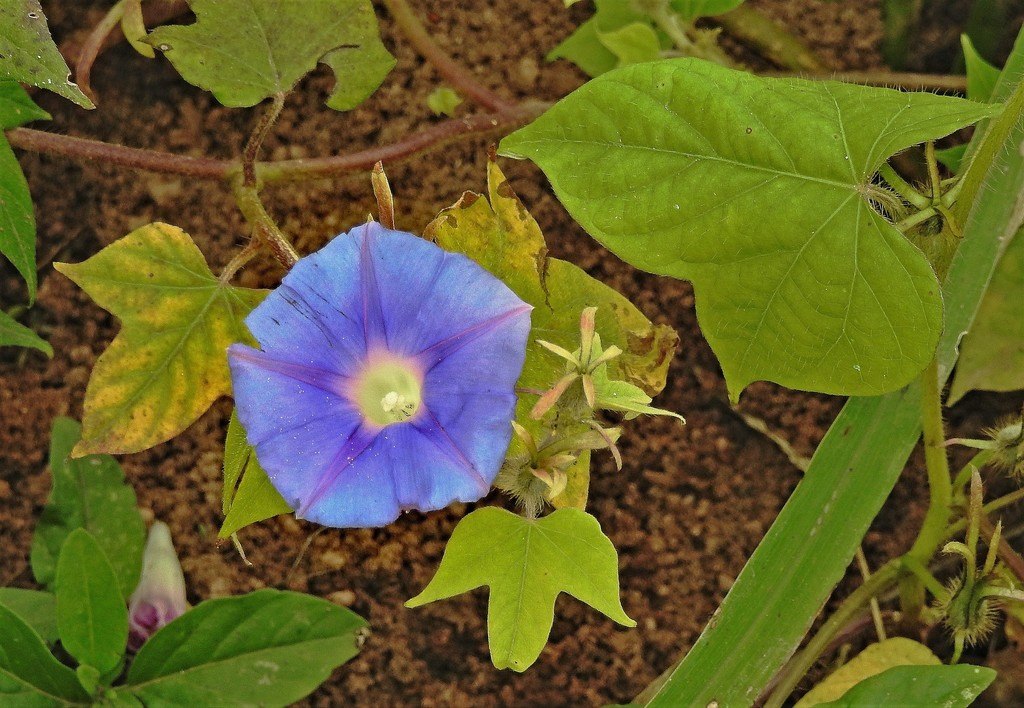
Japanese morning glory is a twining annual in the bindweed family, grown for flowers that last a single morning. The stems run to 5 m in a season and are covered in long hairs that make the plant feel rough when you brush past it. Leaves are 5 to 14 cm long, ovate to almost circular, heart-shaped at the base and cut into three to five pointed lobes.
The flowers are funnels, 4 to 5 cm across at the mouth, opening at first light and closing by early afternoon. A single cluster carries buds, flowers at full size and spent corollas at once, so the vine looks untidy and generous in the same glance. The sepals are long, lance-shaped and conspicuously hairy, 15 to 25 mm.
Two things about the name are worth knowing before you buy seed. The plant is not Japanese; it is native to the tropical Americas, from Mexico down through Central America and across northern South America. And it is very hard to separate from Ipomoea hederacea on leaf shape alone, since both carry three-lobed leaves on hairy stems. The sepals are the reliable difference: long and narrow here, shorter and blunter there. The list carries allies in Ipomoea aquatica, Ipomoea quamoclit and Convolvulus tricolor.
Science & Biotechnology
Each flower opens once. The corolla is a fused tube, and once it has unfurled the tissue is spent; nothing will make it reopen. That is why a plant in full bloom at eight in the morning can be bare by four, and why the vine makes a new flush of buds every day instead of holding a display. The display is the flush, not the flower.
The seed coat is hard and water-resistant, a form of physical dormancy that spreads germination across weeks rather than days. In the wild that protects the seedling from a false start after unseasonal rain. In the garden it means a packet sown dry can sit for a month. Nicking the coat with a file or soaking overnight shortens the wait to a week or so.
Japanese breeders have worked on the species since the Edo period, selecting mutations for doubled flowers, variegated leaves and colour patterns that run in stripes and splashes. Most of those traits are recessive. Save seed from a good plant without isolating it and the next generation comes back plain blue or plain pink, which is a disappointment that has been repeated for two centuries.
Uses & Benefits
It covers a fence, a shed wall or an obelisk in one season, where a clematis would take three. The flowers face outward and slightly upward, so the vine reads best from below or at eye level, and it is worth building the support before the plant needs it. In warm climates it also self-seeds, which is a gift or a nuisance depending on where it lands.
In Japan the plant has a social history of its own. It reached the country from China in the Heian period, and by the Edo period city dwellers were growing it in pots trained over cylindrical frames called andon shitate, so that the vine resembled a paper lantern at night. The Iriya market in Tokyo still sells potted plants in early July, three days of crowds around the temple.
The seed is not edible. Morning glory seeds contain alkaloids that cause violent vomiting, and the ripe capsules rattle when shaken, which makes them interesting to children. Grow the vine for the flower and keep the pods out of reach. The foliage is mildly toxic to livestock as well, though cattle rarely take more than a mouthful.
Growing from Seed
Sow indoors four to six weeks before the last frost, or direct where the vine is to climb once the soil has warmed. Nick the seed or soak it overnight, then sow 6 mm deep in individual pots rather than a shared tray. Germination takes five to fourteen days at 20 to 24 °C and is never even, so sow more than you need.
Transplant carefully. The seedlings resent root disturbance and sit still for a week after a bad move, so individual pots or soil blocks repay the trouble. Give them a support at planting rather than later; a stem that has already run along the ground is reluctant to climb and will need tying in for a fortnight.
Full sun, ordinary soil and steady water until the roots are down. Too much nitrogen produces a wall of leaf and few flowers, so skip the feed unless the ground is genuinely poor. The first flowers open about ten to twelve weeks from sowing and the flush continues until the first frost blackens the vine overnight.
Our Take
The single-morning flower is the point, not a defect. You do not grow this vine for one bloom; you grow it for the daily supply, and for the way a bare fence becomes a curtain in eight weeks. Judged on that basis it ranks among the most generous annuals available, and one of the cheapest.
Buy open-pollinated strains if you intend to save seed, and expect the Japanese named varieties to cost more and to vary from the picture. Either way, sow a few extra. Germination is patchy, slugs take their share, and a spare plant in a pot is much easier to place in July than a gap is to explain.
Related Reading
If Japanese Morning Glory appeals to you, these related plants are worth a look: