


Portulaca grandiflora Seeds | Moss Rose
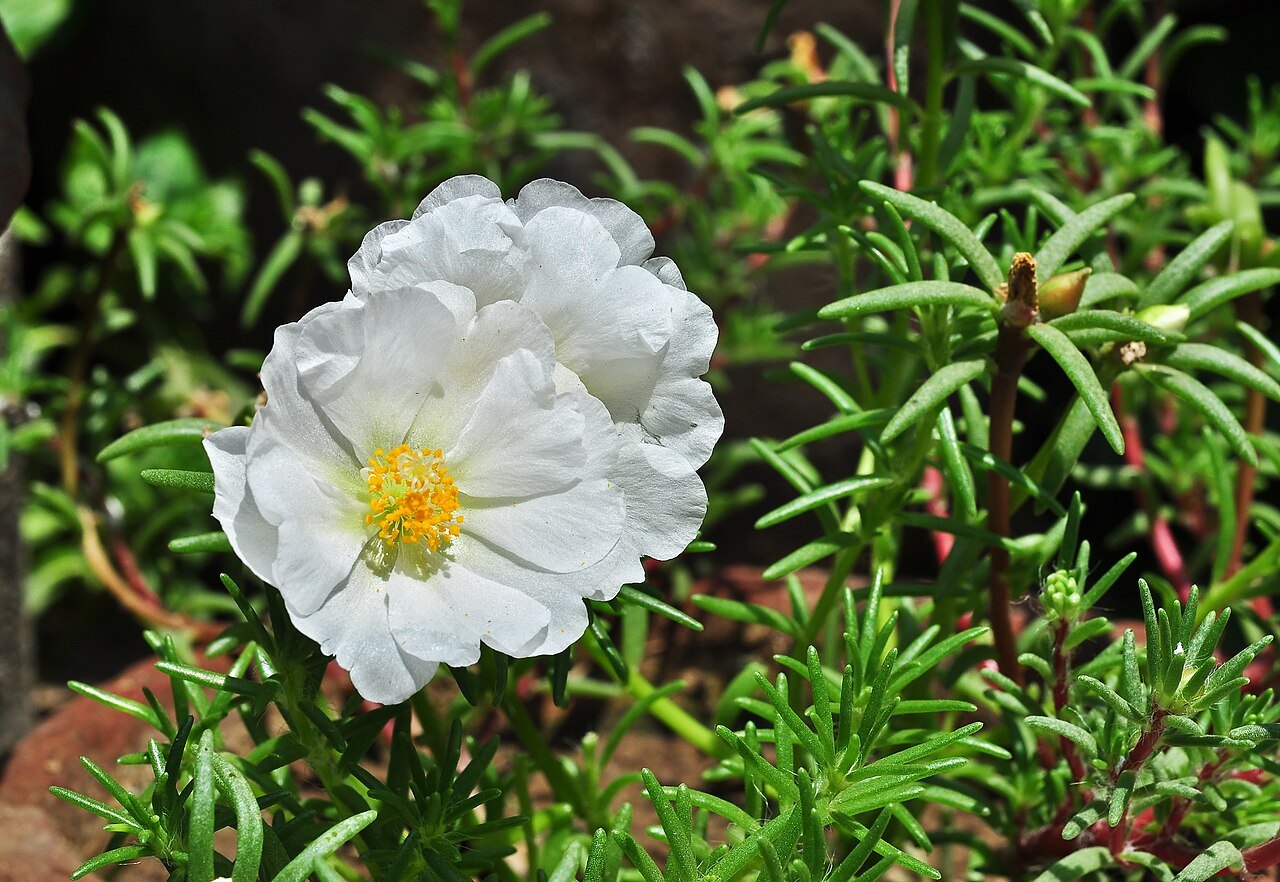
LATIN NAME: Portulaca grandiflora
COMMON NAME: Moss Rose
Plant Profile
Moss rose, eleven o’clock, rose moss, Mexican rose, sun rose: the names accumulate because the plant has been passed around gardens for two centuries and picked up a nickname in each language. It is native to southern Brazil, Argentina and Uruguay, with the WCVP checklist extending its natural range through Bolivia, Paraguay and Peru. None of the names is botanically accurate; the flower resembles a rose the way a paper flower does.
It belongs to Portulacaceae, in the order Caryophyllales, which makes it a closer relative of carnations and cacti than of anything with a rose in its name. That matters for how you grow it. The family signature is succulence, and moss rose carries it in needle-like leaves up to 2.5 cm long, thick, fleshy and arranged alternately or in small clusters along stems that branch near the base.
Growth is prostrate and fast. A plant reaches 30 cm in a good summer, usually less, and spreads wider than it is tall, with upright shoots that lean outward as they extend. The flowers are 2.5 to 4 cm across with five petals, in red, orange, pink, white or yellow, and the petal surface has a satin sheen that photographs badly and looks superb in flat light.
Science & Biotechnology
Moss rose is one of a small number of plants that runs both C4 photosynthesis and Crassulacean acid metabolism, and it does so in different cells of the same leaf. Most plants pick one system. C4 concentrates carbon dioxide before it reaches Rubisco, which cuts photorespiration in heat. CAM does the opposite in time, fixing carbon at night when the stomata can open without losing water.
Running both at once gives the plant a wider operating window than either system alone. In mild conditions the C4 route does the work. As the leaf heats and dries, the CAM contribution rises and the plant keeps growing while ordinary bedding is shutting down. The arrangement has been studied as a model for engineering drought tolerance into C3 crops, though nothing practical has come of it yet.
Garden doubles are a different matter. The extra petals are stamens converted into petal tissue, which is a developmental change rather than a new organ, and the conversion costs the plant its anthers. Double strains therefore set little seed, and what they do set comes back single or semi-double. If you save seed from a double, expect roughly half the seedlings to revert.
Uses & Benefits
Its proper place is the hot, thin, sandy strip where nothing else will grow: the edge of a gravel path, the top of a low wall, a pan of poor compost on a south-facing step. It wants full sun and sharp drainage and gives nothing in return for rich soil or irrigation. In a border it is outgrown by everything around it by July.
The edible reputation is the one error worth correcting. Portulaca oleracea, common purslane, is a vegetable, eaten raw and cooked across the Middle East and Asia. P. grandiflora is bitter and unpleasant, and the two are regularly confused by people who have read that purslane is a free salad. It is not the same plant, and the ornamental one is not worth tasting twice.
Honeybees work it for pollen and nectar, which is more than most bedding offers in August. The doubles are useless to them, since the stamens and nectaries have been converted into petals. A packet of single-flowered mixed seed is a better pollinator plant than any double named variety, and it costs less.
Growing from Seed
Sow on the surface and do not cover. The seed needs light, and a dusting of compost is enough to stop a whole tray. Temperature around 21 to 24 °C, germination in ten to fourteen days, kept just damp and never wet. A propagator lid is fine until the first green shows, then take it off.
The seedlings are tiny and brittle, and pricking out is the fiddly part. Lift them in clumps with a dibber rather than singly, and separate them in the hand. In warm climates direct sowing works better than transplanting: wait until the soil is properly warm in late May, scatter, water once, and thin to 15 cm. Cold ground simply rots the seed.
Do not feed. Rich compost and regular watering produce a mound of soft leaf and very few flowers, which is the commonest reason people give up on the plant after one season. Seed is sold as mixtures, often under the name Double Flowering Mixture, and the mix is the point: single colours in this species look like a mistake in a bedding scheme.
Our Take
Grown in the right place it is close to unkillable, and grown in the wrong one it is an annual that sulks. The distinction is entirely about drainage and sun. Give it a gravel verge and it will seed into the gaps and come back without being asked. Give it a watered border and it will disappear under the dahlias by the end of July.
In frost-free climates the self-sowing becomes a pavement weed, which is where the Balkan towns come in: it turns up between the stones of old roads and walls, in the joints of nineteenth-century kerbs, wherever a little grit has collected. That is the honest picture of the plant. It is a colonist of hot cracks, and the garden use is a kinder version of the same thing.
Related Reading
If Moss Rose appeals to you, these related plants are worth a look: